



Executive Summary
As artificial intelligence becomes embedded in everyday work, speed and automation are no longer the primary differentiators in professional performance. AI excels at processing data, recognizing patterns, and scaling outputs, but it does not understand context, ethics, or consequences. In an AI‑driven workplace, organizations increasingly rely on people to interpret information and remain accountable for outcomes.
Global teams continue to value professionals who can think critically, communicate reasoning, and make sound decisions under ambiguity. For Filipino professionals working with global clients, this shift creates meaningful career growth opportunities, especially when strong communication skills, adaptability, and cultural awareness are paired with the ability to work effectively alongside AI.
iSupport Worldwide offers roles where people are trusted to think, decide, and drive results even as AI and technology continue to redefine how work gets done.
In an AI-driven workplace, experience hasn’t lost its value, but it’s changing what that value looks like.
AI is changing how work gets done faster than most professionals expected. Tasks that once took hours now happen in seconds, and outputs arrive with impressive confidence.
Yet as AI becomes part of everyday workflows, a quieter shift is happening… one that’s redefining what truly sets professionals apart.
The Strengths and Limits of AI at Work
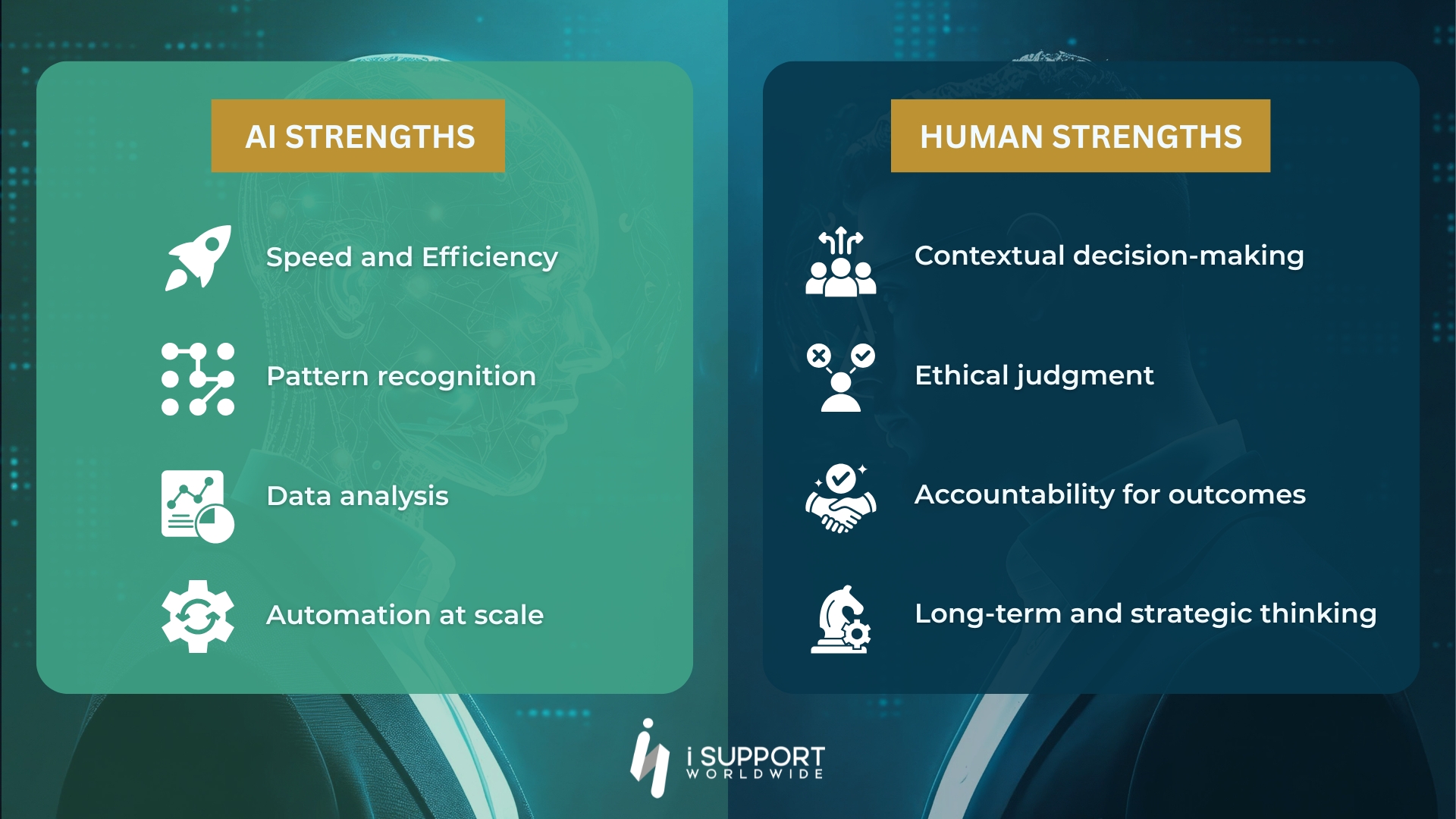
AI performs best in areas where patterns, speed, and scale are required. It can analyze large datasets, summarize information, generate options, and automate repetitive work with impressive efficiency. In an AI‑driven workplace, these strengths help teams move faster and reduce operational friction.
Yet AI does not understand context the way humans do. It cannot weigh ethical implications, assess organizational nuance, or take responsibility for consequences. It does not carry accountability, nor does it possess lived experience. AI generates outputs based on data and probability, not judgment.
This distinction matters more as AI becomes embedded in everyday workflows.
The New Competitive Edge Is Decision Quality
Harvard Business Publishing highlights that many critical decisions remain beyond the reach of algorithms, especially those involving trade‑offs, values, and long‑term impact. In “The Irreplaceable Value of Human Decision‑Making in the Age of AI,” the authors emphasize that as AI grows more capable, human judgment becomes more differentiating rather than less.
Good AI judgment means knowing how to interpret outputs, recognizing blind spots, and understanding when human insight should lead. It also means being accountable for decisions made with AI support and not deferring responsibility to the tool itself.
In jobs in the AI era, this capability separates professionals who simply use AI from those trusted to lead with it.
From AI Insight to Real Business Impact
Strong AI judgment manifests in everyday work. A finance leader evaluates AI‑generated forecasts against market realities. A marketing strategist challenges automated insights that overlook cultural nuance. An operations manager balances AI recommendations with on‑the‑ground constraints.
These moments are where judgment protects quality, reputation, and trust. Global organizations increasingly recognize that tools alone do not drive results. People do. And this is why judgment has become a defining expectation in global work environments.
Global clients look for more than technical execution. They expect professionals who can think critically, communicate reasoning, and make sound decisions under ambiguity. In an AI‑driven workplace, clients value those who can partner with AI while remaining accountable for outcomes.
Filipino professionals bring strong communication skills, adaptability, and cultural awareness to global teams. When combined with sound AI judgment, these strengths become powerful. Many Filipino professionals already work in complex environments that require balancing speed, quality, and client expectations.
That positioning makes Philippine talent for global clients highly competitive in jobs in the AI era, especially when supported by the right organizational environment.
Using AI Without Losing Independent Thinking
In “How Do Workers Develop Good Judgment in the AI Era,” Harvard Business Review explains a growing challenge. AI accelerates productivity for experienced workers, while limiting learning opportunities for those earlier in their careers. When AI handles foundational tasks, professionals may miss the experiences that traditionally build judgment over time.
It is stressed out that judgment develops through exposure to consequences, decision ownership, and reflection. Without deliberate effort, organizations risk creating capable tool users who lack deep decision‑making ability.
Because judgment doesn’t develop automatically, it has to be built intentionally. Professionals who want to stay competitive in an AI‑driven workplace can actively build judgment through intentional habits.
1. Stay grounded in the fundamentals of your work.
In an AI‑driven workplace, strong judgment starts with understanding the work behind the output. Even when AI accelerates analysis or drafting, professionals can strengthen decision‑making by knowing how results are formed and what assumptions influence them. This foundation is essential for jobs in the AI era, where professionals are expected to validate outcomes rather than accept them blindly.
2. Question AI outputs with context and intent.
Good AI judgment grows when professionals pause to assess relevance, accuracy, and business impact. In an AI‑driven workplace, those who ask whether an output fits the client’s goals build stronger credibility. This habit is especially valuable for Philippine talent for global clients, where decisions are closely tied to accountability and trust.
3. Make your reasoning visible to others.
Judgment improves when thinking is articulated. Professionals who explain why a recommendation makes sense sharpen their ability to decide well over time. In jobs in the AI era, global teams value professionals who can communicate logic clearly, especially when collaborating across cultures and time zones.
4. Learn from outcomes.
AI increases speed, but judgment develops through reflection. Reviewing what worked, what missed the mark, and why outcomes happened strengthens decision‑making. For Filipino professionals aiming for long‑term career growth opportunities, this practice turns experience into insight within an AI‑driven workplace.
5. Balance speed with responsibility.
Good judgment means knowing when to move fast and when to slow down. Jobs in the AI era reward efficiency, but career growth opportunities expand for those who consistently show thoughtful restraint. Philippine talent for global clients stands out when decisions reflect care, clarity, and accountability rather than urgency alone.
These practices help professionals grow judgment even as AI becomes more capable.
Build Your Career With iSupport Worldwide
iSupport Worldwide works with US‑based clients who trust Philippine talent for valuable work across finance, operations, marketing, analytics, leadership roles, and more. Our teams operate in environments where AI tools support work, but judgment drives outcomes.
For Filipino professionals exploring jobs in the AI era, iSupport Worldwide offer exposure to collaborative decision‑making and real career growth opportunities within an AI‑driven workplace. Professionals are trusted to think, contribute, and grow alongside global teams.
If you are a Filipino professional who wants meaningful career growth opportunities while working with global clients, this is the moment to explore what is possible. AI will continue to evolve. Strong judgment will continue to matter.
Explore open roles at iSupport Worldwide and see where your experience, perspective, and decision‑making ability can take you.
About the Author Shekina P. Malonzo is a Licensed Professional Teacher and multifaceted Content Developer at iSupport Worldwide, specializing in creating tailored materials for the offshoring industry. |
Founded in 2006, iSupport Worldwide is a US-owned offshoring leader based in the Philippines, delivering tailored solutions to enhance operational efficiency and exceed client expectations. Recognized on the Inc. 5000 list of America’s fastest-growing private companies for three consecutive years, honored in Inc. Magazine’s Power Partner Awards, and a recipient of the ACES Award for Inspiring Workplaces in Asia, iSupport Worldwide embodies a commitment to excellence. |