


Executive Summary
Many U.S. companies are encountering growth constraints not because of weak demand, but because labor costs have increased faster than productivity in several service‑heavy sectors. According to the U.S. Bureau of Labor Statistics (BLS), total employer compensation for private‑sector workers averaged $46.15 per hour as of December 2025, with benefits accounting for roughly 30% of total employer labor cost.
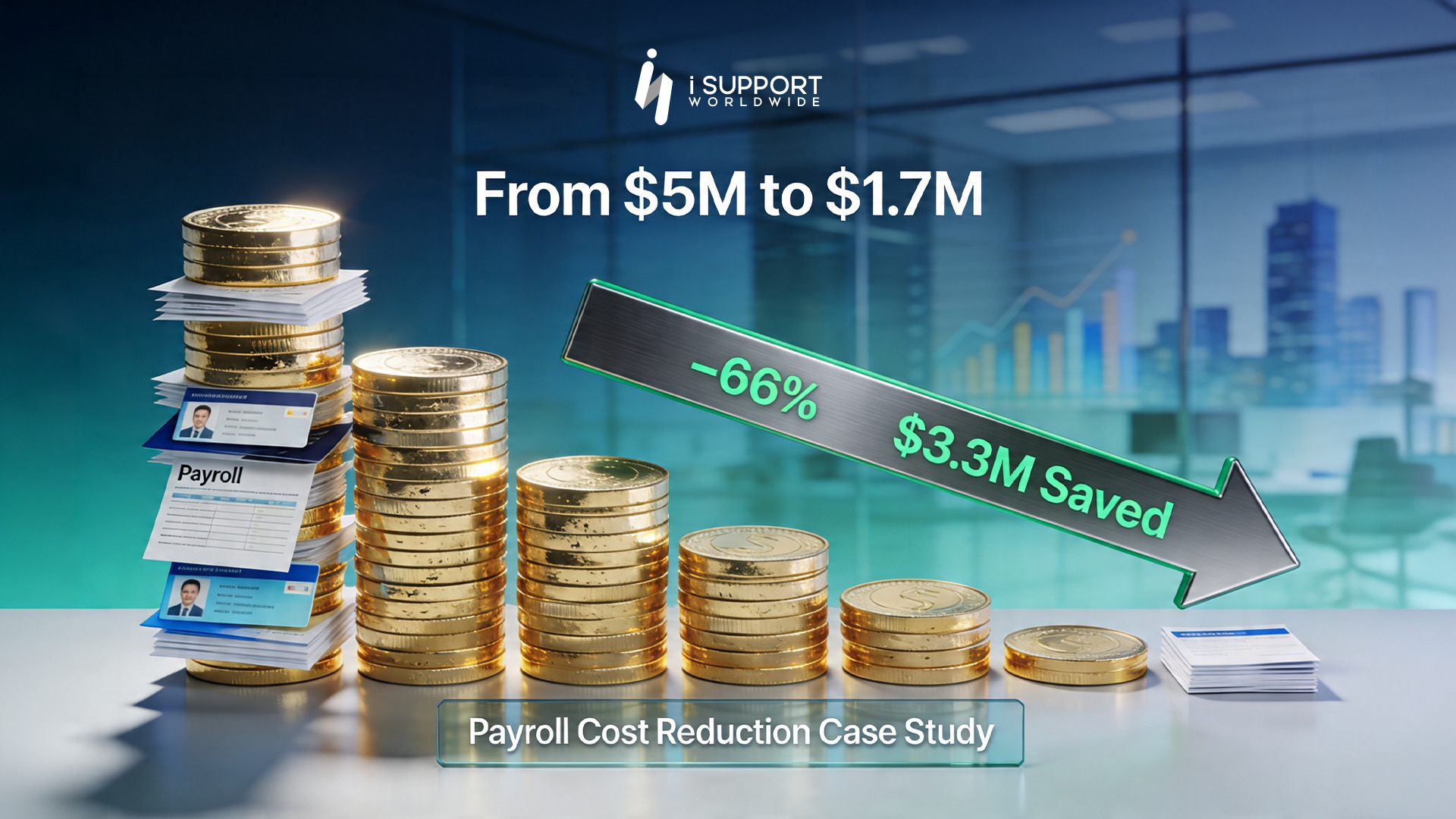
This case study examines how a mid‑growth U.S. company reduced its annual payroll from approximately $5 million to $1.7 million by implementing offshore workforce solutions in the Philippines—redesigning where selected work was performed without changing the nature of the work itself. The company maintained comparable output across defined operational KPIs while achieving meaningful labor cost reduction.
Rather than a one‑time cost cut, the outcome reflects a structural operating‑model shift enabled by managed offshore teams and enterprise‑grade governance—an approach central to how iSupport Worldwide supports long‑term cost optimization.
The Structural Cost Problem in the U.S. Labor Market
Employer labor cost inflation in the United States is not driven by wages alone. BLS data shows that non‑wage components such as health insurance, retirement contributions, payroll taxes, and statutory benefits materially increase total compensation costs, with benefits representing nearly one‑third of employer expenses in private industry
At the same time, labor costs have continued to rise faster than productivity in many white‑collar service roles. The Employment Cost Index (ECI) reports that total compensation increased 3.4% year‑over‑year in Q4 2025, while productivity gains across administrative and support services have remained uneven.
For many organizations, this creates a structural dilemma: continue hiring domestically and absorb margin compression, or limit growth altogether. Incremental efficiency efforts alone are often insufficient, leading companies to explore operating cost reduction strategies such as offshore delivery models.
Company Context (Anonymized)
- Headquarters: United States
- Stage: Scaling, post‑product‑market fit
- Functions evaluated: Finance operations, customer support, back‑office operations, and technical support
- Annual payroll (pre‑transition): ~$5M
- Primary constraint: Rising payroll costs relative to revenue growth
Prior to engaging in the Philippines’ offshore staffing, the company evaluated automation, independent contractors, and nearshore options. While these approaches delivered incremental efficiency, they did not materially alter the company’s long‑term cost structure.
Leadership determined that a structural labor cost reduction strategy was required.
Why Geography (Not Productivity) Was the Primary Variable
International labor economics literature shows that labor cost differences between countries are structural rather than marginal. The OECD defines unit labor costs as the ratio of labor compensation to output and shows wide, persistent variation across countries due to wage levels, employer social contributions, and institutional cost structures.
Similarly, the World Bank notes that labor costs, when expressed in purchasing power parity terms, remain a central determinant of international competitiveness, even when productivity is accounted for.
The Philippines has developed a mature IT‑BPM services ecosystem, supporting multinational enterprises through:
- Over 1.3 million skilled IT‑BPM professionals
- A long history of business process outsourcing (BPO) and shared services delivery
- Sustained productivity growth in export‑oriented services
For the company, offshore outsourcing in the Philippines was not pursued as short‑term labor arbitrage, but as a way to redesign the operating cost base while maintaining service quality—an approach aligned with iSupport Worldwide’s offshore workforce design philosophy.
Decision Framework: Selecting Roles for Offshore Execution
Academic research consistently finds that offshoring outcomes depend on task selection and governance, not wage differentials alone. Harvard Business School research emphasizes that offshoring tends to perform better when tasks are modular, clearly specified, and governed through defined accountability structures
Based on this guidance, the company prioritized:
- Process‑driven finance and operations roles
- Execution‑heavy technical support functions
- Positions with measurable outputs and documented SOPs
These included offshore customer support, offshore technical support, finance operations, and back office outsourcing functions.
Strategic leadership, customer ownership, and core decision‑making functions remained onshore.
Execution Model
The transition followed a phased offshore delivery model, consistent with iSupport Worldwide’s approach to building managed offshore teams:
- Pilot phase – limited scope and benchmarking
- Scale phase – expansion after performance validation
- Stabilization phase – governance, redundancy, and security reinforcement
This sequencing aligns with research showing that staged offshoring outcomes help reduce coordination risk and improve long‑term integration results.
The Conversion Math: From $5M to $1.7M
The reduction was achieved primarily through role reallocation, rather than broad workforce reductions.
U.S. labor data confirms that employer compensation costs include substantial non‑wage components. In contrast, labor cost structures in the Philippines based on World Bank and PSA‑aligned datasets remain materially lower while supporting export‑grade service delivery.
Observed outcome:
- Annual payroll reduced by approximately 66%
- Comparable output maintained across defined operational KPIs during the evaluation period
- Cost savings were redirected toward margin stabilization and growth initiatives.
No single productivity breakthrough was required; the primary lever was structural realignment.
Output and Productivity Validation
Research from MIT Sloan and Harvard Business Review indicates that distributed and global teams can achieve comparable performance levels for execution‑oriented tasks when work is standardized, measured, and governed appropriately
In this case:
- Service‑level agreements replaced informal expectations
- Output metrics were prioritized over hours worked
- Strategic oversight remained centralized
This structure aligns with academic findings on mitigating coordination risk in global delivery models.
Risk, Compliance, and Control
Offshoring outcomes are influenced more by governance design than geography. World Bank and OECD frameworks emphasize that security and compliance performance depend on architecture, access controls, and process discipline rather than location alone.
The company implemented:
- Role‑based access controls
- Segmented system permissions
- Audit‑ready workflows
These controls are consistent with internationally recognized governance principles.
Replicability Considerations
Academic literature suggests this model is more likely to succeed when:
- Tasks are process‑defined
- Outputs are measurable
- Strategic control is retained
Risk increases when work is ambiguous or when governance structures are weak, a finding echoed in long‑standing offshoring research.
Conclusion
This case illustrates how a structurally high-cost base can be recalibrated by rethinking workforce geography while preserving operational capability.
As labor costs continue to rise faster than productivity in some developed markets, companies that periodically reassess where work is performed may be better positioned to manage long‑term cost pressures.
Explore whether comparable structural approaches may be relevant to your organization’s operating model.
External Links
- Total employer labor cost
- Employer Costs for Employee Compensation
- Employment Cost Index (ECI)
- Unit Labor Cost
- World Bank | Labor Costs
- Philippines Growth and Jobs Report 2025
- Outsourcing Primer
- HBR | Offshoring
- MIT Sloan | Productivity
- HBR | Team Performance
- USITC | Journal of International Commerce and Economics
About the Author
Arnaldo M. Jara is a seasoned professional with twenty years of experience writing about business and finance. He combines strategic content development with creative storytelling to help businesses connect with their target audiences.