



Executive Summary
Offshore operations demand security beyond traditional perimeter defenses. Zero Trust protects data across global delivery teams through identity, device, access, and data controls.
In offshore environments, most security incidents don’t stem from network intrusions. They result from credential misuse, over‑privileged access, or delayed offboarding across vendors and regions.
Zero Trust addresses these realities by shifting security from location‑based trust to continuous verification tied to identity and context.
Learn how compliant and secure offshore models reduce risk without slowing performance.
Introduction
Offshore teams power critical business functions across customer experience and IT support, finance, healthcare, and back‑office operations. As organizations expand globally, one question continues to surface:
How do you keep sensitive data secure when access extends beyond your internal network and across borders?
The answer for modern organizations is Zero Trust.
This guide explains what Zero Trust means in an offshore context, why traditional perimeter-based security falls short, and how organizations can design secure offshore operations without sacrificing productivity. We’ll also share a practical roadmap and vendor checklist to help you evaluate offshore partners with confidence.
Why Offshore Operations Require a Zero-Trust Security Model
Traditional security models assume that anything inside the corporate network is trusted. That assumption breaks down quickly in offshore environments, where:
- Teams operate from different countries and facilities.
- Third‑party vendors access core systems.
- Agents use multiple cloud applications and tools.
- Threats increasingly come from compromised credentials, not networks.
In practice, offshore security incidents rarely stem from a single control failing. They emerge when small gaps compound over time. Access that lingers after role changes, credentials reused across tools, or limited visibility into how third‑party teams interact with sensitive systems.
In offshore delivery, trust boundaries multiply, and become harder to see and manage as teams scale across facilities, vendors, and time zones.
A single stolen password or over‑privileged account can expose customer data, intellectual property, or regulated information.
Zero Trust flips the model: instead of trusting by default, every user, device, and session must continuously prove it should have access, regardless of location.
Zero Trust, Explained Simply
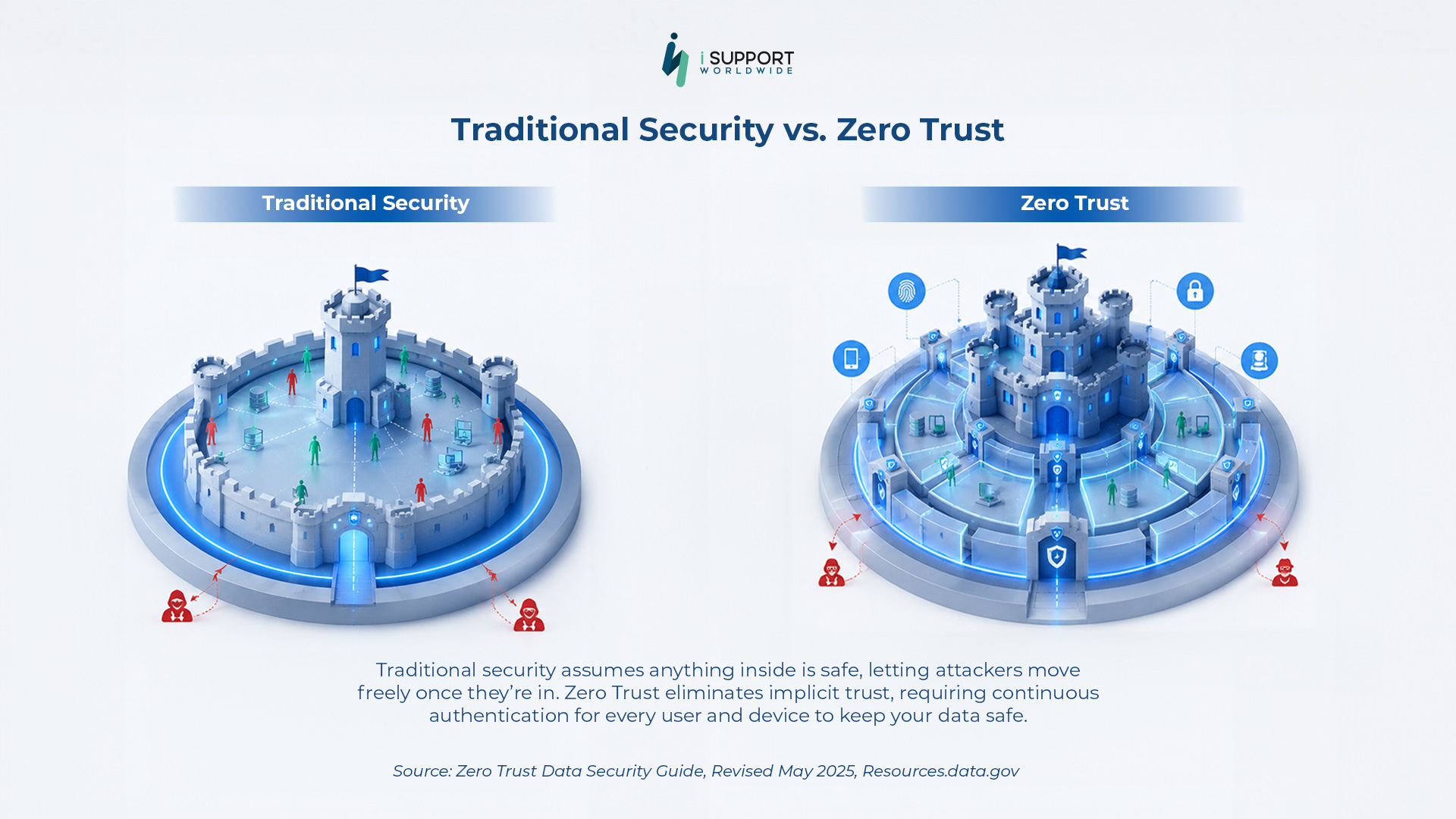
Zero Trust is built on three core principles:
- Verify explicitly
Every access request is authenticated and authorized using identity, device posture, and context. - Use least‑privilege access
Users only get the minimum access needed for the shortest time required. - Assume breach
Security controls are designed to limit damage, detect anomalies early, and contain threats quickly.
What Zero Trust is not:
- A single product you can buy
- A “lock everything down” approach that slows teams
- A replacement for operational discipline
Instead, it’s a framework that spans identity, devices, applications, networks, and data.
For offshore teams, Zero Trust succeeds only when controls align with real delivery workflows. Security models that look complete on paper often fail when they don’t account for shift‑based work, rapid team ramp‑ups, or shared operational responsibility between client and vendor.
The Zero-Trust Model for Offshore Teams
A practical Zero-Trust offshore security program focuses on five control layers.
1. Identity and Access Management
Identity is the new perimeter in offshore operations.
Key controls include:
- Multi‑factor authentication (MFA) for all users
- Role‑based access control (RBAC)
- No shared accounts
- Immediate access revocation during offboarding
- Just‑in‑time (JIT) access for privileged roles
This ensures offshore agents can only access what they’re authorized to—and nothing more.
In offshore environments, identity controls fail most often during change—rapid hiring, role shifts, or program transitions. Strong Zero‑Trust programs treat access reviews and revocation as continuous operational processes, not periodic audits.
2. Device and Endpoint Security
Unmanaged or poorly secured devices are a major risk in outsourced environments.
Best practices include:
- Company‑managed endpoints where possible
- Endpoint detection and response (EDR)
- Full disk encryption and enforced patching
- Removal of local admin privileges
- Device posture checks before granting access
For high‑sensitivity programs, many organizations use locked‑down environments or secure virtual desktops.
3. Network Segmentation
Zero Trust limits lateral movement if an account is compromised.
Controls include:
- Micro‑segmentation between systems and tools
- Separation of production environments from general browsing
- Secure DNS and web filtering
- Restricted access paths for offshore teams
This reduces the “blast radius” of any single incident.
4. Application and Session Controls
Application‑level controls are especially important for offshore delivery teams.
Common approaches:
- Virtual Desktop Infrastructure (VDI) or DaaS for sensitive workflows
- Browser isolation for high‑risk applications
- Session monitoring and recording where appropriate
- Time‑based access tied to shifts or schedules
These controls protect data without impacting agent performance.
Applied indiscriminately, session controls can create friction. High‑performing offshore programs apply them selectively—based on data sensitivity and task type—rather than uniformly across all roles.
5. Data Protection
Ultimately, Zero Trust is about protecting data.
Effective offshore data protection includes:
- Data Loss Prevention (DLP) policies (copy/paste, file transfers, USB blocking)
- Data classification and masking
- Encryption in transit and at rest
- Strict controls on exports, screenshots, and external storage
Even if credentials are compromised, data exposure is minimized.
Offshore Vendor Security Checklist
When evaluating an offshore partner, ask whether they can demonstrate:
Identity & Access
- MFA and SSO enforcement
- Role‑based access with regular reviews
Devices & Environment
- Managed, hardened endpoints
- Physical security controls (badging, CCTV, clean desk policies)
Data Protection
- DLP controls and encrypted storage
- Clear data retention and deletion policies
Monitoring & Response
- Centralized logging
- Defined incident response timelines
Compliance & Governance
- Documented security policies
- Audit readiness and evidence management
iSupport Worldwide’s Security Commitment
Security frameworks are only as strong as their execution. In offshore operations, the hardest part of Zero Trust is consistency over time.
Maintaining identity discipline, endpoint standards, and access hygiene across long‑running, multi‑program engagements requires operational rigor, not just technical controls.
At iSupport Worldwide, Zero-Trust principles are embedded into offshore delivery operations and supported by recognized security and compliance credentials, including:
- SOC 2 controls for security, availability, and confidentiality
- ISO/IEC 27001–aligned information security management systems
- HIPAA‑compliant processes for healthcare and regulated programs
These credentials reflect a commitment to governance, risk management, and continuous improvement, helping clients meet compliance requirements while operating secure, high‑performance offshore teams.
Secure Offshore Operations by Design
Zero Trust doesn’t make offshore work harder—it makes it safer and more resilient.
When identity, devices, access, and data are protected by design, organizations gain:
- Reduced breach impact
- Better visibility into offshore activity
- Stronger compliance posture
- Greater confidence in global delivery models
The result is offshore operations that scale securely because security is embedded into how teams are onboarded, managed, and governed, not bolted on after incidents occur.
Ready to Secure Your Offshore Delivery Model?
Talk to iSupport Worldwide about building a Zero-Trust offshore operation backed by proven security controls and global delivery expertise.
About the Author Denise Romero works as a copywriter at iSupport Worldwide, where she specializes in B2B content that helps businesses flourish. She specializes in creating clear, compelling messages that engage professional audiences and support strategic marketing goals. |
Founded in 2006, iSupport Worldwide is a US-owned offshoring leader based in the Philippines, delivering tailored solutions to enhance operational efficiency and exceed client expectations. Recognized on the Inc. 5000 list of America’s fastest-growing private companies for three consecutive years, honored in Inc. Magazine’s Power Partner Awards, and a recipient of the ACES Award for Inspiring Workplaces in Asia, iSupport Worldwide embodies a commitment to excellence. |