



Executive Summary
Silicon Valley–level output comes from clear ownership, fast feedback, and the right measurement systems. Offshore engineering teams can achieve the same results when built intentionally.
Introduction
Silicon Valley is often treated as the global benchmark for engineering performance. Fast shipping, high-quality releases, and strong in-house productivity are assumed to result from elite talent concentrated in one place.
Offshore developers, by contrast, are still frequently evaluated through cost or headcount rather than output.
This comparison misses a critical truth: developer productivity is not determined by location. Whether teams are based in Silicon Valley or offshore, output depends on how productivity is measured and how engineering systems are designed.
In this article, we examine how high-performing teams actually work, how to measure developer productivity correctly, and when offshore developers can realistically match—or outperform—traditional in-house teams.
What It Really Means to Measure Developer Productivity
Businesses still rely on outdated productivity signals such as hours worked, lines of code written, or the number of tickets closed. These metrics are easy to track, but they say very little about real output.
Modern engineering organizations focus on outcomes, not on activity.
Research from Google’s DevOps Research and Assessment (DORA) group shows that high-performing teams are best evaluated using delivery and reliability indicators, including:
- Lead time for changes
- Deployment frequency
- Change failure rate
- Mean time to recovery (MTTR)
These metrics capture how efficiently teams deliver value; not how busy developers appear to be.
Complementing this, the SPACE framework (developed by GitHub, Microsoft, and academic researchers) emphasizes that developer productivity must balance performance, communication, efficiency, and developer satisfaction.
The takeaway: to measure developer productivity accurately, organizations must look beyond output volume and focus on speed of feedback, quality, and sustainability.
Why Silicon Valley In-House Teams Often Show Higher Productivity
Silicon Valley teams often benefit from strong in-house productivity, not because of geography, but because of how their organizations are structured.
Common characteristics include:
- Clear product vision and stable prioritization
- Mature CI/CD pipelines and automated testing
- Strong ownership of services and product areas
- Fast feedback between users, product managers, and engineers
- Significant investment in developer tooling and experience
These environments reduce friction and rework, allowing developers to spend more time solving meaningful problems.
Talent density matters but it’s not the primary driver. As McKinsey notes, productivity differences are more often explained by how teams are organized and supported, rather than individual developer capability alone
Importantly, these advantages are organizational choices, not location-based benefits. They can be replicated by in-house teams and offshore developers alike.
Where Offshore Developers Can Match or Exceed In-House Productivity
When offshore developers are treated as long-term team members rather than as short-term capacity, their output can rival that of Silicon Valley engineering teams.
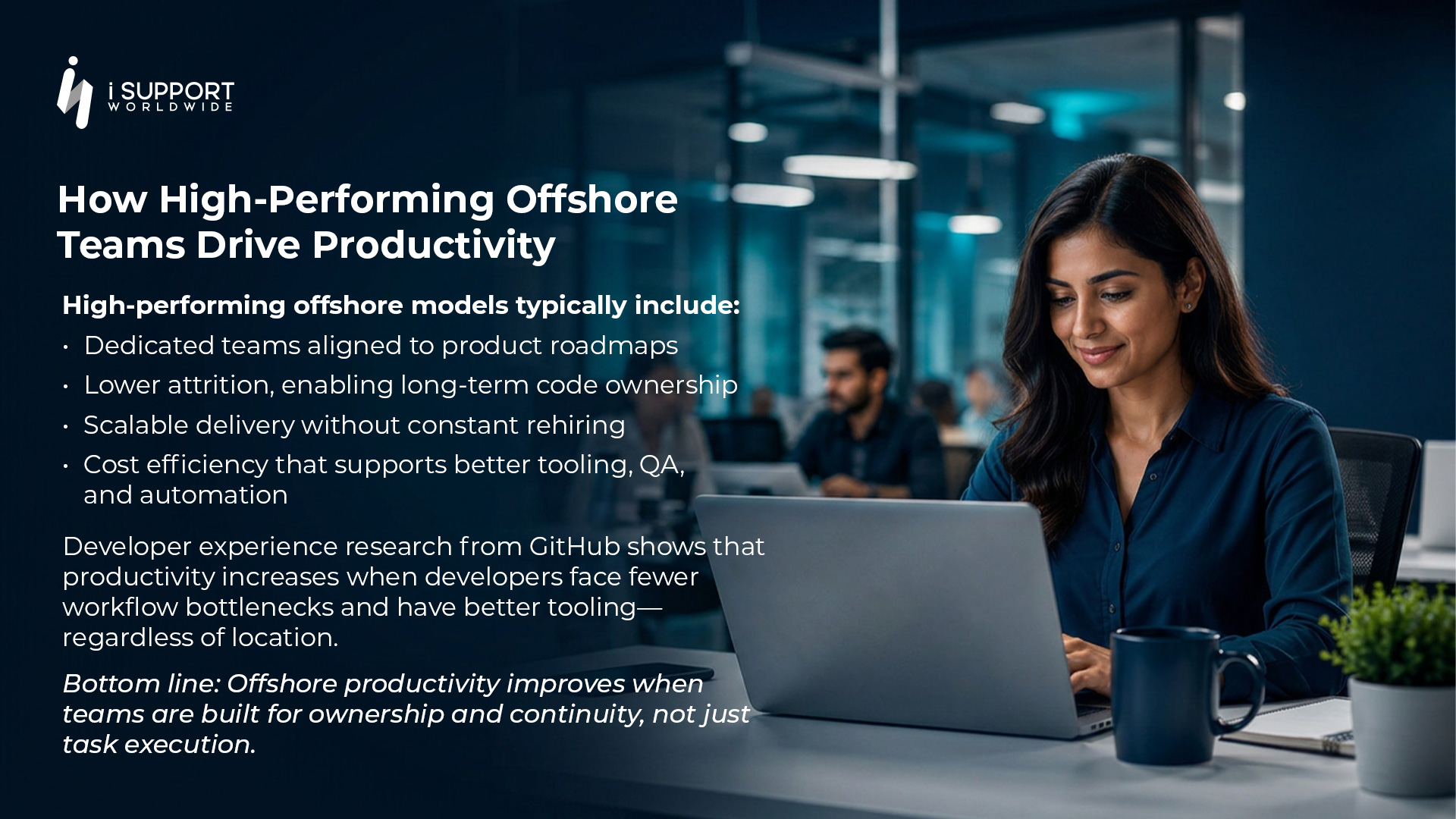
High-performing offshore development models typically include:
- Dedicated offshore teams aligned to product roadmaps
- Lower attrition, enabling long-term code ownership
- Scalable delivery capacity without constant rehiring
- Cost efficiency that supports better tooling, QA, and automation
Developer experience research from GitHub shows that productivity increases when developers face fewer workflow bottlenecks and have better tooling, regardless of location. Offshore developers benefit significantly when these conditions are present.
In other words, offshore productivity improves when teams are built for ownership and continuity rather than for task execution.
Offshore Developers vs Silicon Valley Teams: A Practical Comparison
| Dimension | Silicon Valley (Best Case) | Offshore (Best Case) | Offshore (Failure Mode)
|
| Ownership | Strong | Strong | Fragmented |
| Tooling | Mature | Mature | Manual |
| Requirements | Clear | Clear | Vague |
| Feedback Speed | Fast | Fast | Slow |
| Productivity | High | High | Inconsistent |
The differentiator is not location—it’s how teams are enabled to work.
When Offshore Teams Can Match or Beat SV Output
Offshore development is a strong fit when:
- You can provide clear product direction
- You’re willing to assign real ownership
- You invest in engineering fundamentals
- You design for async-first collaboration
- You value sustainable velocity over heroics
When these conditions are met, offshore teams deliver more consistent output than overstretched in-house teams. That’s where they become a competitive advantage.
Final Takeaway
Silicon Valley productivity is not a function of geography—it’s the result of systems that prioritize clarity, ownership, fast feedback, and developer experience.
Organizations that know how to measure developer productivity correctly can build high-performing teams anywhere. Offshore developers succeed when they are embedded into well-designed engineering systems—not when they are managed as a cost center.
For leaders evaluating offshore development, the most important question isn’t where your developers are—it’s how you enable them to deliver value.
If you’re considering offshore developers or trying to raise productivity across existing teams, iSupport Worldwide helps engineering leaders design offshore teams built for long‑term output and quality.
Connect with our offshore delivery experts to learn how a scalable offshore model can support high‑performing engineering teams.
About the Author Denise Romero works as a copywriter at iSupport Worldwide, where she specializes in B2B content that helps businesses flourish. She specializes in creating clear, compelling messages that engage professional audiences and support strategic marketing goals. |
Founded in 2006, iSupport Worldwide is a US-owned offshoring leader based in the Philippines, delivering tailored solutions to enhance operational efficiency and exceed client expectations. Recognized on the Inc. 5000 list of America’s fastest-growing private companies for three consecutive years, honored in Inc. Magazine’s Power Partner Awards, and a recipient of the ACES Award for Inspiring Workplaces in Asia, iSupport Worldwide embodies a commitment to excellence. |