



Executive Summary
Australia’s productivity challenge isn’t about effort, it’s about capacity design. Overtime across Sydney, Melbourne, Brisbane, Perth, and Adelaide signals planning gaps, not performance. Organisations improving output focus on sustainable capacity planning, better workforce output optimization, and strategic models like global capability centers in the Philippines to reduce overtime while strengthening delivery predictability and team resilience.
ullamcorper mattis, pulvinar dapibus leo.
Table of Contents |
The Overtime Trap: When More Hours Deliver Less Output
Overtime creates an illusion of productivity.
But the math tells a different story:
- Output per hour drops
- Errors increase
- Burnout compounds
- True capacity becomes invisible
This is the overtime trap:
When output is measured in hours, the fastest way to “deliver” is to stretch people until they break.
The GHOTD 2025 survey found Australian employees work an average of 3.6 hours of unpaid overtime per week, adding up to 173 hours or more than 4.5 weeks per year. These numbers consistently appear in any serious overtime productivity Australia discussion.
Weak team capacity planning creates reliance on unpaid hours.
When hours become the KPI, stretching people becomes the default strategy.
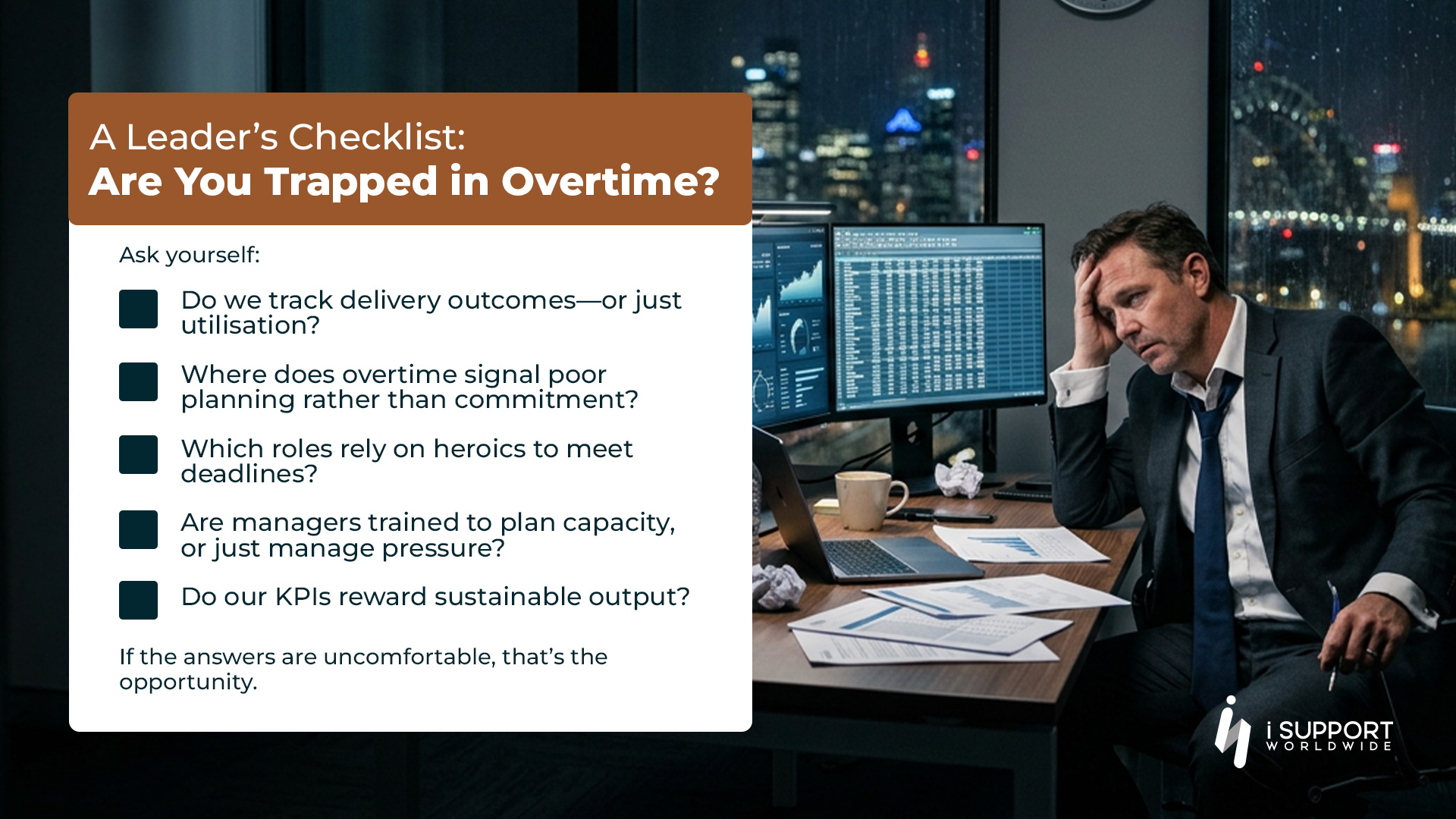
Why Overtime Is a Capacity Planning Failure
Overtime is often framed as a commitment. In reality, it signals poor workforce output optimization.
When organisations rely on overtime to deliver:
- Output per hour declines
- Errors and rework increase
- Managers lose visibility into real capacity
Effective team capacity planning shifts the focus from “how long” people work to “what output” teams can sustainably deliver. This is the foundation of sustainable capacity planning, particularly in high pressure Australian industries.
Across Australia’s major business hubs, the pressure looks different—but the cause is the same.
- In Sydney, rising labour costs and delivery complexity stretch teams beyond planned capacity
- In Melbourne, professional services and tech firms rely heavily on unpaid hours to meet client demand
- In Brisbane and Adelaide, smaller talent pools make team capacity planning even more critical
- In Perth, project‑based industries face sharp spikes that overwhelm static staffing models
In each case, the result is identical: overtime fills the gap left by weak sustainable capacity planning.
Organisations that succeed don’t solve this city by city. They redesign workforce output optimization at the system level.
The Real Productivity Gap: Planning and Execution
Research referenced by the ACTU shows that over half of Australia’s productivity gap with the United States is linked to management practices. Further research highlights a long tail of organisations struggling with execution.
Put simply, Australia doesn’t have a workforce problem.
It has a capacity planning Australia problem—specifically in planning, staffing, and execution.
This is where sustainable capacity planning becomes a leadership priority, not an HR exercise.
Overtime vs. Output: A Comparison
Dimension | Overtime‑led model | Sustainable capacity planning |
Core KPI | Hours worked | Output delivered |
| Planning approach | Reactive | Proactive team capacity planning |
Productivity outcome | Flat | Workforce output optimization |
Burnout risk | High | Managed |
Scalability | Low | High |
Organisations that reduce overtime in Australian teams consistently outperform those that rely on heroics.
Sustainable Capacity Planning in Australia: What Actually Works
Effective sustainable capacity planning includes:
- Clear team capacity planning based on skills, not job titles
- Output‑based KPIs aligned to delivery, not utilisation
- Early signals when workloads exceed capacity
- Strategic resourcing to support workforce output optimization
This approach enables leaders to reduce overtime in Australian teams while improving delivery confidence.
How a Global Capability Center Supports Workforce Output Optimization
For many organisations, fixing capacity issues locally isn’t enough, especially in high-cost markets.
This is where a Global Capability Center model adds leverage.
By establishing a GCC in the Philippines, businesses can support delivery teams across Brisbane, Perth, and Adelaide with:
- Dedicated offshore capacity aligned to output
- Stronger team capacity planning across time zones
- Reduced reliance on overtime during peak demand
The Philippines has become a preferred location for Australian organisations establishing a Global Capability Center, offering skilled talent, strong cultural alignment, and operational continuity.
Rather than asking Australian teams to absorb more work, leaders use a Global Capability Center to stabilise delivery and enable sustainable capacity planning nationwide.
Final Thought: Sustainable Capacity Planning Is Designed
Australia’s productivity challenge looks different in Sydney, Melbourne, Brisbane, Perth, and Adelaide, but the underlying issue is the same.
Unpaid overtime is not a sign of commitment—it’s evidence that capacity planning in Australia hasn’t kept pace with demand. Organisations that make progress do so by strengthening team capacity planning, improving workforce output optimization, and deliberately reducing overtime in Australian teams.
For many leaders, this includes extending their operating model beyond local borders. Partners like iSupport Worldwide help Australian businesses build Global Capability Centers (GCCs) in the Philippines, adding sustainable capacity that supports local teams rather than stretching them further.
Sustainable productivity isn’t demanded. It’s designed.
About the Author Denise Romero works as a copywriter at iSupport Worldwide, where she specializes in B2B content that helps businesses flourish. She specializes in creating clear, compelling messages that engage professional audiences and support strategic marketing goals. |
Founded in 2006, iSupport Worldwide is a US-owned offshoring leader based in the Philippines, delivering tailored solutions to enhance operational efficiency and exceed client expectations. Recognized on the Inc. 5000 list of America’s fastest-growing private companies for three consecutive years, honored in Inc. Magazine’s Power Partner Awards, and a recipient of the ACES Award for Inspiring Workplaces in Asia, iSupport Worldwide embodies a commitment to excellence. |