



Executive Summary
With capital tighter and milestones under scrutiny, leaders need smarter ways to extend runway without stalling execution. Offshoring offers a practical lever, lowering burn while preserving output when done with the right structure.
For leadership teams evaluating cost efficiency and execution risk, offshoring is a smart approach to sustaining growth.
Introduction
Raising more capital isn’t always the fastest or safest way to buy time. For many startups and growth-stage companies, the real challenge is stretching existing cash far enough to hit the next meaningful milestone. That’s where offshoring comes in, not as a blunt cost‑cutting tactic, but as a way to increase operational leverage.
When implemented intentionally, offshoring can extend runway while keeping teams productive, responsive, and focused on growth.
Understanding Runway and Why Labor Costs Matter Most
Runway is simple in theory: the number of months a business can operate before it runs out of cash.
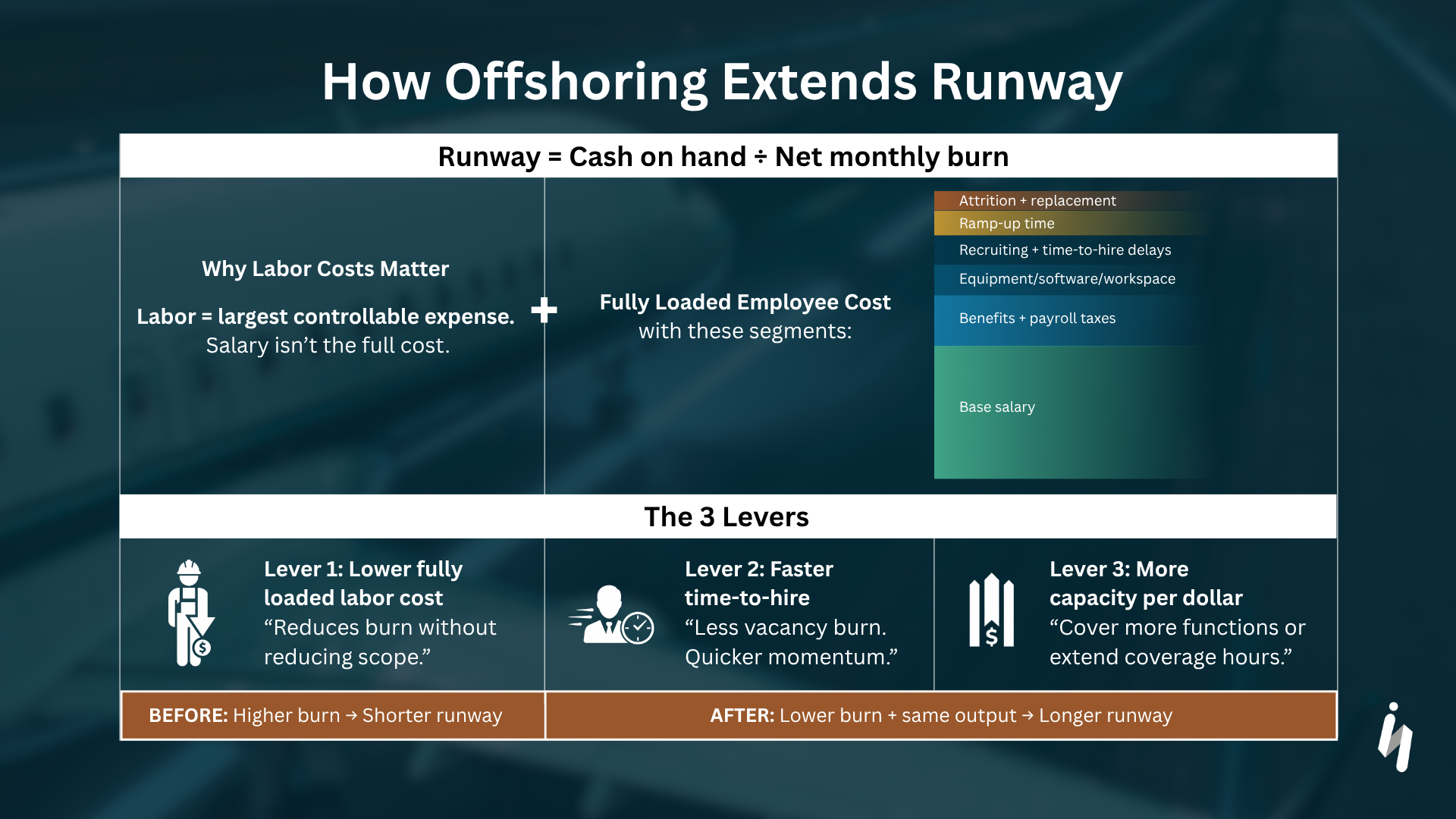
Runway = Cash on hand ÷ Net monthly burn
In practice, runway shrinks faster than expected because burn is often underestimated—especially when it comes to people costs. Labor is typically the largest controllable expense on the P&L, and salary alone doesn’t tell the full story.
The fully loaded cost of an employee includes:
- Base salary
- Benefits and payroll taxes
- Equipment, software, and workspace
- Recruiting fees and time-to-hire delays
- Ramp-up time before full productivity
- Attrition and replacement costs
Even a small number of hires can significantly increase monthly burn, reducing flexibility and forcing tough decisions sooner than planned. Extending runway, then, isn’t just about paying people less—it’s about getting more consistent output per dollar spent.
The Runway Math: How Offshoring Changes the Equation
How to extend runway without cutting growth? Offshoring changes runway math in three keyways.
First, it lowers fully loaded labor costs. While offshore professionals are highly skilled, total employment costs are often materially lower due to differences in labor markets and overhead. This directly reduces monthly burn without reducing headcount or scope.
Second, offshoring shortens the time to hire. Open roles are expensive. Every month a position sits unfilled is a month of lost output, delayed projects, and opportunity cost. Offshore hiring models are typically faster, which means less “vacancy burn” and quicker momentum.
Third, it increases capacity per dollar. Instead of choosing between one hire or another, teams can often cover more functions or extend coverage hours with the same budget—accelerating execution across operations, marketing, support, or finance.
For example, reallocating part of an onshore hiring budget to a small offshore team can reduce monthly burn while maintaining—or even increasing—overall output. The result is a longer runway and better odds of reaching revenue, product, or growth targets before cash constraints tighten.
This is the core reason why offshoring extends runway: it improves efficiency without forcing growth to pause.
The Best Roles to Offshore First (High Impact, Low Risk)
Not every role should be offshored immediately. The highest returns usually come from functions that are process-driven, well-defined, and closely tied to execution rather than executive decision-making.
Common high-impact roles include:
- Operations & Administration: documentation, data management, quality checks, process support
- Customer Experience: customer support specialists, QA analysts, knowledge base management
- Marketing Production: design, video editing, content operations, SEO, and campaign support
- Finance Support: accounts payable/receivable, reconciliations, reporting preparation (with controls)
- Sales Enablement: lead research, CRM hygiene, proposal, and pipeline support
These roles free up onshore leaders and specialists to focus on strategy, relationships, and high-stakes decisions.
Roles typically not offshored first include executive leadership positions or functions with no existing processes. Offshoring works best when there is at least a minimum level of documentation, tools, and success metrics to anchor performance.
Offshoring vs. Outsourcing: Why the Difference Matters for Runway
Offshoring and outsourcing are often used interchangeably, but the distinction matters, especially when the runway is on the line.
Offshoring involves dedicated team members who work exclusively for your business. They’re embedded into your tools, workflows, and cadence, and they accumulate institutional knowledge over time.
Outsourcing is usually output-based. Teams may change, context resets are common, and control is limited to what’s written in a contract.
From a runway perspective, offshoring offers:
- More predictable monthly costs
- Better knowledge retention
- Less rework and retraining
- Compounding returns as teams mature
That predictability is critical when leaders are managing burn closely and need confidence that savings won’t be offset by quality issues or operational drag
A Low-Risk Playbook to Extend Runway with Offshore Teams
Successful offshoring isn’t accidental. It follows a deliberate rollout that balances speed with control.
Start with a pilot.
Choose one or two roles, define clear KPIs, and document core processes. The goal is to quickly validate fit and performance.
Stabilize execution.
Introduce quality checks, reporting cadence, and feedback loops. This is where consistency and trust are built.
Scale thoughtfully.
Add adjacent roles or form small functional pods (e.g., a marketing production pod or a support pod) to increase leverage.
Optimize over time.
Cross-train team members, introduce automation, and build redundancy to protect continuity.
Common pitfalls such as weak onboarding, unclear ownership, or a lack of performance metrics can erode savings. Strong governance, security controls, and management oversight are what turn offshoring into a sustainable runway strategy rather than a short-term experiment.
Final Thought
Extending the runway doesn’t have to mean shrinking ambition. With the right structure, offshoring allows companies to lower burn, move faster, and protect momentum when it matters most. For teams navigating tighter capital environments, it’s one of the most practical levers available—when done right.
If you’re exploring how offshoring could impact your burn and runway, a simple cost model can clarify what’s possible before you commit.