



Executive Summary
For many mid- to senior-level professionals, golden handcuffs appear in leadership tracks and specialized positions where retention strategies are common. Over time, these incentives can create a subtle pressure to stay, even when the role no longer supports career development, personal goals, or evolving professional identity.
By offering opportunities that combine competitive compensation with global exposure, meaningful work, and a healthy workplace culture, iSupport Worldwide helps individuals move forward without sacrificing stability.
What if the biggest thing holding your career back isn’t your workload but your compensation?
What are "golden handcuffs” and why do they feel so hard to break?
The term “golden handcuffs” first emerged in 1976. The phrase gained traction as Wall Street bankers’ salaries outpaced an average private-sector worker’s earnings, as noted in BBC. This situation made it financially risky for key personnel to jump ship to a competitor.
Golden handcuffs are rewards that shine like gold but hold like chains.
They come in the form of high salaries, generous bonuses, or long-term perks that feel too valuable to walk away from. At first, they make a job feel like a win, like you’ve found a hidden gem.
In reality, it introduces a hidden psychological contract.
Stay and you get paid. Leave early, and you lose a portion of your compensation. It’s like saying: “You’re free to go… but if you do, you lose all this gold.”
Many professionals encounter this in senior roles, leadership tracks, and specialized functions where compensation packages include retention bonuses or performance-linked incentives. These arrangements are common in competitive talent markets where employers need to retain experienced professionals.
But the challenge is not the incentives themselves. The challenge is how they influence your decisions.
Are you staying for growth or just avoiding the loss?
A professional reaches a point where:
- The workload is heavier than before
- The learning curve has flattened
- The role no longer aligns with long-term goals
Yet they stay. The reason is rarely stated directly, but it’s clear in conversation.
“I’d be giving up too much if I leave.”
That mindset shifts your decision-making framework. You’re no longer evaluating what’s best for your career. You’re calculating what you might lose.
When professionals weigh career decisions, compensation usually dominates the conversation. What’s often missing is a serious evaluation of opportunity cost.
Opportunity cost is the value of the path you didn’t take.
In the context of golden handcuffs, it can look like:
- Staying in a high-paying role that doesn’t expand your skill set
- Missing exposure to global clients in more strategic roles
- Delaying leadership experience that could accelerate your career
Over time, these missed opportunities accumulate, and in some cases, they become harder to recover from than any financial benefit you held onto.
Golden handcuffs make the loss visible. Opportunity cost hides in the background.
Why high compensation doesn’t guarantee career satisfaction
A strong salary can solve many short-term problems. It can give you stability, flexibility, and financial confidence, but it doesn’t automatically create alignment, purpose, or long-term fulfillment.
Over time, many mid- to senior-level professionals realize that compensation and career satisfaction follow different timelines. One is immediate. The other is cumulative. This disconnect is where golden handcuffs start to feel heavier.
Here’s what typically drives declining career satisfaction despite high pay.
Your role no longer reflects who you’re becoming as a professional
You may have accepted the job at a stage where stability and income were your priorities. As your goals evolve, your role may no longer align with your identity as a specialist, leader, or strategic contributor.
You feel “successful” externally but disconnected internally
Filipino professionals often place value on recognition, stability, and pride in their role. When your position looks strong on paper but feels unfulfilling in practice, it creates tension between external validation and internal reality.
You’re maintaining a reputation instead of building your future
You’ve invested years proving your capability in your current role. Leaving can feel like stepping away from that identity. So instead of growing, you stay to protect what you’ve already built.
Your work no longer supports your long-term life goals
At mid- to senior-level stages, priorities shift. Family time, health, and meaningful work become more important. A high-paying role that demands constant trade-offs can start to conflict with these evolving values.
You’ve outgrown the environment, but the compensation keeps you anchored
You might recognize that your peers in a company with a healthy workplace culture or those who work in a global capability center are gaining broader exposure. Yet leaving feels like abandoning a stable identity.
Your sense of progress becomes tied to income instead of growthh
When compensation becomes the primary indicator of success, it can mask stagnation. You are earning more but not necessarily becoming more competitive in your field.
How to evaluate if your golden handcuffs are worth it
Golden handcuffs are not automatically bad. In many cases, they reflect that your skills are valuable, and your employer is willing to invest in you. The challenge is knowing whether that investment still aligns with your long-term direction.
The decision is not simply about staying or leaving. It’s about understanding whether what you’re gaining is still greater than your opportunity cost.
Here’s how experienced professionals can evaluate it.
Recognize the classic signs you're in golden handcuffs
Before you evaluate anything, start with awareness.
Many professionals assume they are making strategic career decisions because golden handcuffs are justified on paper, but there are consistent patterns that signal when compensation is starting to drive your decisions more than career satisfaction.
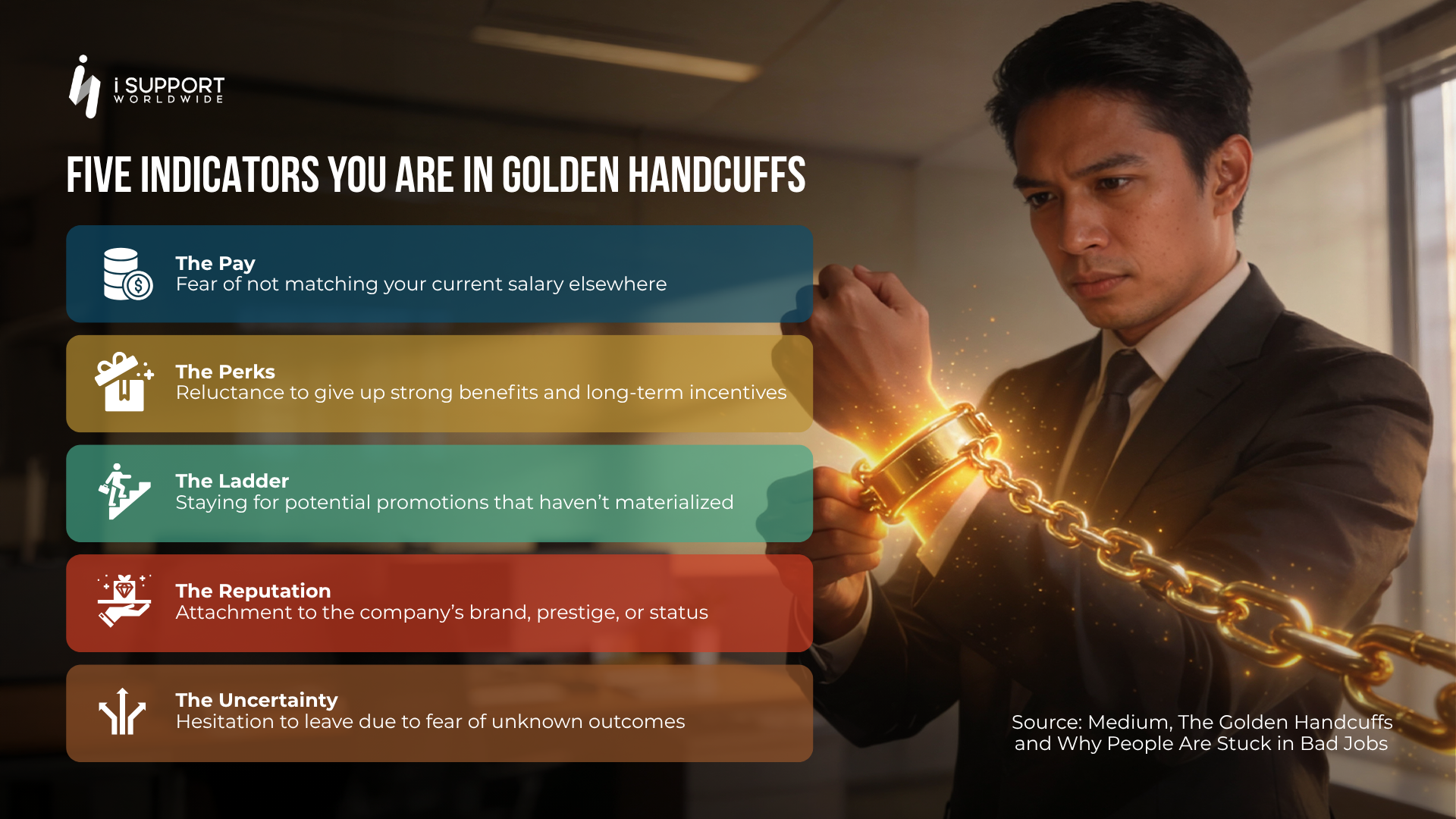
As Medium outlines, there are five clear indicators professionals experience when they are in golden handcuffs.
Look at the total value, not just the salary
Golden handcuffs typically include deferred incentives, bonuses, or benefits tied to tenure.
To evaluate them properly, you need to look beyond base pay:
- What portion of your compensation is guaranteed versus conditional
- What you actually lose if you leave today
- Whether the additional income justifies your current workload and stress
A high salary can look strong in isolation, but total value depends on what you’re gaining in return over time.
Compare career satisfaction against financial security
A well-paying role should still support long-term career satisfaction.
Evaluate your current state:
- Do you still find meaning in your daily work?
- Are you engaged or just maintaining performance?
- Are you growing or repeating the same outputs?
The more your motivation leans toward compensation alone, the more your career satisfaction becomes at risk.
Make your opportunity cost visible
Most professionals clearly see what they might lose by leaving.
Few outline what they are giving up by staying.
To evaluate your opportunity cost, compare your situation with:
- Roles where you can work in a global capability center and gain broader exposure
- Opportunities that involve more strategic or leadership responsibilities
- Those who work in a company with a healthy workplace culture
Golden handcuffs can delay these moves, increasing your long-term opportunity cost without making it obvious.
Assess your growth over the next 2–3 years
Your decision should not only be based on today’s comfort.
It should also be based on future positioning.
Ask yourself:
- Will this role expand your responsibilities in a meaningful way?
- Will you gain new, market-relevant skills?
- Will you become more competitive in your field?
Golden handcuffs often provide financial growth while professional growth slows down.
Evaluate both sustainability and tolerance
A role can be tolerable and still be unsustainable.
This is where many professionals underestimate the real trade-off.
Consider:
- Is your workload manageable long-term?
- Does your role support your personal priorities?
- Are you in a company with a healthy workplace culture?
High compensation can delay burnout, but it does not eliminate it.
Move forward without compromising stability
If you’re at the point where you’re questioning whether your current role is still worth it, that’s already a sign of awareness.
Explore opportunities where you can:
- Maintain competitive compensation without relying on golden handcuffs
- Improve your career satisfaction through meaningful, long-term work
- Work in a global capability center with direct exposure to US clients
- Be part of a company with a healthy workplace culture that supports sustainable performance
iSupport Worldwide continues to work with experienced Filipino professionals who are ready to move forward.
If that sounds like the direction you’re considering, it may be time to take a closer look at what’s available.
About the Author Shekina P. Malonzo is a Licensed Professional Teacher and multifaceted Content Developer at iSupport Worldwide, specializing in creating tailored materials for the offshoring industry. |
Founded in 2006, iSupport Worldwide is a US-owned offshoring leader based in the Philippines, delivering tailored solutions to enhance operational efficiency and exceed client expectations. Recognized on the Inc. 5000 list of America’s fastest-growing private companies for three consecutive years, honored in Inc. Magazine’s Power Partner Awards, and a recipient of the ACES Award for Inspiring Workplaces in Asia, iSupport Worldwide embodies a commitment to excellence. |