



Executive Summary
Engineering capability centers offer a smarter alternative to traditional outsourcing by providing dedicated offshore teams fully integrated into your organization. In the Philippines, companies can reduce costs, accelerate hiring, and scale efficiently.
Why Companies Still Choose the Philippines for Engineering Operations
Engineering outsourcing in the Philippines has long been a practical solution for companies looking to scale efficiently. But as engineering operations grow more complex, many leaders are moving beyond traditional outsourcing toward a more strategic model: engineering capability centers.
This shift reflects a broader change in how companies think about offshore talent. Rather than relying on vendor-managed delivery, organizations are building dedicated offshore teams that operate as a true extension of their engineering function, delivering cost efficiency, stronger control, and long-term scalability.
Outsourcing vs Capability Centers: What’s the Real Difference?
| Model | Traditional Outsourcing | Capability Center |
Structure | Vendor-managed | Dedicated offshore team |
Control | Limited | High |
Talent | Shared resources | Dedicated and retained talent |
Use Case | Short-term projects | Long-term scaling |
Knowledge | Low retention | High retention |
While outsourcing in the Philippines works for short-term needs, global capability centers (GCCs) provide long-term operational leverage and deeper integration.
What Is an Engineering Capability Center?
An engineering capability center is a dedicated offshore team embedded within your engineering organization.
Unlike traditional outsourcing, it integrates into your workflows, systems, and culture, supports continuous product development, and ensures knowledge of retention and alignment.
The goal is simple: create predictable, scalable engineering capacity while retaining institutional knowledge and maintaining alignment with product goals.
Why Capability Centers Are Gaining Traction
1. Lower Cost per Engineer
Reduce total labor costs while preserving skill quality and continuity, helping protect margins without reducing output.
2. Faster Hiring Cycles
Dedicated offshore models enable companies to build teams faster than traditional local hiring, reducing time-to-productivity.
3. Increased Delivery Velocity
By expanding engineering capacity, teams can execute more sprints, accelerate releases, and support multiple product initiatives simultaneously.
4. Greater Executive Focus
Leadership can shift attention from staffing challenges to strategy, product innovation, and growth.
This aligns with a core shift in workforce strategy: using offshore teams not just as a cost lever, but as a growth enabler.
How to Build an Engineering Capability Center
Building a successful global capability center (GCC) requires more than hiring offshore talent—it requires intentional design and integration.
1. Identify Repeatable Engineering Functions
Focus on work that benefits from scale and process consistency, such as QA automation, backend services, and infrastructure support.
2. Define Roles and Career Paths
Create a structured team with clear roles (developers, QA engineers, DevOps/SRE, tech leads) and growth opportunities to support retention.
3. Build a Dedicated Offshore Team
Avoid shared vendor resources. Instead, invest in a dedicated team aligned exclusively to your business to preserve continuity and knowledge.
4. Integrate Into Your Systems and Culture
Embed the team into:
- CI/CD pipelines
- Sprint cycles
- Code ownership structures
- Communication workflows
The most effective capability centers operate indistinguishably from onshore teams.
When Should You Choose a Capability Center?
A capability center is the better choice when you need to:
- Scale engineering operations consistently over time
- Expand long-term capacity rather than deliver one-off projects
- Maintain high development velocity across ongoing work
- Retain knowledge and ensure tighter control of engineering output
If your needs are short-term or project-specific, outsourcing may still be suitable. But for organizations focused on sustained growth, a capability center provides stronger long-term leverage.
Practical Considerations for ExecutivesTo maximize the impact of a capability center, leadership teams should focus on:
|
Build Your Capability Center in the Philippines
Choosing outsourcing in the Philippines gives you access to cost-efficient, scalable engineering talent—but how you structure your offshore team determines the outcome.
iSupport Worldwide helps companies go beyond outsourcing by building dedicated offshore teams that operate as a true extension of their business.
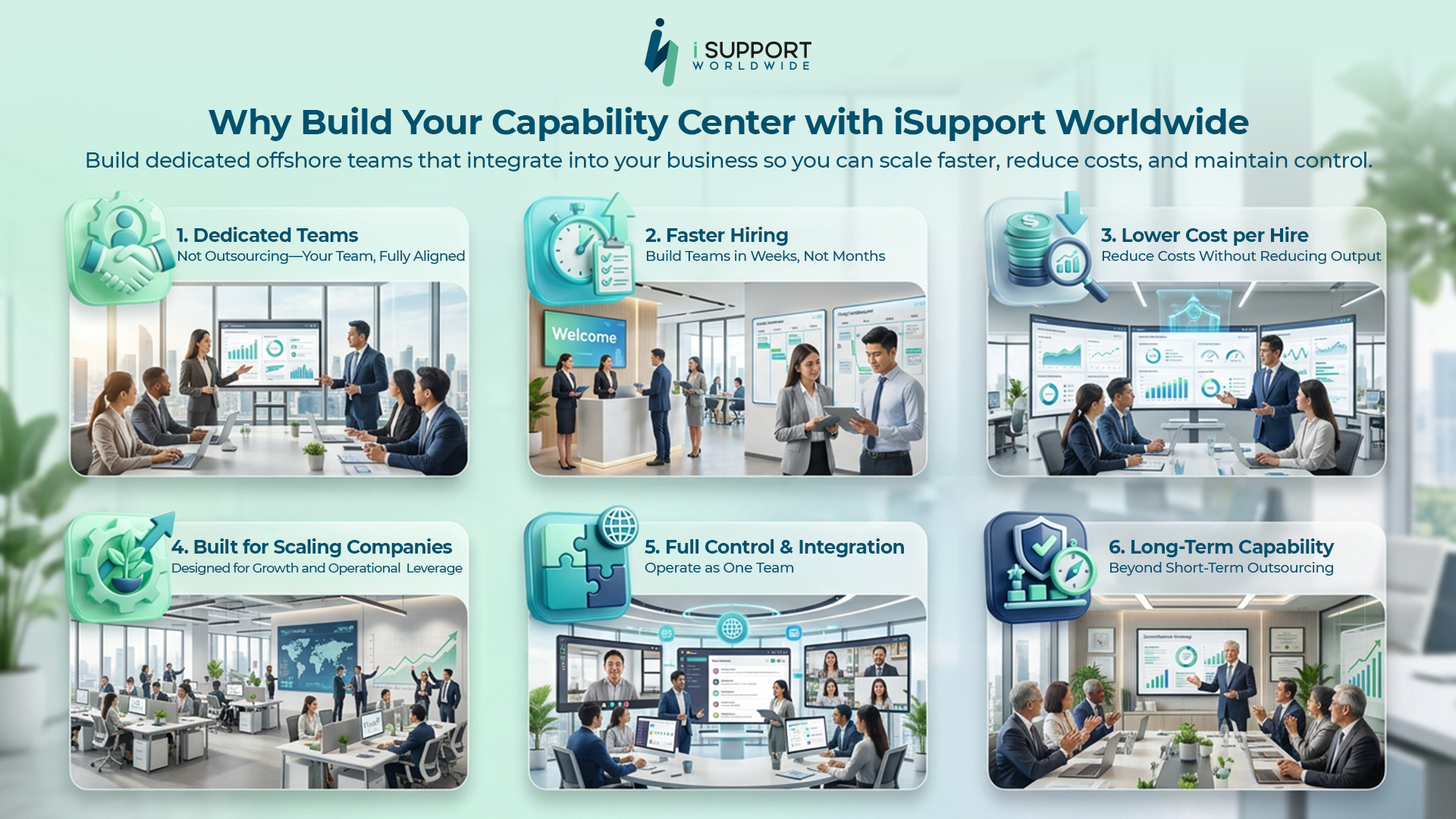
Dedicated Teams, Not Outsourcing
Unlike traditional vendors, iSupport Worldwide builds fully dedicated teams aligned to your systems, workflows, and culture—not shared resources juggling multiple clients.
Built for Scaling Companies
Designed for mid-market and growth-stage organizations, the model supports companies that need to increase capacity, protect margins, and scale without slowing down.
Faster Hiring, Real Capacity
Access pre-qualified talent and build teams in weeks—not months—so hiring becomes a growth driver instead of a bottleneck.
Lower Cost, Higher Leverage
Reduce labor cost per engineer while expanding output—creating immediate operating leverage without cutting quality.
Full Control and Integration
Your offshore team reports into your organization, follows your KPIs, and works inside your tools—ensuring accountability, alignment, and long-term knowledge retention.
Final Thoughts
The most effective companies are no longer asking whether to outsource; they’re asking how to build scalable, integrated engineering organizations across borders.
Capability centers answer that question by combining:
- Lower cost
- Faster hiring
- Greater control
- Long-term operational leverage3
And in markets like the Philippines, they provide a practical path to scaling engineering teams without the constraints of traditional models.
Explore how iSupport Worldwide provides the structure to turn that advantage into a scalable, high-performing engineering capability center.
About the Author Denise Romero works as a copywriter at iSupport Worldwide, where she specializes in B2B content that helps businesses flourish. She specializes in creating clear, compelling messages that engage professional audiences and support strategic marketing goals. |
Founded in 2006, iSupport Worldwide is a US-owned offshoring leader based in the Philippines, delivering tailored solutions to enhance operational efficiency and exceed client expectations. Recognized on the Inc. 5000 list of America’s fastest-growing private companies for three consecutive years, honored in Inc. Magazine’s Power Partner Awards, and a recipient of the ACES Award for Inspiring Workplaces in Asia, iSupport Worldwide embodies a commitment to excellence. |