



Executive Summary
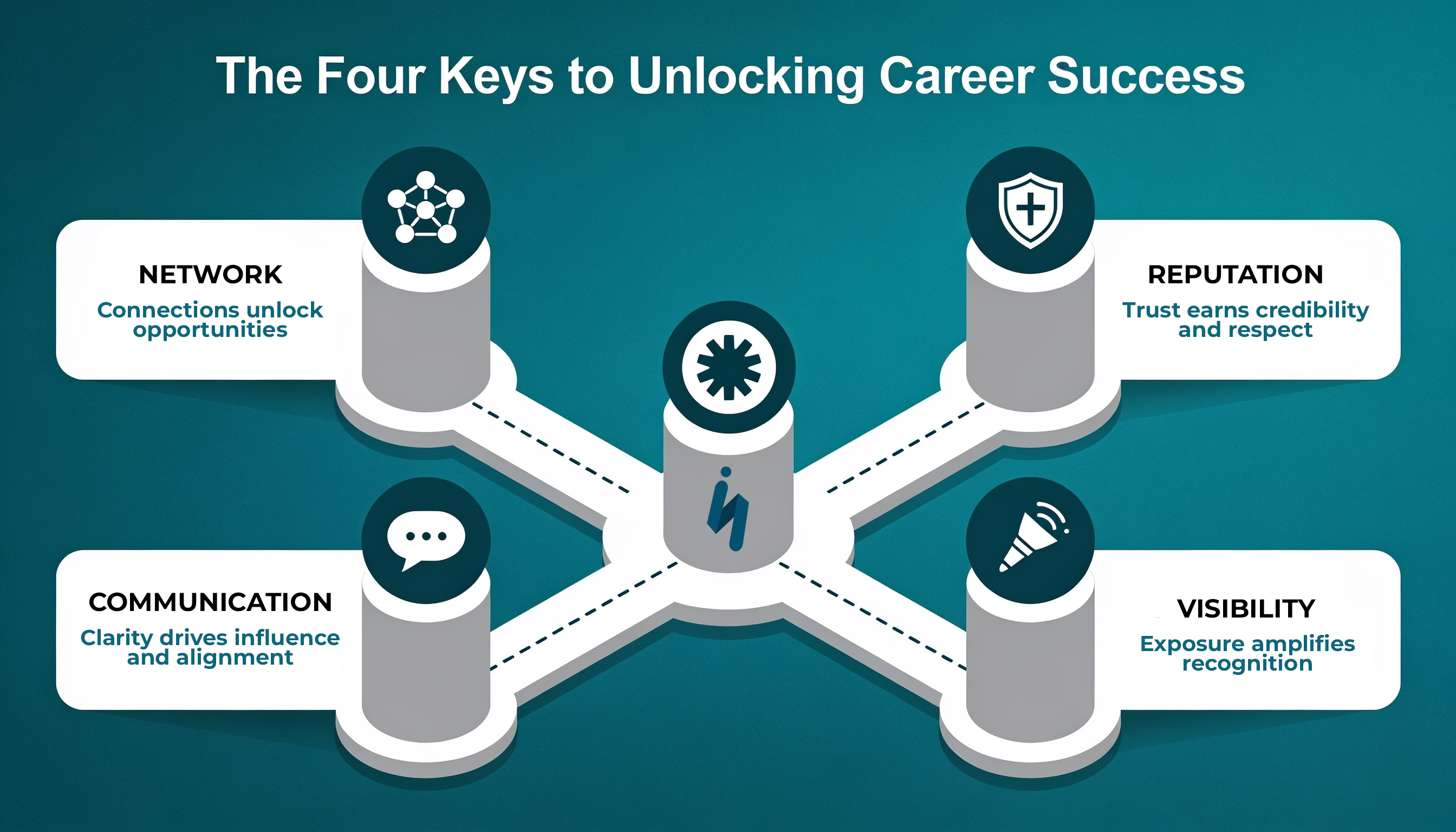
Career success is often associated with technical expertise, certifications, and experience, but long-term advancement depends on more than qualifications alone. Professionals who consistently create new opportunities understand how to develop and leverage four critical career growth pillars: their network, reputation, communication skills, and professional visibility.
At iSupport Worldwide, we recognize that career growth extends beyond hard skills. Through meaningful work, collaborative environments, and opportunities to support global clients, professionals can strengthen their personal brand, expand their networks, and develop the skills needed for long-term success. Explore a career with iSupport Worldwide and discover an environment where your growth, visibility, and potential are supported every step of the way.
Many professionals spend years focusing on acquiring technical expertise, earning certifications, and improving performance, only to discover that career advancement does not always follow the neat and logical path they expected.
This can feel frustrating at first because we naturally assume that doing excellent work should be enough. Yet if you observe how careers unfold across industries, organizations, and leadership levels, you’ll notice a different pattern emerging.
The professionals who consistently create opportunities for themselves are often those who understand four powerful career forces: their network, their reputation, their communication skills, and their visibility.
These four elements may seem intangible compared to qualifications and experience, but together they shape how opportunities find you, how others perceive your value, and how far your influence extends throughout your career.
Your Network
The professional world operates on trust long before it operates on credentials. When organizations need talent, they often begin by consulting people they trust for recommendations rather than conducting an exhaustive search from scratch.
Whether a company is expanding its workforce, building dedicated teams for a new client, or hiring specialists to support offshore staff operations, trusted referrals frequently become a starting point because they reduce uncertainty and accelerate decision-making. This does not mean skills are unimportant. Rather, skills and relationships often work together. People open doors, but your abilities help you walk through them.
The reality is that opportunities rarely move through perfectly organized channels. They move through conversations, recommendations, introductions, and professional relationships that have often been cultivated over many years. This idea aligns with Stanford sociologist Mark Granovetter’s influential “Strength of Weak Ties” theory, which found that acquaintances and broader professional networks often provide access to valuable job opportunities and information.
When a former colleague recommends your name for a leadership role, when an industry contact introduces you to a potential client, or when a former manager offers guidance during a career transition, you are experiencing the value of a network that extends beyond a list of connections. Many professionals mistakenly view networking as an occasional activity reserved for conferences and LinkedIn. In reality, networking is an ongoing practice of building trust and maintaining meaningful relationships.
So how can you build a network that creates opportunities instead of simply increasing your contact count? The answer lies in focusing on relationships that are genuine, mutually beneficial, and nurtured long before you actually need them.
- Developing authentic relationships instead of transactional ones
- Staying connected with former colleagues and peers
- Sharing valuable insights and industry knowledge consistently
- Creating networking strategies that focus on helping others first
- Participating in professional communities where meaningful conversations happen
Think of networking less as collecting contacts and more as planting seeds. The opportunities that appear years from now are often the result of relationships you invest in today.
Building meaningful professional relationships is often where opportunities begin, but relationships alone are rarely enough to sustain long-term career growth. After all, making a strong first impression may open a door, but what keeps that door open is the experience people have working with you. That is where reputation enters the picture. If your network introduces you to opportunities, your reputation determines whether those opportunities continue to come your way.
Your Reputation
Every interaction leaves an impression. Every project completed, commitment honored, challenge managed, and conversation navigated contributes to a growing record of how people perceive you professionally.
Unlike a performance review that happens once or twice a year, your reputation is constantly being built in the background. People share stories. They remember experiences. They discuss reliability, professionalism, accountability, and integrity. Over time, those observations form a collective perception that follows you throughout your career. Just as compound interest grows through consistency, reputation grows through repeated actions.
Once you recognize that people are constantly forming impressions based on your actions, decisions, and interactions, the next question becomes obvious: what impact do those perceptions actually have on your career? As it turns out, quite a significant one. The reputation you build today often influences opportunities long before your resume or portfolio ever enters the conversation.
Organizations operate on confidence and trust. According to Harvard Business School, trust is not merely a byproduct of time but a capability developed through predictable behavior, honesty, reliability, and intentional actions.
For example, many offshoring companies place tremendous value on employees whose reputations demonstrate consistency and reliability because those professionals often become the face of the organization when working directly with clients.
So how can you intentionally build a reputation that works for you instead of leaving it to chance? While reputation may seem like an abstract concept, it is often the result of small professional habits practiced consistently over time:
- Consistently delivering quality work
- Following through on commitments
- Taking responsibility when mistakes occur
- Treating every project as an opportunity to build credibility
- Focusing on reliability, especially during difficult situations
Of course, maintaining a strong reputation is not simply about delivering good work. In today’s workplace, much of your professional reputation is shaped by how effectively you interact with others, share ideas, solve problems, and navigate conversations. In other words, even the most reliable professional can limit their impact if they struggle to communicate their value. This is why communication is often the invisible skill powering both reputation and influence.
Your Communication Skills
The workplace rewards those who can make ideas understandable. No matter how intelligent, experienced, or knowledgeable a professional may be, their impact remains limited if they cannot clearly explain their thinking, align stakeholders, and inspire action.
Communication serves as the bridge between expertise and influence. Successful professionals know how to communicate complex concepts in ways that others can quickly understand and act upon. They are capable of adapting their message for executives, clients, colleagues, and team members without losing clarity or meaning.
In many cases, career growth happens not because someone knows more, but because they can effectively help others understand what they know. In modern workplaces, where collaboration and information-sharing drive results, the ability to communicate effectively often becomes the difference between being knowledgeable and being influential.
Consider a leader managing dedicated teams across multiple functions or a manager coordinating offshore staff from different regions and time zones. Their success rarely depends solely on technical expertise. It depends heavily on their ability to communicate expectations, align priorities, share feedback, and maintain engagement.
Strong communicators often become problem solvers, influencers, and decision-makers because people naturally gravitate toward clarity in environments filled with complexity.
The ability to communicate well transforms knowledge into influence.
So how can you strengthen a skill that influences nearly every aspect of your career? Effective communication is not about using bigger words or sounding smarter than everyone else. It is about making your ideas easier to understand, trust, and act upon.
- Prioritizing clarity over complexity
- Practicing active listening as much as speaking
- Using examples and stories to make concepts memorable
- Adjusting communication based on your audience
- Regularly seeking feedback on your communication style
The best communicators are not necessarily the loudest people in the room or the ones who use the most sophisticated language. More often, they are the professionals who can take complex ideas and make them remarkably easy to understand. When people consistently understand your message, they are more likely to trust your expertise, remember your contributions, and act on your ideas.
And once you’re able to communicate your value clearly, the next step is ensuring that value becomes visible to the people who can create new opportunities for you.
Your Visibility
One of the most persistent myths in professional life is the belief that outstanding work automatically receives recognition.
Unfortunately, modern workplaces are busy environments where managers, executives, clients, and stakeholders often have limited insight into everything happening around them.
As a result, exceptional contributions can remain unnoticed even when they create significant value.
This is where professional visibility becomes important.
Visibility is not about self-promotion or seeking attention for its own sake. Rather, it is about ensuring that the right people understand the value you create, the expertise you possess, and the impact you deliver.
Opportunities often flow toward familiarity. When leaders repeatedly see thoughtful contributions, hear valuable insights, and observe meaningful participation, they develop a clearer understanding of someone’s capabilities.
Consider two professionals who achieve similar results. One consistently shares project outcomes, contributes ideas in meetings, and participates in industry discussions. The other does excellent work but remains largely invisible. Over time, the visible professional naturally becomes more top of mind when opportunities arise.
Professional visibility helps create recognition, and recognition frequently creates opportunity.
So how can you increase your professional visibility without feeling like you’re constantly promoting yourself? The goal isn’t to seek attention for attention’s sake. The goal is to make your contributions, expertise, and impact easier for others to recognize and appreciate.
- Share accomplishments professionally and appropriately
- Contribute ideas during meetings and discussions
- Volunteer for high-impact initiatives
- Build thought leadership within your area of expertise
- Maintain an updated professional profile that reflects your achievements
When you combine strong professional visibility with a trusted reputation, effective communication, and meaningful relationships, you create something even more powerful: a career that generates opportunities naturally rather than one that constantly has to chase them. This is where all four principles come together, forming a foundation that can support long-term growth regardless of your industry, role, or career stage.
Elevate Your Career at iSupport Worldwide
At iSupport Worldwide, we understand that careers are built on more than technical expertise and credentials alone. Whether you are collaborating with clients, supporting businesses through offshore staff solutions, or contributing to high-performing dedicated teams, every experience provides an opportunity to expand your network, strengthen your reputation, sharpen your communication skills, and enhance your professional visibility.
As one of the growing offshoring companies helping businesses scale around the world, iSupport Worldwide is committed to creating an environment where professionals can develop both the hard and soft skills that drive long-term success. If you’re looking for a workplace that supports career growth, meaningful collaboration, and continuous development, explore the opportunities waiting for you at iSupport Worldwide and take the next step in building a career that goes further.
About the Author Shekina Malonzo is a Licensed Professional Teacher and Content Developer at iSupport Worldwide, specializing in creating tailored materials for the outsourcing and offshoring industry. She develops content that supports both client engagement and talent alignment. |
Founded in 2006, iSupport Worldwide is a US-owned offshoring leader based in the Philippines, delivering tailored solutions to enhance operational efficiency and exceed client expectations. Recognized on the Inc. 5000 list of America’s fastest-growing private companies for three consecutive years, honored in Inc. Magazine’s Power Partner Awards, and a recipient of the ACES Award for Inspiring Workplaces in Asia, iSupport Worldwide embodies a commitment to excellence. |