



Executive Summary
Rising costs force tough choices, but layoffs are not inevitable. This article explains how offshoring helps organizations stabilize expenses, protect critical roles, and maintain service quality.
By shifting repeatable work offshore, leaders can preserve onshore talent, sustain morale, and build a resilient cost structure for long-term growth and business continuity.
Introduction
Economic pressure, shifting demand, and rising operating costs often push leaders toward one painful conclusion: layoffs. While cutting headcount may seem like the fastest way to protect margins, it frequently creates long-term damage—lost knowledge, lower morale, reduced customer experience, and expensive rehiring cycles when growth returns.
There is a more sustainable option. Many organizations are choosing to offshore to prevent layoffs, using global teams to stabilize costs while keeping their most critical people employed and engaged.
This approach isn’t about replacing employees. It’s about protecting the business—and the people who make it run.
Why Layoffs Are Rarely the “Quick Fix” They Appear to Be
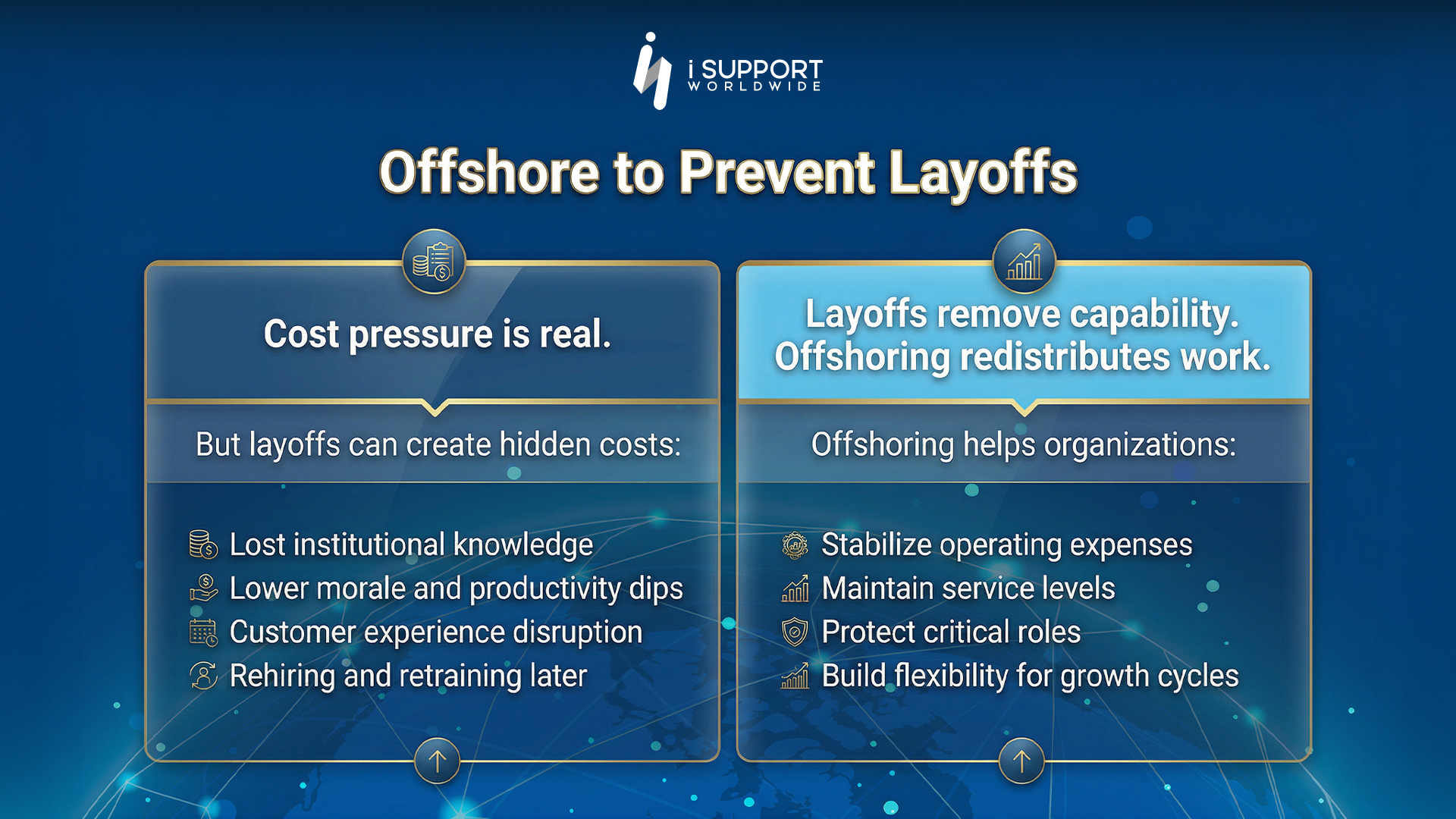
Layoffs reduce payroll on paper, but their true cost extends far beyond salaries. Following layoffs, companies see a dramatic decline in employee outlook; on average, confidence in the company, leadership, and career chances all fall by 10–17 percentage points, according to Harvard Business Review.
Severance, compliance requirements, productivity dips, and the erosion of institutional knowledge all compound the financial impact. Teams that remain often face burnout, uncertainty, and reduced engagement, which can quickly affect customers.
This is why more leaders are rethinking offshoring vs layoffs as a strategic decision rather than a last resort. Layoffs permanently remove capability. Offshoring, when done correctly, redistributes work in a way that preserves organizational strength.
Offshoring as a Strategic Alternative to Layoffs
Offshoring has traditionally been associated with scaling or expansion, but its value during periods of constraint is just as significant.
By shifting well-defined, repeatable tasks to offshore teams, companies can lower operating costs without dismantling their core structure.
For organizations looking for a true alternative to layoffs, offshoring offers flexibility. Instead of eliminating roles entirely, companies can retain onshore employees as process owners, subject matter experts, and quality leaders—while offshore teams handle execution at a lower cost base.. Instead of eliminating roles entirely, companies can retain onshore employees as process owners, subject matter experts, and quality leaders—while offshore teams handle execution at a lower cost base.
This model allows businesses to reduce labor costs without layoffs, protecting both financial health and company culture.
What Work Should Be Offshored First?
Not every role is a good fit for offshoring, especially during a stabilization phase. The goal is to move tasks, not judgment-heavy decision-making or leadership.
Common starting points include:
- Tier 1 customer support (email, chat, basic voice support)
- Back-office administration and data processing
- Finance operations support (AP/AR assistance, reconciliations)
- IT service desk and ticket triage
- Sales operations support (CRM updates, reporting, lead enrichment)
These functions are ideal for offshore staffing to cut costs because they are process-driven, measurable, and scalable without disrupting strategic oversight.
When leaders compare offshoring vs layoffs, these roles often represent the biggest opportunity for immediate savings with minimal risk.
The Hybrid Model That Protects Jobs
The most effective approach to offshore to prevent layoffs is not a full replacement model—it’s a hybrid one.
In this structure:
- Onshore employees shift into higher-value roles such as quality assurance, client interaction, escalation handling, and process optimization.
- Offshore teams focus on volume-driven execution.
- Clear documentation, training, and KPIs ensure consistency across locations.
This setup turns offshoring into an alternative to layoffs that strengthens collaboration rather than weakening it.
It also enables organizations to reduce labor costs without layoffs while increasing operational resilience.
How to Offshore Responsibly (Without Disruption)
Offshoring must be intentional to succeed. Companies that rush the process often struggle with quality or communication issues. A responsible approach includes:
1. Start With Task Mapping
Identify which tasks consume the most time and cost and assess their complexity and risk.
2. Pilot Before You Scale
Launch a small offshore team with structured onboarding, documented SOPs, and defined success metrics.
3. Put Governance in Place
Regular reviews, quality scorecards, and clear escalation paths are essential—especially when using offshore staffing to cut costs during sensitive periods.
4. Measure More Than Savings
Cost reduction matters, but so do turnaround time, accuracy, employee retention, and customer satisfaction.
When done right, this approach makes offshoring vs layoffs a clear choice rather than a difficult tradeoff.
Addressing Common ConcernsLeaders often worry about security, quality, and customer perception. These risks can be mitigated through role-based access controls, strict data governance, and consistent QA processes. In fact, many companies find that customers experience faster response times and better consistency after offshoring—especially when offshore teams operate as an extension of the business rather than a disconnected vendor. This reinforces offshoring as a credible alternative to layoffs, not a compromise. |
The Bigger Picture: Stability Over Short-Term Cuts
Choosing to offshore to prevent layoffs is ultimately about long-term thinking. Layoffs may offer immediate relief, but they often slow recovery and growth. Offshoring, by contrast, allows organizations to adjust cost structures dynamically while preserving talent and momentum.
For companies under pressure to reduce labor costs without layoffs, offshoring provides a path forward that balances financial discipline with human impact.
And when leaders weigh offshoring vs layoffs, the question becomes less about cutting costs and more about protecting the future of the business.
Looking for a smarter way to manage costs without cutting your workforce?
iSupport Worldwide helps organizations design offshore teams that reduce expenses, protect core roles, and maintain service quality. Connect with our team to explore an offshoring strategy built for stability, continuity, and long-term growth.