



Executive Summary
Constructive feedback is one of the most valuable tools for professional growth, but its effectiveness depends on how it is delivered and received. Poorly communicated feedback can create defensiveness, strain professional relationships, and weaken trust.
When feedback is delivered thoughtfully, it becomes a catalyst for growth, helping individuals improve performance, enhance teamwork, and contribute more effectively to organizational success. At iSupport Worldwide, employees are encouraged to learn, collaborate, and develop their careers in a supportive environment where open communication and professional growth are valued. Explore career opportunities with iSupport Worldwide and become part of a team that empowers people to thrive and succeed.
Feedback is a curious workplace currency because, unlike budgets, software licenses, or ergonomic office chairs, its value is determined less by what is given and more by how it is received, which means that even the most insightful observation can land with all the elegance of a dropped stapler if it is delivered without tact, empathy, and well-developed communication skills.
In today’s interconnected workplaces, the ability to provide constructive feedback without damaging trust has become one of the most important professional competencies a leader, manager, or colleague can possess.
Why does feedback often go wrong?
The irony of feedback is that most people offer it with positive intentions, yet many recipients experience it as criticism, judgment, or even an attack on their competence. When unaddressed, it slowly contributes to culture rot..
This disconnect occurs because human beings are wired to protect their sense of identity, and when feedback is delivered without sufficient context, empathy, or clarity, the brain often hears, “You have a problem,” when the speaker merely intended to say, “There’s an opportunity for improvement.”
The challenge becomes even more pronounced in organizations spread across countries and cultures, particularly within the offshoring industry and outsourcing industry, where teams frequently communicate through virtual channels, making it easier for misunderstandings to occur. A sentence that appears straightforward in one culture may feel unnecessarily blunt in another, transforming what was meant to be constructive feedback into an unintended source of tension.
This is precisely why strong communication skills are not merely a desirable trait but a strategic necessity. Effective feedback is rarely about pointing out flaws. It is about creating awareness while preserving dignity.
How can feedback be delivered effectively?
Understanding the importance of constructive feedback is one thing; delivering it in a way that strengthens trust, encourages improvement, and preserves professional relationships is another challenge entirely.
While every workplace interaction is unique, successful feedback conversations often follow a few common principles that help foster psychological safety, strengthen communication skills, and support healthy conflict resolution.
Whether you’re leading a team in an offshoring industry environment, collaborating within the outsourcing industry, or managing stakeholders in a global capability center, the following strategies can help ensure your feedback is received as guidance rather than criticism and as an opportunity rather than an obstacle.
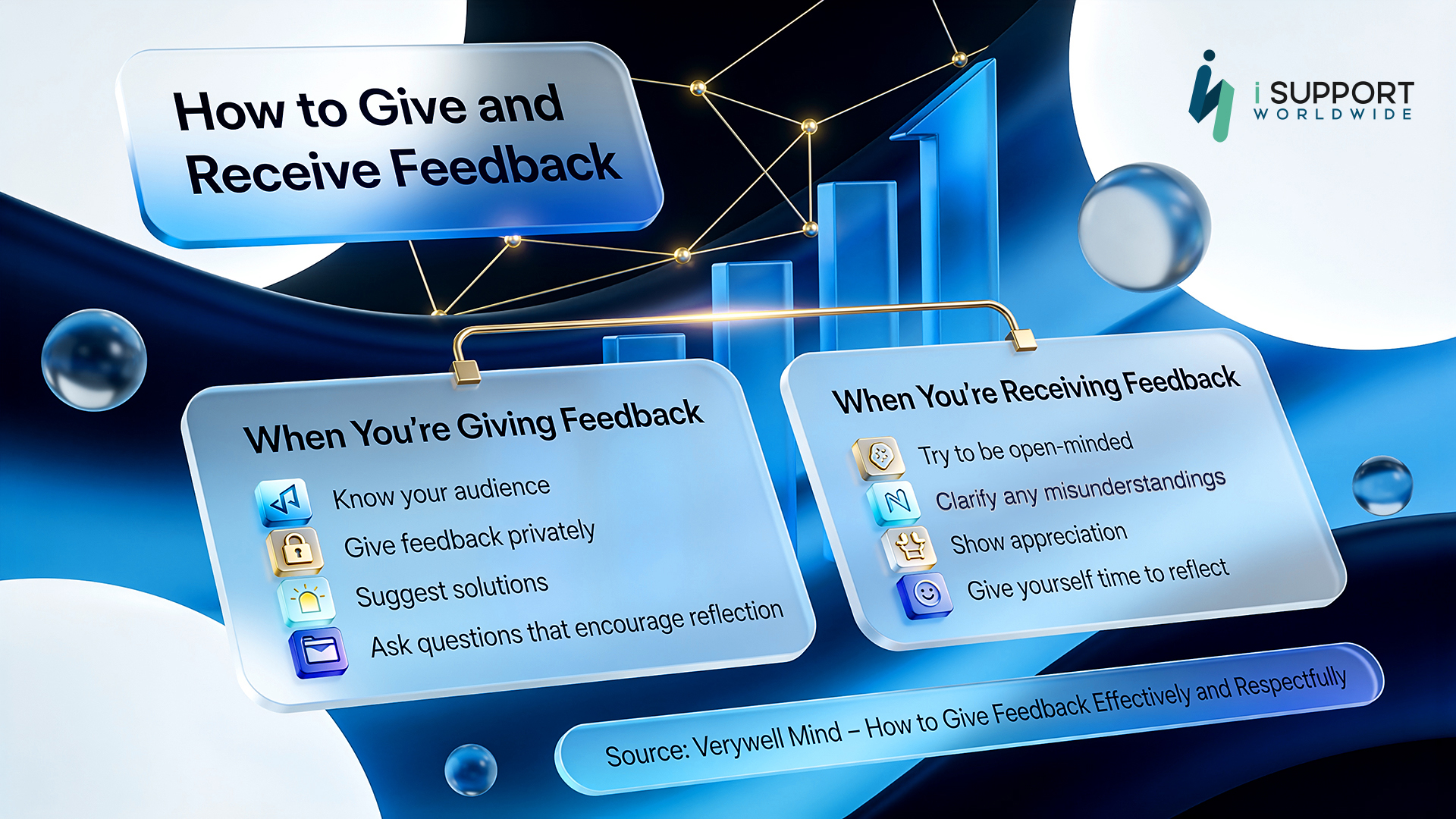
Verywell Mind identifies the following best practices for giving and receiving feedback effectively.
Improve the quality of your workplace relationships
Many professionals make the mistake of jumping directly into correction mode, treating feedback like a software update that simply needs installation, yet people are not operating systems, and relationships cannot be upgraded through force.
Before delivering constructive feedback, consider the quality of your existing professional relationships. When trust is strong, individuals are more likely to interpret input as support rather than criticism. When trust is weak, even the most carefully worded suggestion may be viewed with suspicion.
Think of trust as the emotional bandwidth that allows feedback to travel smoothly between people. Without it, every comment encounters resistance. With it, even difficult conversations become significantly more productive.
Employees who feel respected and valued often assume positive intent, which allows feedback discussions to focus on improvement rather than self-defense. Strong professional relationships create an environment where growth conversations feel collaborative instead of confrontational.
Focus on the behavior instead of the personality
One of the quickest ways to damage a relationship is to attach feedback to someone’s character rather than their actions.
Saying, “You’re careless,” transforms a specific issue into a personal label. Saying, “The report contained several data inconsistencies that affected accuracy,” focuses on observable behavior and opens the door to discussion and improvement.
This distinction may appear subtle, but it dramatically influences how feedback is received. Effective constructive feedback concentrates on actions, outcomes, and opportunities rather than assumptions about personality traits.
Create psychological safety before seeking accountability
Many leaders believe accountability comes first, but the most effective workplaces understand that psychological safety is the foundation upon which accountability is built.
Psychological safety refers to an environment where individuals feel comfortable expressing ideas, asking questions, admitting mistakes, and receiving feedback without fear of humiliation or punishment.
When this environment exists, people become more receptive to constructive feedback because they believe the conversation is intended to help them succeed rather than expose their shortcomings.
Imagine trying to teach someone to swim while simultaneously convincing them that the water is full of sharks. The lesson would not be particularly effective. Similarly, feedback struggles to achieve results when individuals feel threatened. Employees who feel secure are more likely to listen, learn, and improve.
Use curiosity as a conflict resolution tool
One of the most underrated components of conflict resolution is curiosity.
When performance issues arise, many managers approach conversations with conclusions already prepared, effectively turning feedback sessions into courtroom proceedings where the verdict has already been decided. A more productive approach is to ask questions before making assumptions.
Instead of saying, “You missed the deadline,” consider asking, “What challenges affected the timeline?”
Instead of declaring, “Your communication was unclear,” ask, “How did you approach explaining the project requirements?”
Questions create dialogue. Accusations create defenses.
This approach significantly strengthens communication skills because it shifts feedback from a monologue to a conversation. It also supports effective conflict resolution, allowing both parties to explore root causes rather than merely debate symptoms.
Balance honesty with empathy
Many people struggle with feedback because they believe they must choose between being kind and being honest. Fortunately, effective feedback does not require such a choice.
Honesty without empathy can feel harsh. Empathy without honesty can feel unhelpful.
The sweet spot exists where both qualities coexist.
You can acknowledge effort while discussing improvement opportunities. You can recognize strengths while addressing challenges. You can deliver difficult messages without diminishing someone’s confidence.
The best constructive feedback leaves people with a clearer understanding of expectations while preserving their sense of capability and self-worth.
Make feedback an ongoing conversation
Perhaps the greatest mistake organizations make is treating feedback like an annual event instead of an ongoing process.
Feedback should resemble navigation rather than archaeology. The goal is to help people adjust their direction in real time, not to excavate mistakes from six months ago and present them like historical artifacts.
Regular conversations foster stronger communication skills, improve conflict resolution, reinforce psychological safety, and strengthen professional relationships. They also make feedback feel normal rather than intimidating.
Ultimately, giving feedback without damaging relationships is not about mastering a script or memorizing a management framework. It is about demonstrating respect, practicing empathy, communicating clearly, and creating an environment where learning is valued over blame.
Give meaningful and specific feedback
Effective feedback should be clear, focused, and actionable.
According to Gallup, meaningful feedback helps employees understand what they are doing well and where they can improve. Vague comments or broad evaluations often fail to drive meaningful change because they do not reflect an individual’s unique strengths, contributions, and daily responsibilities.
Instead, feedback should be specific, relevant, and tied to observable behaviors or outcomes so that employees can better understand expectations and take concrete steps toward growth and development.
What should be avoided when giving feedback?
While effective constructive feedback can strengthen teams and improve performance, certain behaviors and phrases can have the opposite effect, creating unnecessary tension, weakening professional relationships, and eroding psychological safety.
Here are some common pitfalls to avoid:
Avoid using absolute words such as “always” and “never. These statements often sound exaggerated and accusatory, making it more difficult for the recipient to stay open-minded and receptive to the conversation
Avoid criticizing the person instead of the behavior.
Personal criticism can feel like an attack on someone’s character, which may trigger defensiveness and distract from the actual issue that needs to be addressed.
Avoid giving negative feedback in public.
Public criticism can cause embarrassment and damage trust, ultimately affecting team morale and weakening professional relationships.
Avoid making assumptions about intentions.
Assuming motives shifts the discussion away from facts and can create misunderstandings, making conflict resolution more challenging.
Avoid delivering feedback when emotions are running high.
Emotional conversations are more likely to focus on frustration rather than solutions, reducing the effectiveness of the feedback.
Avoid vague statements that offer no clear direction.
Feedback is most valuable when it provides clarity, and vague comments leave individuals unsure about what needs to improve.
Avoid turning the conversation into a lecture.
Effective feedback should encourage two-way communication, allowing both parties to share perspectives and work toward a common understanding.
Avoid comparing your colleagues to one another.
Comparisons can create resentment, lower morale, and foster unhealthy competition instead of collaboration.
Avoid overwhelming someone with a long list of mistakes.
Addressing too many issues at once can feel discouraging and make it difficult for the individual to identify and prioritize improvements.
Avoid ending the conversation without discussing next steps.
Feedback should provide a path forward, helping the recipient understand expectations and how they can achieve success moving forward.
How iSupport Worldwide promotes growth through constructive feedback
At iSupport Worldwide, constructive feedback is viewed not as a tool for criticism, but as a catalyst for continuous growth, professional development, and stronger workplace relationships.
By fostering open communication and encouraging employees to engage in respectful, solution-oriented conversations, the company helps create an environment where feedback becomes a valuable part of everyday collaboration rather than a source of anxiety.
This commitment to honest yet supportive dialogue strengthens communication skills, reinforces psychological safety, and empowers team members to learn from challenges while building on their strengths.
If you’re looking for a workplace that values collaboration, encourages constructive feedback, and supports your professional development every step of the way, explore career opportunities with iSupport Worldwide and become part of a team.
About the Author Shekina P. Malonzo is a Licensed Professional Teacher and multifaceted Content Developer at iSupport Worldwide, specializing in creating tailored materials for the offshoring industry. |
Founded in 2006, iSupport Worldwide is a US-owned offshoring leader based in the Philippines, delivering tailored solutions to enhance operational efficiency and exceed client expectations. Recognized on the Inc. 5000 list of America’s fastest-growing private companies for three consecutive years, honored in Inc. Magazine’s Power Partner Awards, and a recipient of the ACES Award for Inspiring Workplaces in Asia, iSupport Worldwide embodies a commitment to excellence. |