



Executive Summary
Many businesses hit a scale ceiling when demand outpaces their ability to hire, support customers, and manage operations efficiently. Growth stalls as costs rise and internal bottlenecks limit capacity. By leveraging dedicated teams through outsourcing to the Philippines, companies can access skilled talent, increase operational flexibility, reduce hiring costs, and build the capacity needed to scale sustainably while maintaining service quality and protecting profitability., companies can access skilled talent, increase operational flexibility, reduce hiring costs, and build the capacity needed to scale sustainably while maintaining service quality and protecting profitability.
Introduction
You’re growing but your revenue isn’t.
That gap is one of the clearest signs you may have hit a scale ceiling: the point where demand is still there, but your internal structure can’t keep up. When sales growth stalls, the problem is often not the market. It’s the model behind growth.
When systems, roles, and cost structures can’t keep pace with demand, growth flattens. Here’s how to diagnose that ceiling and break through it using modern scaling strategies: offshoring and outsourcing to the Philippines.
What is the scale ceiling?
The scale ceiling is the invisible limit where revenue growth stalls despite continued effort. You can generate more leads, run more campaigns, and hire faster, yet bookings and ARR stop rising. That’s not market failure; it’s an operational constraint.
The scale ceiling appears when your people, processes, and cost base aren’t built to scale in repeatable, efficient ways.
Instead of scaling smoothly, every new lead, hire, or process adds friction.
Signs you’ve hit the scale ceiling
- Revenue plateaus while lead volume or spend increases.
- Customer acquisition costs (CAC) rise unexpectedly.
- Hiring bottlenecks slow new market entry or product rollouts.
- Sales reps are overloaded; conversion rates drop.
- Tools and processes fail under higher transaction volume.
Why the scale ceiling happens
Operational bottlenecks
Manual workflows and limited automation create throughput limits. When too much of sales still depends on people doing repetitive tasks by hand, capacity runs out quickly. Add a high-cost local team structure, and expansion becomes expensive before it becomes efficient.
Absence of an offshoring strategy reduces available capacity and flexibility. Without access to dedicated teams that can support sales operations, lead generation, customer service, and administrative tasks, businesses often struggle to scale efficiently.
Talent and cost constraints
AI is changing workflows, but it is not eliminating large-scale demand for human support roles. Many businesses hit a hiring wall long before demand disappears. The challenge is not only finding talent but finding enough of it fast enough and at a cost that still supports healthy margins.
Overlooking outsourcing to the Philippines means missing a deep, scalable talent pool known for sales support, BPO, and technical roles. By leveraging dedicated teams in the Philippines, organizations can access skilled professionals, expand capacity quickly, and maintain cost efficiency while supporting sustainable growth.
Structural limitations
A business that relies only on local hiring or founder-led selling can scale only so far. Without a distributed delivery model such as outsourcing to the Philippines, capacity stays centralized and fragile. The result is a sales function that works at a smaller size but strains under expansion.
Strategy misalignment
- Document repeatable sales processes (from lead qualification to handoff).
- Automate routine tasks: lead enrichment, follow-ups, scheduling, and reporting.
- Adopt tools that scale (CRM automation, cadence platforms, shared knowledge bases).
Impact: Reduces variability and increases throughput per headcount.
The Breakthrough Framework: The 4 Levers of Scale Breakthrough
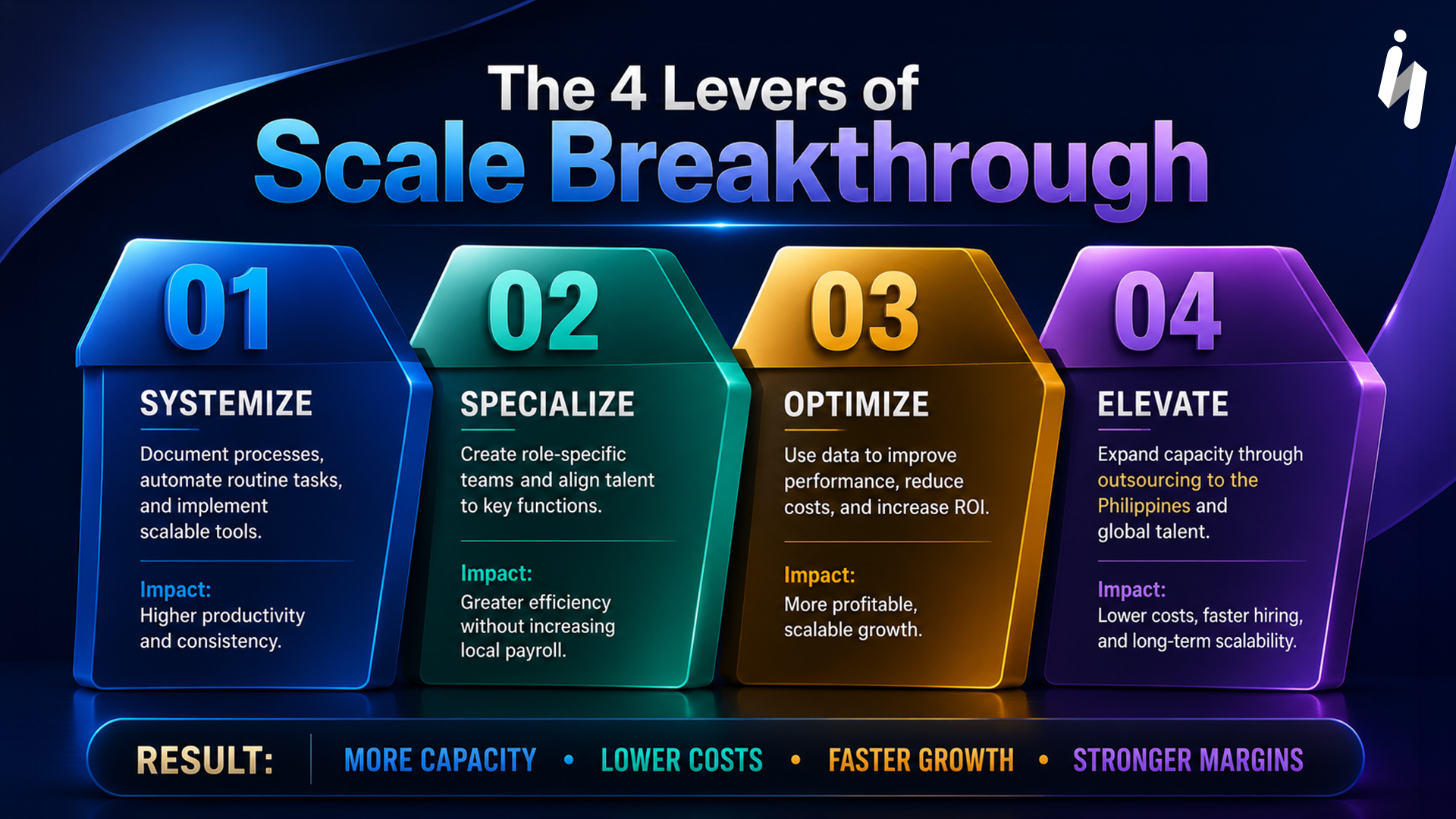
You can think of breaking the scale ceiling as pulling four levers: Systemize, Specialize, Optimize, Elevate.
1. Systemize
- Document repeatable sales processes (from lead qualification to handoff).
- Automate routine tasks: lead enrichment, follow-ups, scheduling, and reporting.
- Adopt tools that scale (CRM automation, cadence platforms, shared knowledge bases).
Impact: Reduces variability and increases throughput per headcount.
2. Specialize
- Move from “one-size” reps to role segmentation (SDRs, AEs, CS, renewals).
- Create small, focused pods around industry or buyer persona.
- Use dedicated offshore teams to expand capacity for specific roles (outbound SDRs, customer support, sales ops).
Impact: Improves efficiency and skill concentration without inflating local payroll.
3. Optimize
- Use data to find highest-converting motions and double down.
- Align cost structures with unit economics (LTV: CAC targets, pay mix for offshore vs onshore).
- Run ramp experiments with hybrid teams and measure lead-to-close times.
This ensures every hire and tool contributes to margin-positive growth.
4. Elevate (Globalize Your Operations)
- Expand hiring beyond local constraints; treat global talent as part of the core operating model.
- Evaluate outsourcing to the Philippines for high-quality, cost-effective talent in SDR, customer success, finance, and tech support.
- Consider a centralized offshore pod like revops, finance, and talent services—building long-term capability and institutional knowledge offshore.
It unlocks scalable, lower-cost capacity and builds a durable global talent engine.
Why the Philippines is often the practical choice
Even with the quick uptake of AI, the Philippine contact center and business process management sector added over 60,000 jobs in 2025, showing that automation is not replacing the need for global talent at scale.
- Talent depth: Large, English-proficient workforce with experience across B2B sales support and back-office functions.
- Cost efficiency: Lower total employment cost compared to US/EU equivalents, improving unit economics scale.
- Cultural fit: High customer-facing skills and alignment with Western business norms.
- Proven outsourcing ecosystem: Training partners, BPO experience, and established compliance frameworks make ramping faster and less risky.
Real-world example
A mid-market SaaS company doubles marketing spend and signs more inbound leads, but bookings flatline because hiring locally for SDRs and onboarding takes 4–6 months.
Action:
- Systemized qualification criteria and playbooks.
- Hired an SDR pod in the Philippines focused on lead qualification and initial demos.
- Moved routine admin and reporting to an offshore pod finance and ops center.
- Implemented weekly performance dashboards and ramp templates.
Result: Qualification throughput increased 2.5x, cost per qualified lead fell 40%, and sales velocity recovered—restoring sustainable ARR growth within three quarters.
Practical steps to break your scale ceiling
- Audit where you’re constrained: people, process, or cost. Identify the single biggest bottleneck this quarter.
- Map roles that can be outsourced: SDRs, lead ops, customer success, billing, and technical support.
- Pilot a small pod (3–6 seats) focused on one high-leverage function with clear KPIs.
- Evaluate the Philippines as a strategic hub: recruitment partners, legal/employment frameworks, and training plans.
- Consider a GCC when you need centralized, mission-critical capabilities with long-term ownership. Start with a hybrid model to mitigate risk.
- Align leadership on global scaling: set unified metrics, shared scorecards, and a 90-day roadmap for the pilot to prove ROI.
Risks and how to manage them
- Onboarding & quality gaps: Mitigate with documented playbooks, shadowing, and QA cadence.
- Cultural and communication friction: Hire local leads, invest in cross-cultural training, and set clear meeting rhythms.
- Compliance and security: Use vetted partners, local legal counsel, and robust data controls when handling customer data.
Why iSupport Worldwide Helps Businesses Scale
Breaking through a scale ceiling requires more than adding headcount. It requires building a workforce model that can grow alongside the business.
iSupport Worldwide helps companies scale by providing access to dedicated teams in the Philippines that integrates with existing workflows, systems, and performance standards.
We focus on building long-term dedicated teams that support critical functions such as customer service, finance, administrative operations, IT, healthcare support, and back-office processes.
This approach helps businesses increase capacity, reduce labor costs, accelerate hiring, and protect margins while maintaining service quality, enabling sustainable growth without the limitations of relying solely on local hiring.
Conclusion
Hitting a sales plateau rarely means demand is gone. More often, your structure, systems, and talent model form an internal ceiling. Breaking it requires a deliberate shift: systemize, specialize, optimize, and elevate your operations globally. Distributed models such as outsourcing to the Philippines and building dedicated teams are not shortcuts. They are strategic levers that expand capacity, reduce costs, and create repeatable growth engines.
Ready to break your scale ceiling?
Discover how dedicated teams and an outsourcing strategy can unlock your next growth phase. Talk to us about building your team in the Philippines or assess your scale readiness.
About the Author Denise Romero works as a copywriter at iSupport Worldwide, where she specializes in B2B content that helps businesses flourish. She specializes in creating clear, compelling messages that engage professional audiences and support strategic marketing goals. |
Founded in 2006, iSupport Worldwide is a US-owned offshoring leader based in the Philippines, delivering tailored solutions to enhance operational efficiency and exceed client expectations. Recognized on the Inc. 5000 list of America’s fastest-growing private companies for three consecutive years, honored in Inc. Magazine’s Power Partner Awards, and a recipient of the ACES Award for Inspiring Workplaces in Asia, iSupport Worldwide embodies a commitment to excellence. |