



Executive Summary
The helps organizations scale through global talent, distributed execution, and dedicated Manila teams, enabling leaders to maintain full control while accelerating growth, agility, and workforce scalability.
Introduction
The companies scaling fastest today are not necessarily those with the biggest offices or the largest local talent pools. Instead, they are the organizations that have mastered a new way of leading: one that transcends geography, embraces global talent, and enables high-performance execution across borders.
This approach is known as the hybrid global leadership model.
As businesses expand into new markets, embrace remote work, and compete for increasingly scarce talent, traditional leadership structures are struggling to keep pace.
Research from Deloitte’s 2024 Global Human Capital Trends study shows that organizations are operating in a more “boundaryless” work environment, requiring leaders to rethink governance, collaboration, and workforce strategy.
Leaders can no longer rely on proximity to drive collaboration, accountability, or culture. Success now depends on the ability to manage distributed teams while maintaining strategic alignment across the organization.
The hybrid global leadership model offers a solution. By combining centralized leadership with distributed execution, organizations gain access to worldwide talent, improve operational agility, and create a scalable foundation for growth.
What Is the Hybrid Global Leadership Model?
The hybrid global leadership model is a workforce management approach that combines centralized strategic leadership with geographically distributed teams and operations.
In this model, executive leadership remains responsible for vision, decision-making, governance, and business priorities. Meanwhile, execution is distributed across regional offices, outsourced employees, outsourced functions, and dedicated offshore teams.
Rather than viewing location as a limitation, organizations structure leadership around outcomes, accountability, and collaboration. Technology platforms, standardized processes, and clear communication frameworks ensure that all teams stay aligned regardless of time zone or geography.
This model has become increasingly relevant as businesses seek greater flexibility and access to specialized talent that may be difficult or expensive to source locally.
A company may maintain executive leadership in North America while expanding operations through global specialists, distributed project teams, or dedicated offshore professionals in other regions. Leadership remains centralized, but delivery and execution occur globally.
The result is a scalable operating model that supports growth without sacrificing visibility, control, or quality.
Why Traditional Leadership Models Struggle to Scale
Many leadership structures were designed for a workforce that operated primarily from a single office or geographic region. While these models may have been effective in the past, they often struggle to support modern business demands.
Organizations commonly encounter five major challenges.
1. Limited Access to Talent
One of the biggest challenges is talent availability. Organizations competing for the same local talent pools frequently face hiring delays, rising labor costs, and skill shortages.
2. Slower Workforce Scalability
As businesses grow, local hiring alone may not provide the speed or flexibility needed to support expansion. Organizations often struggle to scale operations quickly enough to meet market demands.
3. Limited Operational Agility
At the same time, business growth increasingly requires around-the-clock operations, faster execution cycles, and access to specialized expertise. Traditional office-centric leadership models can create bottlenecks when teams are expected to be physically present or concentrated in one location.
4. Communication and Coordination Complexities
Communication complexity is another challenge. As organizations expand internationally, relying on informal management practices becomes increasingly risky. Without structured leadership frameworks, companies can experience misalignment, inconsistent decision-making, and reduced accountability.
5. Rising Operational Costs
There is also growing pressure to achieve more with leaner resources. Leaders must balance cost efficiency with business performance while maintaining employee engagement and operational excellence.
These realities have driven many organizations to explore new workforce models that incorporate dedicated offshore teams, outsourcing partnerships, and global talent strategies.
However, these approaches only succeed when supported by leadership systems designed to manage distributed teams effectively.
The Five Pillars of Effective Hybrid Global Leadership
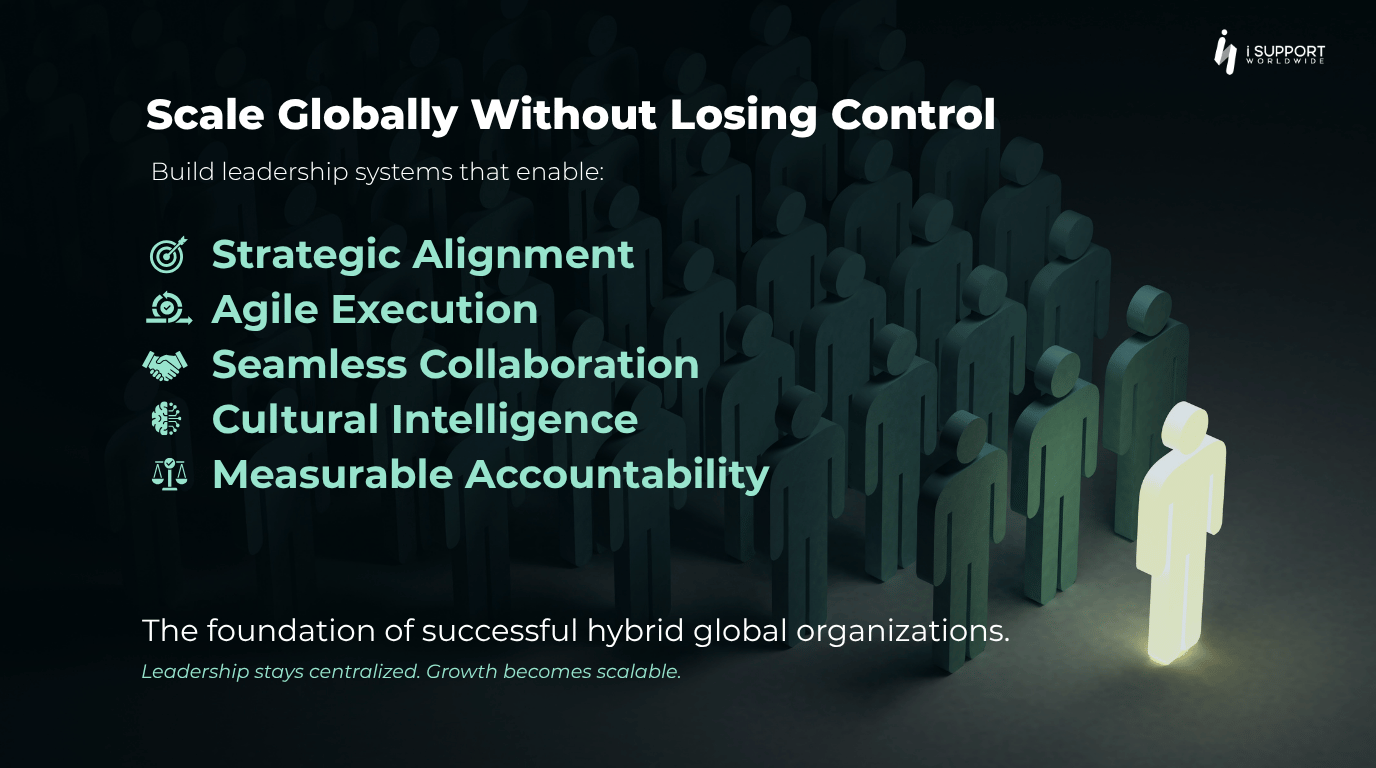
Organizations that excel in distributed workforce management typically build their leadership strategy around five core principles.
1. Centralized Strategic Direction
Successful global organizations maintain a unified vision, clear goals, and consistent leadership standards. While teams may operate across multiple regions, strategic priorities remain centralized.
This ensures everyone is working toward the same business objectives.
2. Distributed Operational Execution
Execution is delegated to the teams closest to the work, customers, or market opportunities.
This distributed approach improves speed, agility, and responsiveness while allowing organizations to leverage specialized expertise across different locations.
Dedicated offshore teams often play an important role in this structure by providing additional capacity and specialized skills that support growth initiatives.
For example, iSupport Worldwide builds dedicated Manila teams that operate as an extension of U.S. businesses without requiring them to incorporate, directly employ staff, or manage a Philippine-based office. This allows leadership to retain full control over strategy, priorities, culture, and performance while expanding access to highly skilled global talent.
The key advantage is that leadership remains centralized while execution becomes scalable. Organizations gain the flexibility to grow operations, increase capacity, and access specialized talent without adding unnecessary management complexity.
3. Technology-Enabled Collaboration
Modern leadership depends on digital collaboration.
Cloud-based platforms, project management tools, communication systems, and workforce analytics enable teams to collaborate effectively regardless of location.
The right technology creates transparency, improves decision-making, and helps leaders maintain visibility across global operations.
4. Cross-Cultural Leadership Capability
Effective global leadership requires more than operational management. Leaders must understand how to navigate cultural differences, communication styles, and regional work practices.
Organizations that develop cultural intelligence often experience stronger collaboration, improved employee engagement, and better team performance.
5. Structured Accountability
Scalability depends on accountability.
High-performing global organizations establish clear roles, measurable outcomes, and performance frameworks that focus on results rather than physical presence.
When expectations are clearly defined, distributed teams can operate with greater autonomy while remaining aligned with broader business goals.
Building a Workforce Designed for Global Growth
The future of workforce management is not about choosing between office-based employees and remote teams. It is about creating leadership systems capable of supporting both.
Organizations that embrace the gain access to broader talent markets, improve workforce flexibility, and build greater resilience in an increasingly competitive environment.
This approach creates opportunities to scale more efficiently through strategic workforce solutions, including outsourced staffing, dedicated offshore teams, and specialized outsourcing partnerships.
Rather than being viewed as staffing alternatives, these outsourcing solutions become integral components of a larger talent and growth strategy.
For example, companies can build dedicated Manila teams that function as a seamless extension of their existing operations while leadership maintains full oversight and control, eliminating the need to establish a local entity or manage an overseas office.
Ultimately, companies that scale successfully are no longer defined by where their employees are located. They are defined by how effectively their leaders manage talent across borders, cultures, and time zones.
As global competition intensifies and workforce expectations continue to evolve, leadership will become one of the most important differentiators between organizations that struggle to scale and those that thrive.
Building a Workforce Designed for Global Growth
If your organization is exploring new ways to access talent, improve operational flexibility, and support long-term growth, now is the time to evaluate your workforce strategy. Discover how a modern leadership framework, combined with dedicated offshore teams and global talent solutions, can help your business scale efficiently while maintaining alignment, accountability, and performance.
Book a no-obligation consultation to explore the right global talent model for your organization.
About the Author |
| Denise Romero works as a copywriter at iSupport Worldwide, where she specializes in B2B content that helps businesses flourish. She specializes in creating clear, compelling messages that engage professional audiences and support strategic marketing goals. |