



Executive Summary
Ghost growth happens when professionals take on more responsibilities, increased visibility, and higher expectations without a corresponding change in compensation, title, or authority. While it can resemble progress on the surface, it often reflects a lack of structured career development rather than true advancement.
Companies like iSupport Worldwide offer career opportunities built on measurable performance and aligned expectations within dedicated teams so professionals can clearly see how their work drives real business results and career growth.
You’re growing fast, or at least… it looks that way.
More tasks. More ownership. More expectations.
But when it comes to your title, salary, and career direction? Nothing changed.
You are experiencing “ghost growth”
Forbes defines ghost growth as “the illusion of career advancement without a comparable raise, promotion, or increase in authority.”
Take a moment to evaluate your situation with these three questions:
Question 1: If I resign tomorrow, would my replacement be hired at a higher level than me?
If yes, you’ve likely outgrown your role. Many employees are carrying responsibilities far beyond their job grades, yet when they leave, companies suddenly open a higher job opening position to replace them.
Question 2: Has my responsibility increased but my compensation or title hasn’t?
Increased scope should trigger a re-evaluation of your role. If it doesn’t, the organization may be benefiting from output without formal recognition.
Question 3: Can my immediate supervisor clearly explain my path to promotion?
The answer shouldn’t be a generic statement. Not “soon,” “we’re working on it,” or “just keep going.”
A real answer sounds like:
- “You need to deliver X metric.”
- “Complete Y leadership milestone.”
- “The target promotion timeline is within Z months.”
If that clarity isn’t there, you’re relying on assumptions instead of a defined path.
What does career growth look like?
A lot of professionals in the Philippine job market stay longer than they should because the appearance of progress feels close enough to real progress, but here’s the reality experienced professionals eventually recognize:
- More work is not a promotion
- Visibility is not a career path
- Trust is not compensation
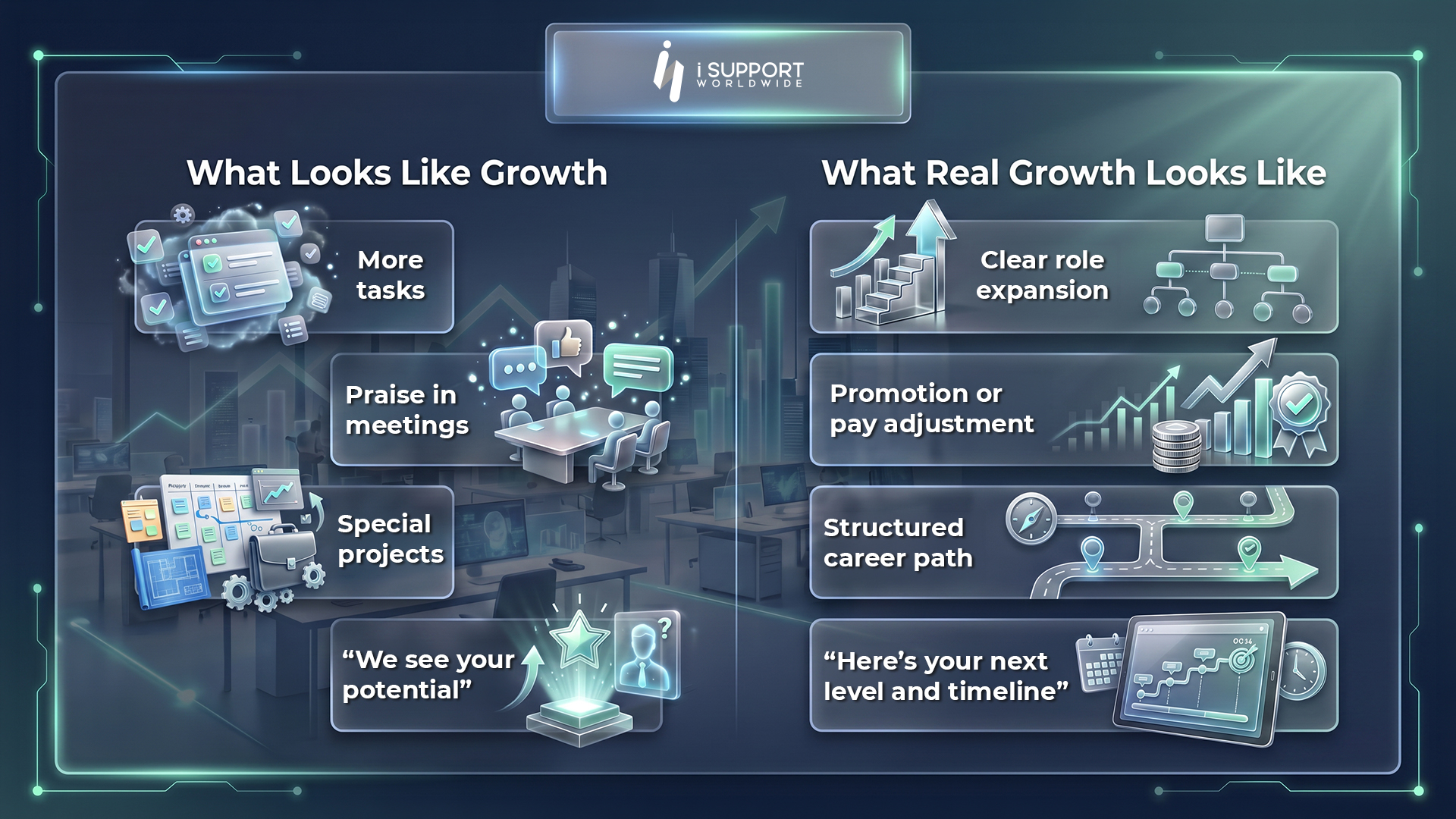
Real career growth opportunities are concrete and measurable. Without that, what you have is performance being rewarded with more expectations instead of advancement.
Here’s what you can do
If your role has expanded but your career hasn’t, it’s not something you should ignore. Growth should be intentional, measurable, and aligned with clear outcomes, not just reflected in how busy you are.
The good news is, there are practical steps you can take to regain clarity, advocate for your value, and move your career forward with purpose.
Here’s what you can do
If your role has expanded but your career hasn’t, it’s not something you should ignore. Growth should be intentional, measurable, and aligned with clear outcomes, not just reflected in how busy you are.
The good news is, there are practical steps you can take to regain clarity, advocate for your value, and move your career forward with purpose.
Start tracking your value
High-performing professionals often assume their work speaks for itself. In reality, it doesn’t… at least not in a way that drives decisions on promotion or compensation.
What matters in most organizations is documented business impact.
Track your contributions in terms of outcomes:
- Projects delivered with measurable results
- Improvements in efficiency, quality, or turnaround time
- Revenue or cost impact
- Any leadership responsibility, even if informal
For example:
- Instead of: “Handled client communications”
- Position it as: “Managed a U.S.-based client portfolio, reduced response time by 30%, and improved retention metrics”
Decisions around career growth opportunities are typically based on measurable results. When your impact is clear, your value becomes harder to overlook.
Ask for clarity on the path forward
Instead of seeking reassurance, focus on alignment.
Do not ask: “Am I doing a good job?”
Ask: “What specific outcomes or milestones are required for me to move to the next level?”
Look for answers that include:
- Defined metrics or deliverables
- A realistic timeline
- A clear expansion of responsibility or scope
If those elements are missing, it often indicates that progression is not formally structured.
In practice, this means your growth depends more on timing or internal decisions than on your performance. And over time, that lack of structure can directly affect both your career development and long-term job satisfaction.
Recognize when the environment is the limiting factor
Even high performance does not guarantee progress if the system itself is not designed to support advancement.
But experience eventually makes one reality clear: you can perform at a high level and still remain in the same position if the system around you isn’t designed for progression.
Based on the data presented by MyPerfectResume, performative career development can lead to attrition:
- 68% considered leaving their jobs due to superficial or performative growth, such as receiving promotions without corresponding pay increases
- 27% already resigned for the reason stated above
- 41% admitted they stayed but still entertained the idea of quitting
- 39% took on additional responsibilities in hopes of advancing yet received little to no recognition.
- 31% described the experience as disappointing
In these situations, the solution is not always to work harder or try to perform better; it is to recognize that the environment itself may be the constraint, and to actively choose one that is built to support real progress and career development.
What to look for in a growth-oriented environment
Some companies are starting to move away from surface-level progression and focusing more on structured, measurable career development.
That shift often comes down to how teams are built and managed.
iSupport Worldwide operates on a dedicated team model, where Filipino professionals work directly within a global capability center as part of a long-term team. Instead of being placed into shared environments or task-based roles, you are aligned to specific workflows, systems, and expectations.
In practical terms, that changes how growth happens.
- Your role is defined based on real business needs, not generic job scopes
- Your performance is tied to measurable outcomes within client operations
- Your responsibilities expand within a structured environment, not informally over time
Because teams are integrated into client systems, expectations are clearer. You know what success looks like. You understand how your output connects to business results. And that clarity creates more grounded career growth opportunities.
From a career perspective, it offers a different experience compared to traditional outsourcing:
- You work within a dedicated team
- You operate under clear workflows, KPIs, and standards
- You gain exposure to how international companies run their day-to-day operations
Just as important, the environment is designed to support consistency. A company with a healthy workplace culture does not rely on informal recognition or assumptions about growth. It builds systems around role clarity, accountability, and ongoing support.
When your environment is built for clarity, your growth starts becoming intentional.
About the Author Shekina P. Malonzo is a Licensed Professional Teacher and multifaceted Content Developer at iSupport Worldwide, specializing in creating tailored materials for the offshoring industry. |
Founded in 2006, iSupport Worldwide is a US-owned offshoring leader based in the Philippines, delivering tailored solutions to enhance operational efficiency and exceed client expectations. Recognized on the Inc. 5000 list of America’s fastest-growing private companies for three consecutive years, honored in Inc. Magazine’s Power Partner Awards, and a recipient of the ACES Award for Inspiring Workplaces in Asia, iSupport Worldwide embodies a commitment to excellence. |