



Executive Summary
Career complacency often develops gradually, making it one of the most difficult obstacles to recognize in professional life. While it may appear as stability and comfort, complacency can lead to stagnant skills, reduced professional visibility, a weakening personal brand, and fewer career advancement opportunities.
At iSupport Worldwide, growth is more than a career goal. It’s part of the culture. Through exposure to global clients, dynamic projects, collaborative dedicated teams, and opportunities to develop new skills, professionals are empowered to keep learning, evolving, and unlocking their full potential. If you’re ready to move beyond comfort and take the next step in your career journey, iSupport Worldwide provides opportunities where growth never stands still.
Career setbacks are often imagined as dramatic events: a missed promotion, an unexpected layoff, or an ambitious project that crashes and burns in spectacular fashion. Yet one of the most dangerous threats to professional growth arrives with far less fanfare, settling quietly into daily routines until it becomes difficult to distinguish comfort from complacency. Unlike obvious career obstacles, complacency often disguises itself as stability, making it particularly difficult to recognize before opportunities begin slipping away.
What does it mean to be “complacent”?
Career complacency refers to a state in which professionals become overly comfortable with their current position, responsibilities, or skill set, causing them to stop seeking growth, learning opportunities, and career advancement. It is not necessarily a sign of laziness or lack of talent; rather, it is the gradual acceptance of the status quo, even when greater possibilities exist beyond it.
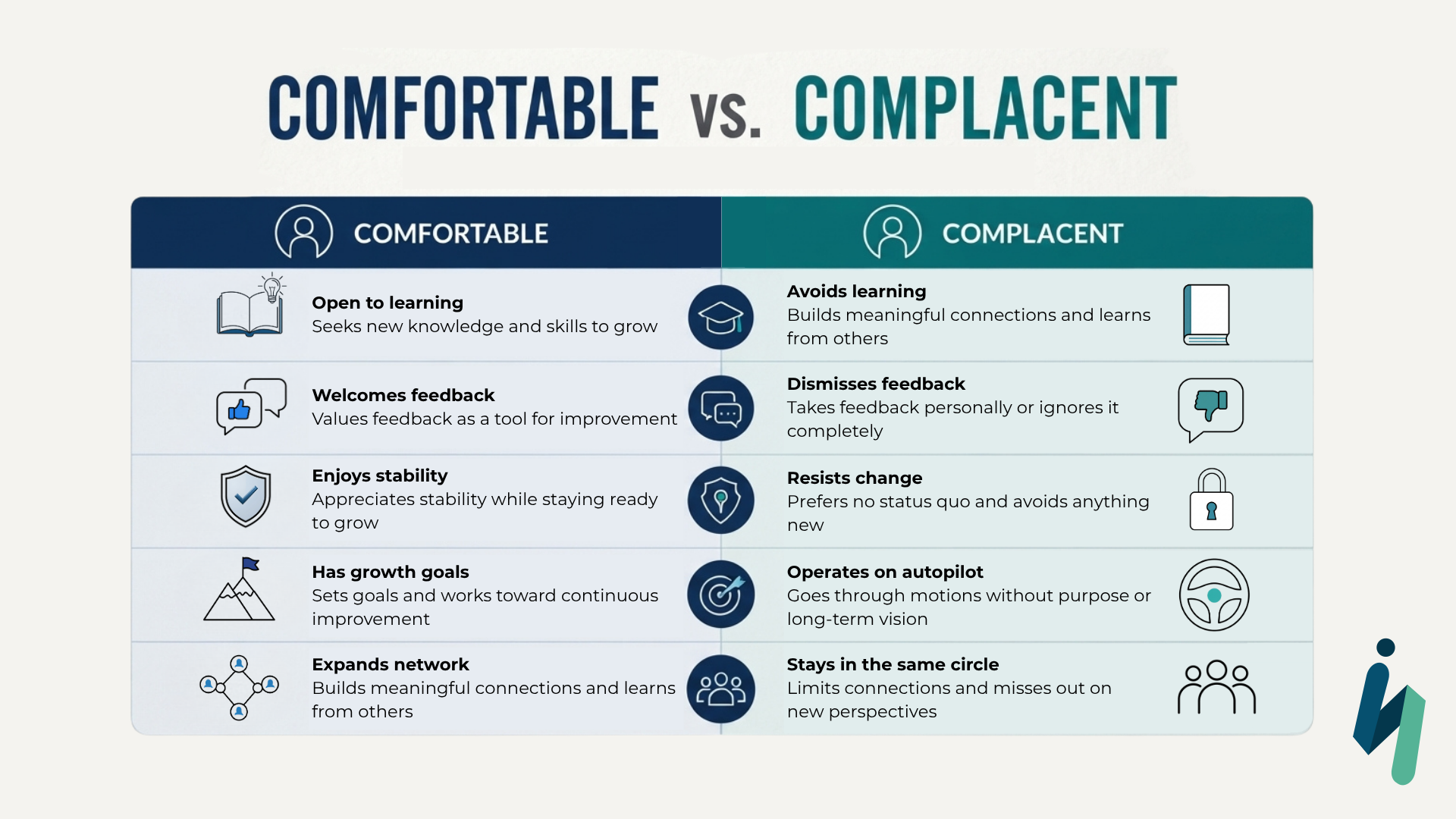
It is important to distinguish career complacency from genuine career satisfaction. Being content means appreciating your current role while remaining open to growth, innovation, and new challenges. Stagnation, on the other hand, occurs when comfort becomes a permanent residence rather than a temporary resting place, leaving professional development parked in the same spot while the workforce continues moving forward.
Why do we become complacent?
Career complacency rarely develops overnight. More often, it is the result of subtle habits and mindsets that accumulate over time.
Fear of change
Change can feel like stepping onto a bridge that disappears into the fog, especially when the current situation offers a predictable paycheck, manageable responsibilities, and familiar colleagues. Many professionals remain in their comfort zones because pursuing a promotion, switching industries, or adopting new technologies introduces uncertainty, and uncertainty often feels riskier than standing still.
The irony, however, is that avoiding change may ultimately create greater risk than embracing it. Industries evolve, skill requirements shift, and organizations transform, meaning the comfort of today may become the vulnerability of tomorrow.
Routine and predictability
There is undeniable comfort in knowing exactly how each workday will unfold, but when every week begins to resemble a photocopy of the previous one, professional growth can quietly stall. Familiar routines create efficiency, yet they can also discourage exploration, innovation, and learning.
Many employees fall into a pattern where they complete tasks exceptionally well but rarely venture beyond them, eventually becoming experts in yesterday’s requirements rather than tomorrow’s opportunities.
Lack of clear career goals
Without clear objectives, careers can drift much like a ship without a destination, moving but not necessarily progressing. Professionals who do not regularly evaluate where they want to be in three, five, or ten years may find themselves working hard without moving closer to meaningful advancement.
When there is no vision guiding career decisions, complacency often fills the gap, replacing ambition with routine and replacing strategy with habit.
Overconfidence in existing skills
Experience is valuable, but relying exclusively on existing expertise can become a professional trap. Technology, business practices, and market expectations evolve continuously, making yesterday’s competitive advantage increasingly vulnerable to obsolescence.
Research from the World Economic Forum indicates that ongoing reskilling and upskilling have become essential workforce strategies as employers prepare for continued skills disruption across industries.
Professionals who assume that their current knowledge will always remain relevant may discover that industries have moved forward while their skills have remained parked in neutral.
Here are the signs you may be becoming complacent
Career complacency can be difficult to detect because it often feels comfortable rather than alarming. However, several warning signs may indicate that professional stagnation is beginning to take hold.
You may be experiencing complacency if:
- You rarely seek new learning opportunities or certifications.
- Feedback feels unnecessary because you believe you already know everything required for success.
- Your work no longer challenges or excites you.
- You avoid responsibilities that stretch your capabilities.
- You consistently postpone career planning discussions.
- Your professional network has stopped growing.
- You have not updated your resume, portfolio, or personal brand in years.
- You find yourself saying, “This has always worked before,” whenever change is introduced.
If several of these signs sound familiar, it may be time to take a closer look at your professional trajectory before stagnation becomes deeply rooted.
What are the consequences of being complacent?
Career complacency rarely announces itself with flashing warning signs. More often, it quietly chips away at your long-term potential while allowing you to believe everything is under control.
Unfortunately, by the time the consequences become visible, valuable opportunities may have already passed by.
Your personal brand begins to fade
Every professional has a personal brand, whether they actively cultivate one or not. It is the collective perception of your professional value, expertise, work ethic, and leadership potential. When complacency sets in, many people stop investing in their personal brand, assuming that past accomplishments will continue speaking for them indefinitely.
The problem is that professional reputations, much like gardens, require ongoing attention. If you stop sharing ideas, contributing to strategic discussions, pursuing additional certifications, or demonstrating growth, your personal brand can gradually become less compelling than those of peers who continue evolving. In competitive industries, a stagnant personal brand can make it harder to secure promotions, leadership opportunities, or high-impact projects.
Professional visibility starts to decline
One of the most overlooked consequences of complacency is the decline in professional visibility. Many employees believe that simply doing their jobs well will automatically earn recognition, but modern workplaces often reward visibility alongside performance.
Strong professional visibility is built through initiative, collaboration, innovation, and active participation. Professionals who constantly volunteer for meaningful projects, contribute valuable insights, and seek opportunities to work with cross-functional teams naturally strengthen their professional visibility.
By contrast, complacent professionals often limit themselves to their immediate responsibilities. While they may continue performing adequately, their reduced professional visibility can cause decision-makers to overlook them when considering candidates for promotions, leadership roles, or strategic business initiatives.
Your network stops growing
Many professionals unknowingly become complacent with their professional relationships as well. They remain connected to the same circle of colleagues year after year without actively expanding their network.
Effective networking strategies are essential for career advancement because opportunities rarely arise in isolation. New partnerships, job openings, mentorship opportunities, and industry insights frequently emerge from meaningful professional relationships.
Research highlighted by MIT found that “weak ties,” or professional connections outside an individual’s closest circle, are often more effective for job mobility because they provide access to new information, networks, and career opportunities that may not be available through existing contacts.
Professionals who prioritize networking strategies attend industry events, engage with thought leaders, participate in online communities, and build relationships beyond their immediate workplace. Those who neglect networking strategies often discover that they have limited visibility into emerging opportunities and fewer advocates supporting their career growth.
You become less adaptable to industry changes
Today’s workforce is evolving at a remarkable pace. Global collaboration models, remote operations, and dedicated teams have transformed how organizations function. Professionals who become comfortable with familiar systems may struggle to adapt to these shifts.
In today’s rapidly changing workplace, adaptability has become one of the most valuable professional skills, enabling individuals to navigate new technologies, evolving business models, and increasingly global ways of working.
Consider a manager who suddenly needs to oversee offshore operations for the first time. Success requires learning new communication methods, understanding cultural nuances, and adapting leadership techniques across geographical boundaries. Someone committed to continuous development will embrace the challenge, while a complacent professional may resist it.
Similarly, organizations increasingly rely on dedicated teams composed of specialists from different regions and backgrounds. Professionals who actively develop new skills often thrive when working with dedicated teams, leveraging collaboration as a competitive advantage. Those who resist growth may struggle to contribute effectively in these dynamic environments.
How can you break free from complacency?
Fortunately, complacency is not permanent, and even small actions can reignite professional momentum.
Set new career goals
Create specific, measurable objectives that challenge you to grow. Whether your goal is earning a certification, pursuing leadership responsibilities, or transitioning into a new specialization, having a destination helps transform routine effort into intentional progress.
Invest in continuous learning
Attend workshops, enroll in online courses, participate in webinars, and explore emerging trends within your industry. Every new skill acquired increases both confidence and adaptability.
Strengthen your personal brand
Your personal brand is more than a polished LinkedIn profile. It is the professional reputation that precedes you into conversations, meetings, and opportunities. Share insights, contribute ideas, and showcase your expertise in ways that position you as someone who continually evolves.
Increase professional visibility
Volunteer for cross-functional projects, participate in workplace initiatives, and contribute meaningful ideas during discussions. Enhancing your professional visibility ensures that decision-makers recognize not only your capabilities but also your potential.
Expand your network
Develop intentional networking strategies that extend beyond collecting connections. Engage with industry communities, attend professional events, participate in discussions, and cultivate relationships that provide fresh perspectives and growth opportunities.
Embrace strategic discomfort
Growth rarely occurs inside perfectly comfortable boundaries. Taking on a challenging assignment, learning a new system, or pursuing a role with greater responsibility may feel intimidating, but these experiences often become the most transformative moments in a career.
Accelerate your growth with iSupport Worldwide
Breaking free from career complacency becomes significantly easier when you are surrounded by opportunities that encourage continuous learning, professional development, and meaningful collaboration.
At iSupport Worldwide, professionals gain exposure to global business environments, innovative projects, and dynamic teams that challenge conventional thinking while supporting long-term career growth. Whether you are collaborating with international clients, working alongside high-performing dedicated teams, or contributing to organizations that rely on strategic offshore operations, every experience creates opportunities to expand your expertise and strengthen your professional value.
Rather than settling into routines that limit potential, professionals at iSupport Worldwide are encouraged to develop new skills, increase their professional visibility, and build rewarding careers that evolve alongside the changing demands of the global workforce.
Career complacency may arrive quietly, but it does not have to stay. The moment you choose growth over comfort, curiosity over routine, and ambition over stagnation is the moment your career begins moving forward again. And in a world that never stops evolving, staying in motion may be one of the smartest career decisions you can make.
About the Author Shekina P. Malonzo is a Licensed Professional Teacher and multifaceted Content Developer at iSupport Worldwide, specializing in creating tailored materials for the offshoring industry. |
Founded in 2006, iSupport Worldwide is a US-owned offshoring leader based in the Philippines, delivering tailored solutions to enhance operational efficiency and exceed client expectations. Recognized on the Inc. 5000 list of America’s fastest-growing private companies for three consecutive years, honored in Inc. Magazine’s Power Partner Awards, and a recipient of the ACES Award for Inspiring Workplaces in Asia, iSupport Worldwide embodies a commitment to excellence. |