



Executive Summary
For business leaders evaluating offshore models, looking at security compliance beyond certifications can provide a clearer framework for decision-making. This becomes especially relevant when considering a Global Capability Center (GCC) in the Philippines. It offers a more grounded way to assess your options with confidence.
Introduction
Most offshoring conversations don’t break down on cost.
They break down in trust.
Leadership teams can clearly see the upside of an offshoring business strategy: access to global talent, faster scaling, and improved efficiency. But as conversations move deeper into the organization, a different question emerges:
Can this offshore model operate to the same standards as our internal teams, especially in terms of security, control, and reliability?
This is where offshore security compliance, particularly SOC2 and ISO, becomes critical.
But not for reasons most companies think.
Why Offshore Decisions Break Down at the Security Level
In early-stage discussions, offshore is often positioned as an offshoring solution, a way to extend capacity without increasing internal overhead.
But as stakeholders expand beyond leadership, into legal, IT, and operations, the conversation changes.
Suddenly, the focus shifts to risk:
- Data security
- Process control
- Operational visibility
- Scalability under pressure
This is where many deals stall. Not because offshore doesn’t work. But because the model behind it hasn’t been proven, it can meet enterprise expectations.
As a result, what begins as a cost discussion becomes a confidence decision.
What SOC2 and ISO Actually Signal in an Offshoring Solution
SOC2 and ISO are often treated as procurement checkboxes.
At a high level, SOC2 and ISO are frameworks designed to ensure that a company can protect data, maintain control, and operate securely at scale.
- SOC2 focuses on how an organization handles sensitive data, ensuring that systems are secure, access is controlled, and information is protected.
- ISO (specifically ISO 27001) focuses on how an organization manages security across its entire operation—covering processes, risk management, and continuous improvement.
In practical terms:
- SOC2 answers: Can we trust this partner with our data?
- ISO answers: Can we trust how this company runs its entire operation?
In reality, they are indicators of something far more important: whether the offshore model is built for integration, control, and scale.
For business leaders, offshore security compliance answers a critical question:
Is this an outsourced service or an operating extension of the business?
That distinction matters.
When offshore teams are embedded in finance operations, customer experience, or internal workflows, compliance must be built into the system right from the start.
This is why modern offshoring success is no longer about delegation.
It’s about design.
From Outsourcing to Global Capability Center (GCC)
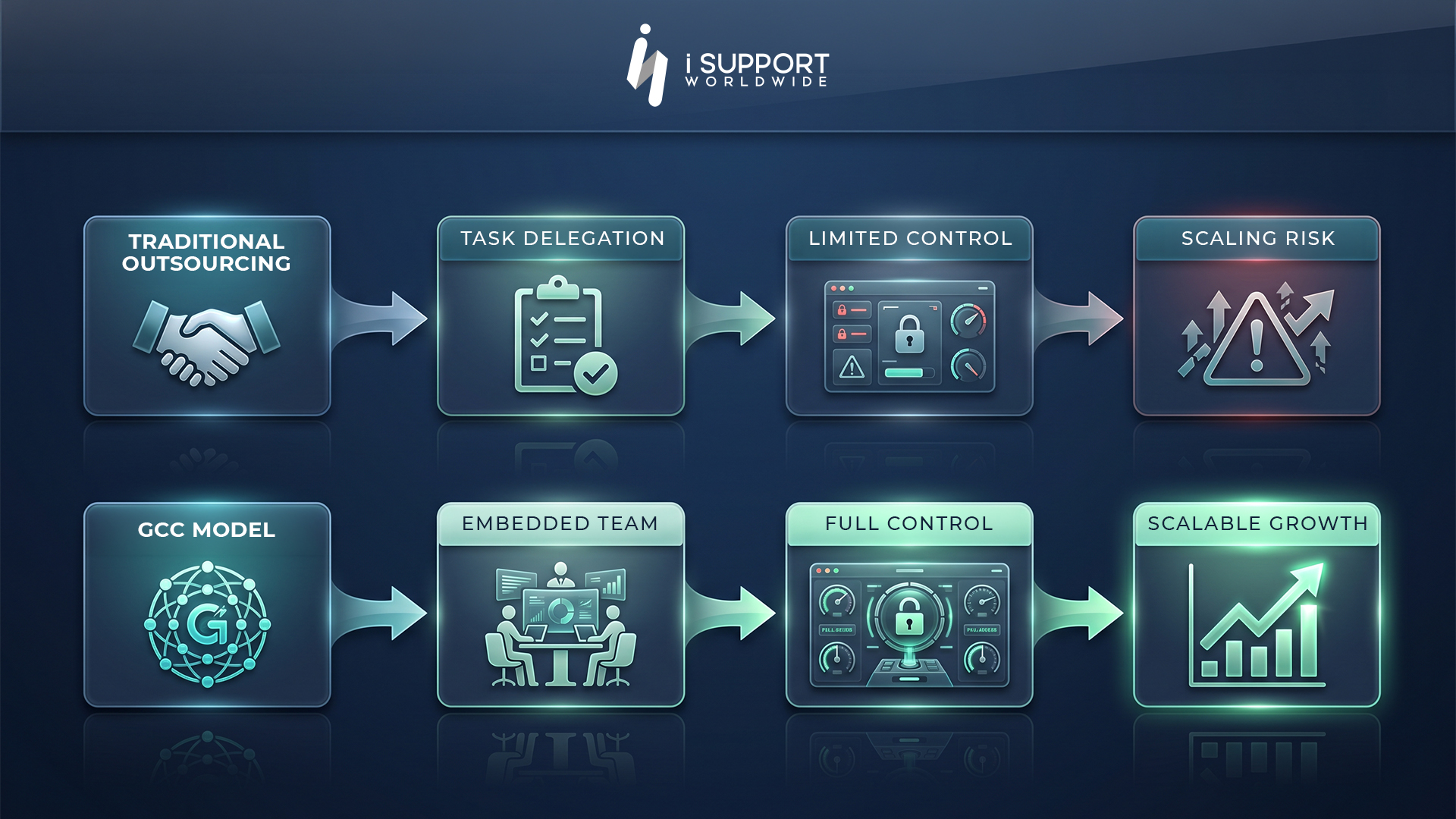
Traditional outsourcing was built around a simple exchange:
- Work is sent out
- Output is returned
It worked for transactional tasks but struggled as complexity increased.
Today, that model is being replaced.
Leading organizations are shifting toward the Global Capability Center (GCC) model.
A GCC is not just an offshore team. It is a dedicated, integrated extension of the business, designed to operate within the company’s systems, workflows, and standards.
This is especially visible in the rise of the GCC in the Philippines, where companies are building long-term teams aligned to their operational and strategic goals.
In this model:
- Teams are dedicated, not shared.
- Work is embedded, not transactional.
- Control remains with the business.
- Infrastructure, HR, and support are externally managed.
This is the fundamental shift.
From outsourcing tasks → to building capability.
How Offshore Security Compliance Enables Control and Scale
When properly implemented, offshore security compliance is not just a safeguard; it is a fundamental pillar of security. It becomes a growth lever.
A well-designed offshoring solution enables:
Security Embedded in Operations
Compliance is integrated into workflows, access controls, and systems—not treated as an add-on.
Control Without Operational Burden
Leaders maintain ownership of outcomes and direction, while the offshore partner manages execution infrastructure.
Consistent Performance at Scale
Processes are structured and repeatable, allowing teams to grow without compromising quality or control.
Risk That Doesn’t Multiply
As teams expand, governance and reliability remain stable, reducing friction across functions.
This is what separates a basic offshoring company in the Philippines from a true capability-building partner.
Offshore Client Story: When Compliance Became the Turning Point
One offshore client story illustrates this shift clearly. A mid-sized company initially explored offshore support to reduce costs. At the leadership level, the idea made sense.
But internally, concerns surfaced:
- Sensitive customer data exposure
- Limited visibility into offshore workflows
- Risk of inconsistent performance at scale
The initiative stalled. The turning point came when the offshore model demonstrated:
- Structured compliance processes
- Secure infrastructure integration
- Clear accountability and control mechanisms
The conversation changed. It was no longer about savings. It became operational confidence.
And with that confidence, the decision moved forward.
Choosing the Right Offshoring Company in the Philippines
If you’re evaluating an offshoring business strategy, compliance should not be viewed in isolation.
It should be evaluated in the context of the entire operating model.
Key questions to consider:
- Is security built into workflows or layered on after?
- Do you retain control over outcomes, or have you delegated it?
- Can the model scale without increasing operational risk?
- Is the team integrated into your business, or does it operate externally?
The right partner will not just meet compliance standards. They will demonstrate how those standards support:
- control
- consistency
- long-term scalability
This is where companies like iSupport Worldwide position differently, not as a traditional outsourcing provider, but as a strategic builder of Global Capability Centers (GCCs) designed for secure, scalable growth.
Compliance Makes Offshore Work at Scale
SOC2 and ISO don’t define the value of an offshore model. They reveal whether it can function inside a real business environment.
For companies building a GCC in the Philippines, offshore security compliance is not just about audit readiness.
It’s about enabling:
- deeper integration
- stronger control
- scalable, predictable growth
The real question is not, “Is this partner compliant?” but “Can this model support how we operate—and how we grow?”
If you’re thinking about how this applies to your organization, it’s worth stepping back to evaluate your current offshore approach. It’s not just about cost, but also about how well it supports control, security, and long-term scale.
Partnering with an experienced provider like iSupport Worldwide can help you assess your structure, identify gaps, and design a Global Capability Center that’s built to operate securely and scale with confidence.
About the Author Denise Romero works as a copywriter at iSupport Worldwide, where she specializes in B2B content that helps businesses flourish. She specializes in creating clear, compelling messages that engage professional audiences and support strategic marketing goals. |
Founded in 2006, iSupport Worldwide is a US-owned offshoring leader based in the Philippines, delivering tailored solutions to enhance operational efficiency and exceed client expectations. Recognized on the Inc. 5000 list of America’s fastest-growing private companies for three consecutive years, honored in Inc. Magazine’s Power Partner Awards, and a recipient of the ACES Award for Inspiring Workplaces in Asia, iSupport Worldwide embodies a commitment to excellence. |