


Executive Summary
Offshore data management no longer needs to increase risk. With the right model, organizations gain security, control, and scalability through integrated global capability. By building structured, dedicated offshore teams, businesses protect data while expanding capacity.
Introduction
Data is your operational backbone, your competitive advantage, and if mishandled, your biggest liability.
Yet as organizations scale, a paradox emerges: the more data you manage, the harder it becomes to control internally.
Rising infrastructure costs, talent shortages (only 28% of data roles are filled within 90 days), and fragmented systems are pushing leaders to consider offshore data management.
One question remains constant: “Can we do this without increasing risk?”
The answer isn’t just yes; it’s how you structure it. Companies using modern offshore capability models report 40-60% cost reduction while maintaining or improving security posture and data governance standards.
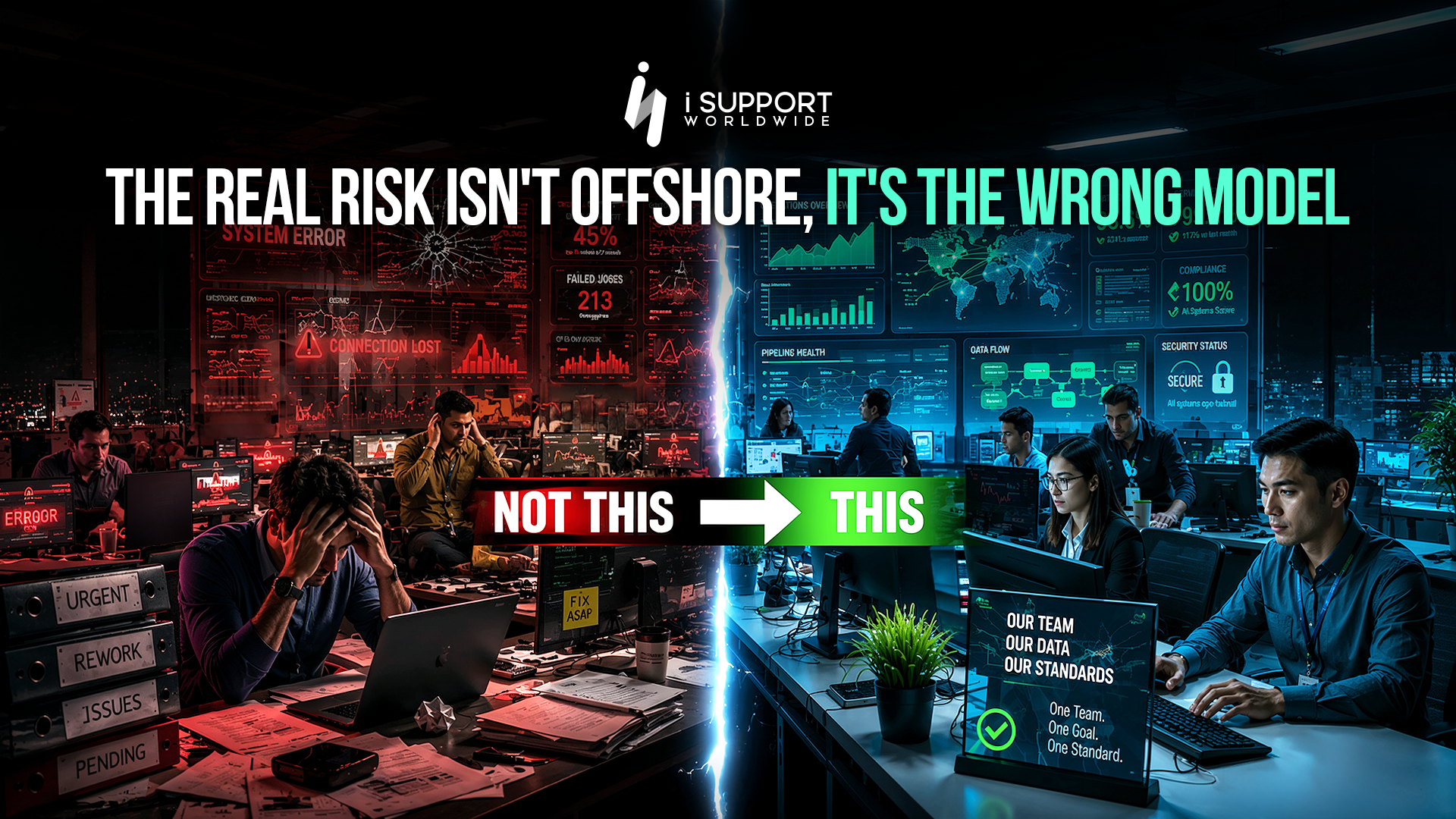
The Real Risk Isn't Geography. It's the Model You Choose.
For years, offshore data management earned a bad reputation. Traditional outsourcing introduced legitimate concerns.
| Traditional Outsourcing Risks | Root Cause |
| Loss of visibility | No direct reporting structures |
| Weak data governance | Shared resources, unclear ownership |
| Inconsistent quality control | Multiple clients, competing priorities |
| Security vulnerabilities | Outdated infrastructure, weak compliance |
These weren’t imagined risks—they were structural failures. Here’s what most businesses miss: Risk doesn’t come from geography. It comes from a lack of control.
Modern offshore strategies have evolved. Today’s best-performing companies aren’t outsourcing data management. They’re building controlled offshore capability centers that function like internal teams, just located where talent is more available and cost-effective.
From Vendor Dependency to Capability Ownership
The shift is subtle but critical. Instead of handing off data operations to third parties, leading organizations are creating what functions like a global capability center (GCC)—without the heavy lift of building one from scratch.
This approach changes everything:
- You don’t lose control. You extend it.
- You don’t compromise security. You standardize it.
- You don’t fragment operations. You integrate them.
At its core, this model is built around a simple principle:
You own the outcomes. The offshore partner enables execution.
This aligns with a key operational pillar: maintaining control without operational burden, where leadership retains direction while infrastructure, compliance, and support layers are managed externally.
How Risk Is Engineered Out of Offshore Data Management
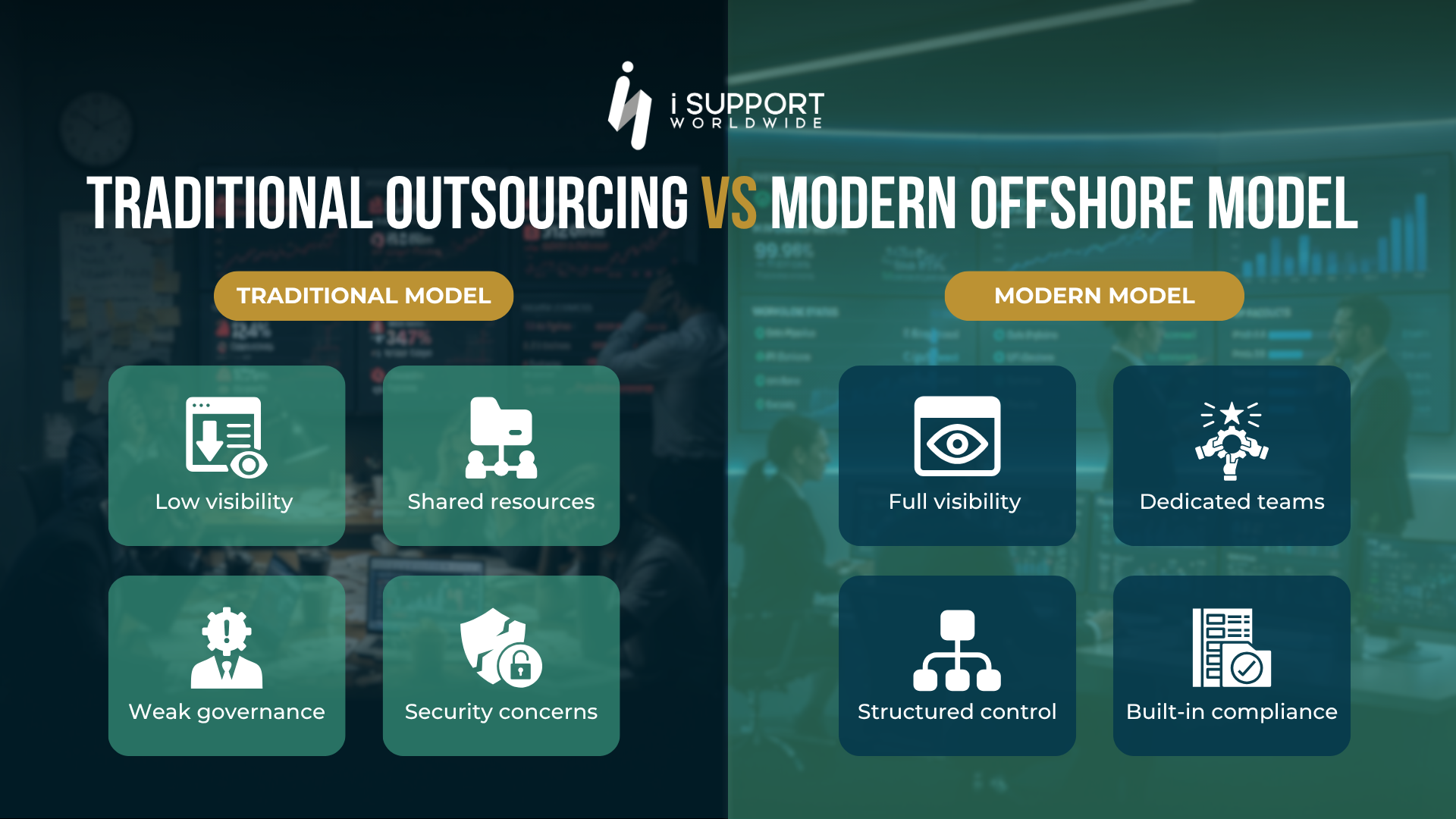
To make offshore data management truly risk-free, three elements must be non-negotiable.
Built-In Security and Compliance
Security must be embedded in the infrastructure from day one. Modern offshore environments operate with:
- Enterprise-grade systems: Encrypted data at rest and in transit (AES-256), multi-factor authentication, zero-trust architecture
- Controlled access protocols: Role-based access control (RBAC), single sign-on (SSO), session monitoring
- Structured compliance workflows: SOC 2 Type II, ISO 27001, GDPR-compliant data handling, HIPAA (if applicable)
- Regular audits: Quarterly vulnerability assessments, annual third-party security audits
This transforms offshore teams into secure extensions of your internal environment, instead of external vulnerabilities.
Risk mitigation becomes proactive, not reactive, addressing data security and performance stability before issues arise.
Dedicated, Embedded Teams
Risk increases when responsibility is diffused across multiple clients. The alternative? Dedicated offshore teams aligned to your business alone.
These teams:
- Follow your workflows and SOPs.
- Integrate into your systems (Slack, Jira, Snowflake, etc.)
- Operate within your governance models.
- Attend your standups and planning sessions.
They’re not vendors executing tasks. They’re operators driving outcomes within your structure.
Result: Operational reliability at scale, where consistency, 90%+ retention rates, and process repeatability reduce variability, and therefore risk.
Full Visibility and Control
One of the biggest myths about offshoring operations is that oversight is lost.
Modern models are designed to give you more visibility, not less.
You maintain:
- Direct reporting structures
- Workflow transparency
- Performance accountability
This eliminates the “black box” problem that defines traditional outsourcing.
Instead of relinquishing control, you’re extending your operational footprint securely.
Why Leaders Are Quietly Moving This Direction
C-suite leaders aren’t asking, “Should we offshore data management?”
They’re asking, “How do we scale data operations without increasing risk or overhead?”
Internally, the challenges are clear: hiring ceilings in specialized data roles, rising payroll and infrastructure costs, increasing compliance complexity, and slower scalability.
Offshore capability solves these, but only when structured properly.
From “outsourcing data processes” to “Extending our organization through a globally integrated capability layer.”
A model that behaves like a GCC without the $500k+ capital, 12-18 time, and operational burden of building one internally.
The Strategic Advantage: Risk Reduction as a Growth Lever
Risk-free offshore data management is no longer just about protection.
It’s about unlocking growth safely.
When executed correctly, organizations gain:
- Scalability without organizational drag
- Access to global data expertise
- Operational consistency across regions
- Stronger governance through standardized systems
All while maintaining full control of outcomes.
This transforms offshore from a cost decision into a strategic one—aligned with growth, resilience, and long-term capability building.
The Bottom Line
Offshore data management isn’t inherently risky. Unstructured offshore models are.
The companies winning today aren’t avoiding offshore. They’re redefining it:
Old Model | New Model |
Outsourcing | Capability building |
| Cost-cutting | Growth enablement |
| Risk exposure | Risk engineering |
The Bottom Line Ready to Evaluate If Offshore Is Right for Your Data Operations?
If your data operations are becoming harder to scale, control, or secure internally, it may not be a capacity problem. It may be a structure problem.
The question is no longer whether to offshore but whether your model is built to protect what matters most.
About the Author Denise Romero works as a copywriter at iSupport Worldwide, where she specializes in B2B content that helps businesses flourish. She specializes in creating clear, compelling messages that engage professional audiences and support strategic marketing goals. |
Founded in 2006, iSupport Worldwide is a US-owned offshoring leader based in the Philippines, delivering tailored solutions to enhance operational efficiency and exceed client expectations. Recognized on the Inc. 5000 list of America’s fastest-growing private companies for three consecutive years, honored in Inc. Magazine’s Power Partner Awards, and a recipient of the ACES Award for Inspiring Workplaces in Asia, iSupport Worldwide embodies a commitment to excellence. |