


Executive Summary
Scaling offshore operations requires a structured approach. A 30-60-90 offshore ramp plan enables effective onboarding, faster productivity, and sustainable growth.
Whether you aim to build offshore teams in the Philippines or develop a global capability center, the right strategy and partner can simplify execution and support long-term success for organizations.
Introduction
Scaling global operations requires more than just hiring talent. It demands a structured offshore ramp plan that ensures teams are productive, aligned, and ready to contribute to business growth. For organizations looking to build offshore teams or establish a global capability center (GCC) in the Philippines, a well-executed 30-60-90 strategy is essential.
What Is a 30‑60‑90 Offshore Ramp Plan?
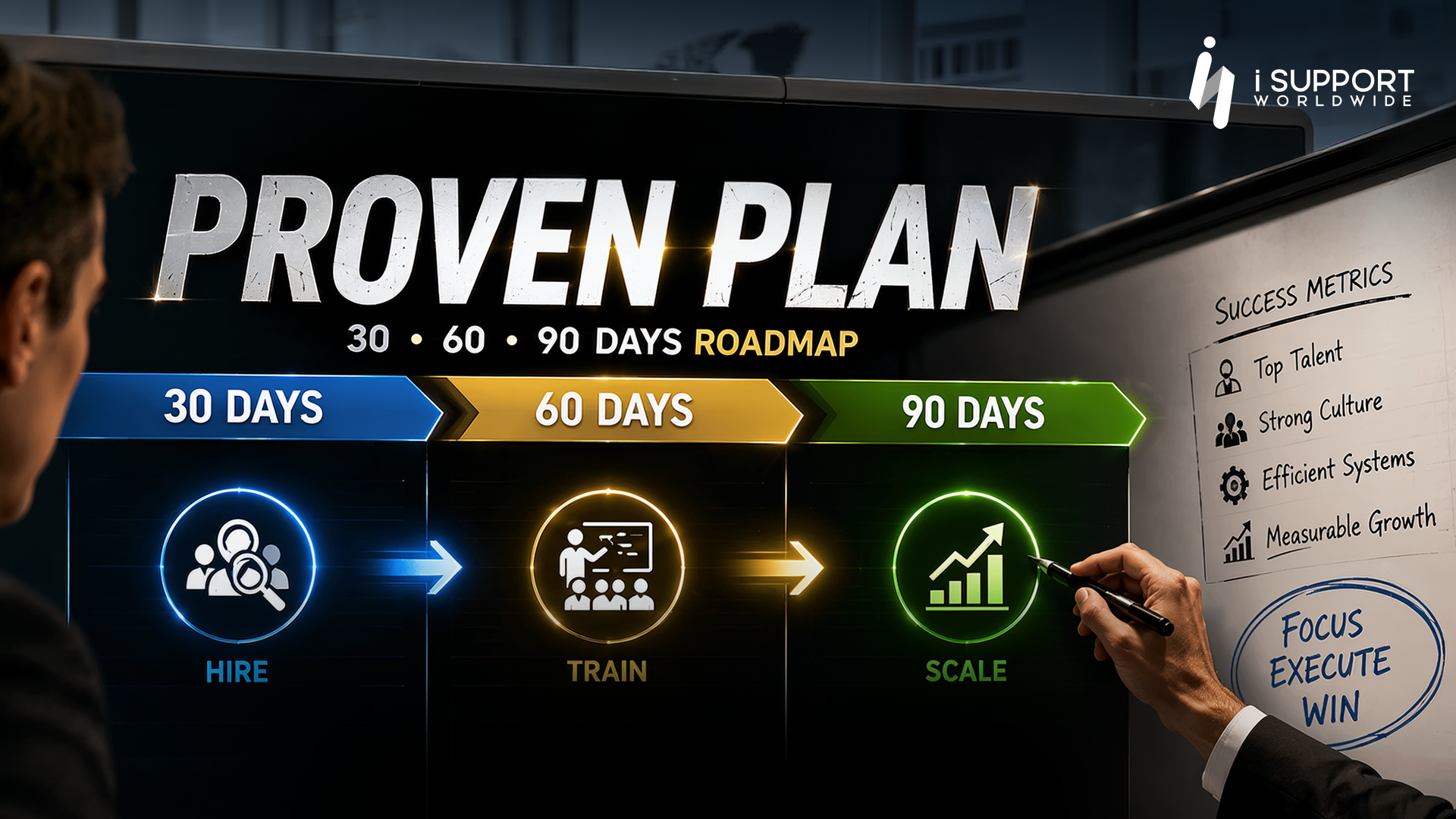
A 30-60-90 offshore ramp plan is a tiered structure for transitioning offshore hires from onboarding to full production. It guarantees that offshore teams are properly trained and integrated into your business operations.
The Three Phases
Days 1-30 (Foundation)
Training, onboarding, and alignment
Days 31-60 (Integration)
Guided execution and performance tracking
Days 61-90 (Optimization)
Full ownership and scaling output
This approach is particularly critical for companies building offshore teams or launching a global capability center in the Philippines, where alignment and speed-to-productivity are key.
Why It Matters for Offshore Teams
Without a clear offshore ramp plan, companies often struggle with delayed productivity, miscommunication across teams, inconsistent output quality, and inefficient offshore team onboarding.
A structured plan solves these challenges by providing clarity, measurable milestones, and a repeatable model for growth, especially when scaling in a competitive talent market like the Philippines.
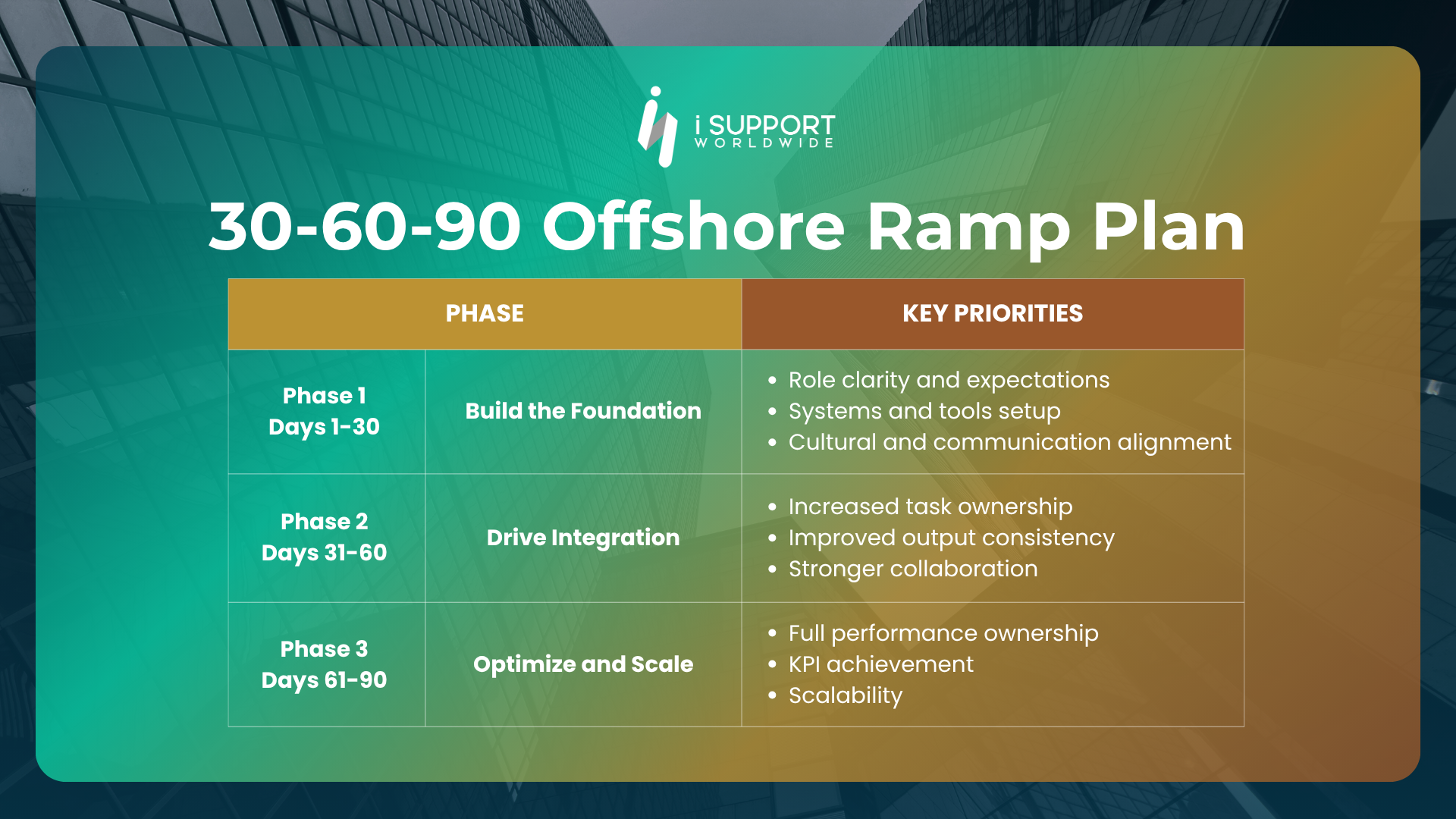
Phase 1: Days 1-30 - Build the Foundation
The success of your entire offshore operation begins here. This phase focuses heavily on offshore team onboarding and setting the groundwork for long-term success.
Key Priorities
- Role clarity and expectations
- Systems and tools setup
- Cultural and communication alignment
Best Practices
1. Structured Offshore Team Onboarding
Create a comprehensive onboarding experience that includes a company overview and expectations, SOPs and workflows, and communication protocols and escalation paths.
2. Training and Shadowing
Enable new hires to observe real workflows, shadow experienced team members, and practice in controlled environments.
3. KPI Alignment
Define early performance benchmarks such as quality metrics, output expectations (adjusted for ramp stage), and communication standards.
Outcome: By day 30, your offshore team can handle basic tasks with guidance and has a strong understanding of processes.
Phase 2: Days 31-60 - Drive Integration
At this stage, your offshore team transitions from learning to execution. This is where your offshore ramp plan begins to show real impact.
Key Priorities
- Increased task ownership
- Improved output consistency
- Stronger collaboration
Best Practices
1. Gradual Workload Expansion
Introduce more complex tasks while increasing volume.
2. Performance Tracking
Implement structured reviews to monitor KPIs, identify gaps, and reinforce strengths.
3. Cross-Team Collaboration
Encourage offshore staff to join meetings, engage in problem–solving, and contribute ideas.
4. Process Refinement
Continuously improve workflows based on feedback.
Outcome: By day 60, the team can independently manage core tasks with consistent quality.
Phase 3: Days 61-90 - Optimize and Scale
This phase focuses on achieving full productivity and preparing for scale, whether you’re expanding an offshore team or building a GCC in the Philippines.
Key Priorities:
- Full performance ownership
- KPI achievement
- Scalability
Best Practices
1. Ownership and Accountability
Teams should manage workflows independently, meet or exceed performance metrics, and take initiative.
2. Advanced Training
Invest in specialization, cross–training, and leadership development.
3. Performance Optimization
Use insights to identify top performers, standardize best practices, and eliminate inefficiencies.
Outcome: By day 90, your offshore team operates at full capacity and contributes to strategic goals.
How to Ramp Up an Offshore Team in the Philippines
If you’re wondering how to ramp up an offshore team in the Philippines, success comes down to three critical factors.
1. Talent + Structure
The Philippines offers a highly skilled, English-proficient workforce-but success depends on pairing talent with a strong ramp framework.
2. Clear Workflow Systems
Documented SOPs and defined processes reduce ramp time and improve consistency.
3. Strong Onboarding and Communication
Effective offshore team onboarding ensures alignment across time zones and teams.
By combining these elements with a structured 30‑60‑90 offshore ramp plan, businesses can achieve faster and more sustainable scaling.
From Offshore Teams to Global Capability Centers (GCC)
Many companies today are evolving beyond traditional outsourcing and building global capability centers (GCC), dedicated offshore hubs that handle critical business functions.
A 30-60-90 offshore ramp approach plays a key role in this transition by:
- Establishing operational consistency early
- Enabling faster team scalability
- Supporting long-term capability development
Whether you’re starting small or planning to build a GCC, a structured ramp plan ensures your offshore operation grows strategically, not reactively.
Final Thoughts
A 30‑60‑90 offshore ramp plan is more than an onboarding tool-it’s a strategic framework for building high-performing offshore teams and scaling operations with confidence.
For businesses looking to build offshore teams in the Philippines or establish a GCC in the Philippines, success lies in combining structured onboarding, clear performance milestones, and the right local partner.
With the right strategy and support, offshore expansion becomes a powerful driver of growth, efficiency, and long-term capability building.
If you’re exploring how to ramp up an offshore team in the Philippines or transition toward a global capability center, partnering with an experienced provider like iSupport Worldwide can help you move faster with less risk—while ensuring your teams are set up for sustainable success from day one.
About the Author Denise Romero works as a copywriter at iSupport Worldwide, where she specializes in B2B content that helps businesses flourish. She specializes in creating clear, compelling messages that engage professional audiences and support strategic marketing goals. |
Founded in 2006, iSupport Worldwide is a US-owned offshoring leader based in the Philippines, delivering tailored solutions to enhance operational efficiency and exceed client expectations. Recognized on the Inc. 5000 list of America’s fastest-growing private companies for three consecutive years, honored in Inc. Magazine’s Power Partner Awards, and a recipient of the ACES Award for Inspiring Workplaces in Asia, iSupport Worldwide embodies a commitment to excellence. |