



Executive Summary
AI has made it easier than ever to create reports, presentations, strategies, and business content at an unprecedented speed. However, faster output does not always translate to better outcomes. As AI adoption accelerates across industries, organizations are encountering a growing challenge known as workslop: AI-generated content that appears credible but delivers little meaningful value.
Whether you’re developing AI literacy, strengthening leadership capabilities, or deepening your industry expertise, iSupport Worldwide provides the tools, support, and career opportunities to help you stay ahead of change and create meaningful impact far beyond what AI alone can achieve.
Thanks to generative AI, reports can be written in minutes, presentations can be built in seconds, and entire strategies can emerge from a carefully crafted prompt.
As businesses race to adopt AI, understanding the difference between expertise and AI-generated output may become one of the most important challenges of the modern workplace.
What is workslop?
Many workplaces are discovering that producing more work and producing better work are not necessarily the same thing.
A 2025 Stanford Social Media Lab and BetterUp Labs study, cited by CNBC, found that 40% of workers had received workslop, which was described as content that “masquerades as good work” while contributing little meaningful value.
Workslop can appear in strategic planning, customer communications, project documentation, business analysis, internal reports, and even leadership updates. Because the content often sounds convincing, employees may assume that the conclusions are sound without applying the level of scrutiny that would normally accompany important business decisions.
The result is a workplace where people spend increasing amounts of time reviewing, correcting, and interpreting AI-generated output rather than benefiting from it.
Ironically, a technology designed to save time can sometimes create additional work when used carelessly.
The insights below are based on research conducted by BetterUp and the Stanford Social Media Lab, involving an online survey of 1,150 full-time U.S. desk workers in September 2025.
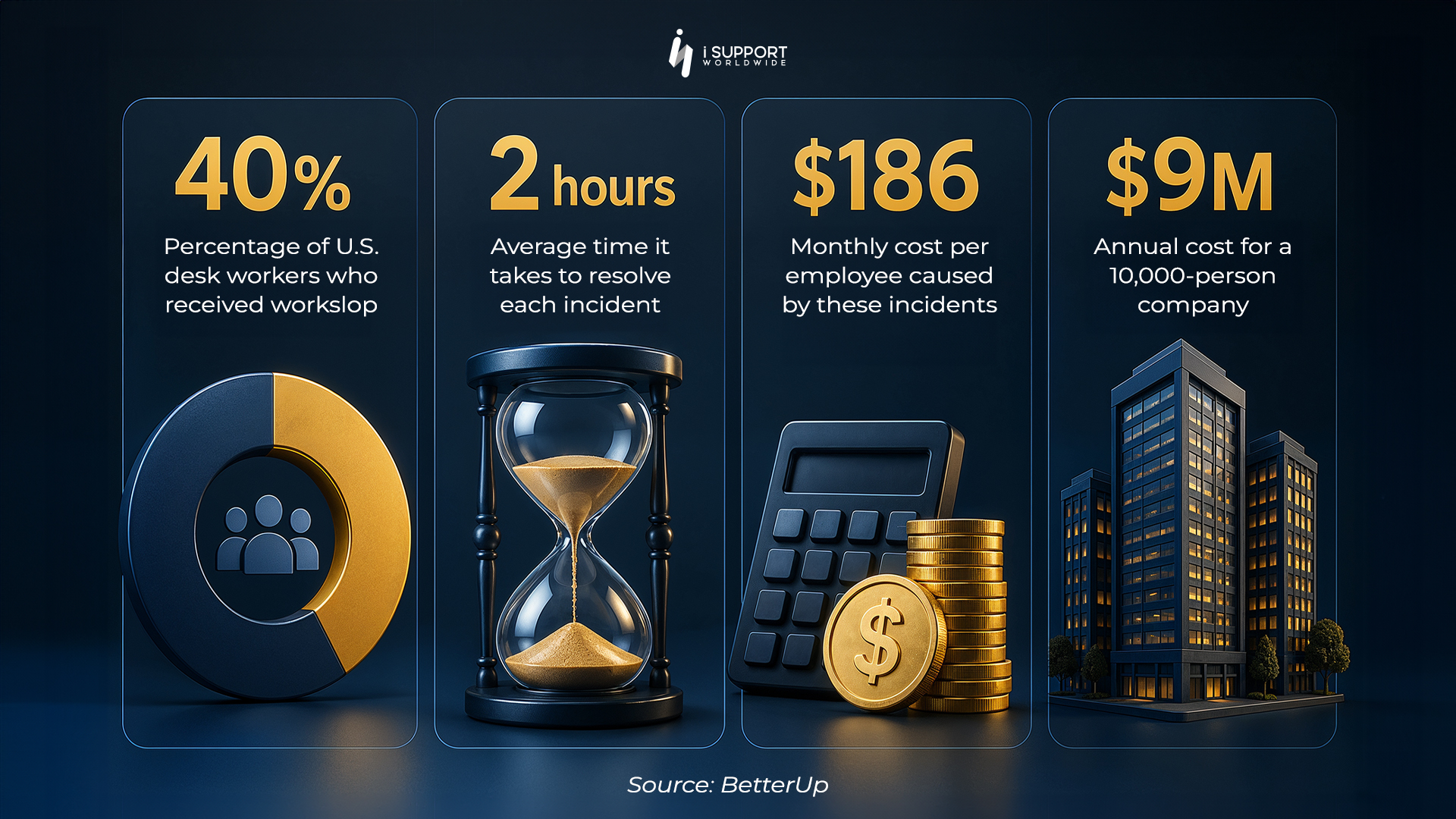
Producing more content does not automatically produce more understanding, better decisions, stronger collaboration, or improved business results. In fact, when teams spend additional time filtering through low-value content, the efficiency gains promised by AI can begin to erode.
In many cases, the problem is not the technology itself but the unrealistic expectations people place on it. As organizations including the outsourcing industry, offshoring industry, and modern global capability center (GCC) landscape continue integrating AI into everyday operations, understanding these misconceptions may be one of the most important components of AI literacy.
What are the common misconceptions about AI?
Before businesses can fully unlock the benefits of human-AI collaboration, they must first separate reality from hype.
Let’s start with some of the most common misconceptions surrounding artificial intelligence today.
Misconception #1: If AI generated it, it must be correct
One of the most dangerous assumptions emerging from widespread AI adoption is the belief that AI-generated content is inherently accurate because it sounds authoritative.
Unfortunately, sounding confident and being correct are two very different things.
Modern AI systems are exceptionally skilled at generating convincing language, which means they can present inaccurate information with the same confidence they use to present accurate information. This capability makes AI incredibly useful for drafting content and accelerating research, but it also creates risks for organizations that treat AI outputs as final answers rather than preliminary suggestions.
This is precisely why AI literacy is becoming one of the most valuable skills in the modern workplace.
Professionals with strong AI literacy understand that every AI-generated response should be evaluated in the same way a thoughtful manager reviews a recommendation from a colleague. Not rejected automatically, but certainly not accepted blindly.
Misconception #2: AI output can replace expertise
Another misconception gaining traction is the belief that because AI has access to vast amounts of information, it can effectively replace experts.
This assumption misunderstands the nature of expertise itself.
A financial analyst does not deliver value merely because they know financial concepts. They deliver value because they can interpret market signals, understand risk, and recognize patterns that may not be obvious to others.
A marketer does not deliver value simply because they understand advertising terminology. They deliver value because they understand human behavior, customer motivation, and market dynamics.
A project manager does not succeed because they can create timelines. They succeed because they understand people, communication, priorities, and organizational complexity.
Prompt engineering can help professionals extract better outputs from AI systems, but prompt engineering is not a substitute for expertise. The quality of the answer often depends on the quality of the person asking the question.
The prompt matters, but the expertise behind the prompt matters even more.
Misconception #3: AI can make business decisions
A growing number of professionals use AI to support strategic discussions, analyze data, evaluate options, and generate recommendations.
There is absolutely nothing wrong with that.
The problem emerges when organizations begin treating AI recommendations as decisions rather than inputs. Business decisions rarely involve straightforward answers. They involve trade-offs, competing priorities, organizational realities, customer expectations, market conditions, and ethical considerations that cannot always be captured in a dataset or a prompt.
AI can help leaders understand possibilities, but it cannot assume responsibility for the consequences.
That is why successful organizations increasingly focus on human-AI collaboration, where AI provides speed, scale, and analytical support while humans provide judgment, accountability, and decision-making expertise.
Misconception #4: AI can replace cognitive work
Few topics generate more discussion than the future of cognitive work.
Stories about automation often create the impression that knowledge workers will eventually become unnecessary because AI can complete many tasks faster than humans.
What these conversations often overlook is that cognitive work consists of far more than producing outputs.
Complex cognitive work involves critical thinking, creative problem-solving, communicating ideas, challenging assumptions, managing stakeholders, interpreting ambiguity, navigating uncertainty, and making decisions when information is incomplete.
AI can automate portions of cognitive work, but it cannot fully replicate the human ability to understand context, navigate complexity, and exercise wisdom.
Rather than eliminating cognitive work, AI is transforming it. Professionals are increasingly moving away from producing first drafts and spending more time reviewing, validating, refining, and improving ideas generated through human-AI collaboration.
How can you prevent AI from taking over you as a professional?
The best way to remain valuable in an AI-powered world is not to compete with AI on speed. Instead, focus on developing the skills and capabilities that become even more valuable as artificial intelligence becomes more common in the workplace.
Here are some practical ways to stay ahead of the workslop curve:
Develop strong AI literacy
Understanding how AI works and where it can go wrong helps you recognize when an output is useful and when it simply sounds convincing. Strong AI literacy enables you to spot potential workslop before it reaches your colleagues, clients, or decision-makers.
Use prompt engineering to improve quality
Good prompt engineering is about producing more relevant content. Asking AI clear, specific, and context-rich questions reduces generic responses and increases the likelihood of generating substantial output.
Always add human judgment
AI should generate the first draft, not the final output. Before sharing any AI-generated content, ask yourself whether it offers meaningful insight, addresses the actual problem, and would still make sense if someone asked you to defend it.
Validate facts, assumptions, and recommendations
One of the fastest ways workslop spreads is when AI-generated content goes unchecked. Verify important facts, challenge recommendations, and review assumptions before using AI outputs to influence business decisions.
Focus on insight and not just the output
A 10-page report that says nothing is still saying nothing. Instead of measuring success by the amount of content produced, focus on whether the content helps people understand, decide, solve, or improve something.
Develop deeper industry expertise
The strongest defense against workslop is expertise. The more knowledge you have about your field, the easier it becomes to identify superficial recommendations, generic observations, and AI-generated conclusions that lack context.
Embrace human-AI collaboration
The goal should never be to let AI think for you. Instead, use human-AI collaboration to combine AI’s speed with your experience, creativity, judgment, and understanding of business realities. That combination creates value. AI alone often creates workslop.
Stay curious and keep learning
AI tools evolve quickly, and so do the challenges that come with them. Professionals who continuously invest in learning, experimentation, and critical thinking are less likely to become dependent on AI-generated content and more likely to use AI as a genuine competitive advantage.
iSupport Worldwide empowers human-AI collaboration Add Your Heading Text Here
As AI transforms the workplace, professionals who combine technical skills with critical thinking and business expertise will have the greatest advantage. At iSupport Worldwide, we help employees stay competitive through continuous learning opportunities, upskilling initiatives, and certification programs that support long-term career growth.
By investing in both technology and talent development, iSupport Worldwide equips professionals with the knowledge, adaptability, and expertise needed to grow their careers, take on new opportunities, and create value beyond what AI alone can deliver.
If you’re ready to build in-demand skills, earn valuable certifications, and grow your career in a future-focused workplace, iSupport Worldwide can help you take the next step.
About the Author Shekina P. Malonzo is a Licensed Professional Teacher and multifaceted Content Developer at iSupport Worldwide, specializing in creating tailored materials for the offshoring industry. |
Founded in 2006, iSupport Worldwide is a US-owned offshoring leader based in the Philippines, delivering tailored solutions to enhance operational efficiency and exceed client expectations. Recognized on the Inc. 5000 list of America’s fastest-growing private companies for three consecutive years, honored in Inc. Magazine’s Power Partner Awards, and a recipient of the ACES Award for Inspiring Workplaces in Asia, iSupport Worldwide embodies a commitment to excellence. |