



Executive Summary
Finance leaders are shifting from traditional outsourcing to dedicated offshore finance teams and GCCs to reduce labor costs, improve control, and scale operations while building long-term, integrated, high-performing finance capabilities.
Introduction
Finance leaders are under pressure to reduce costs, improve control, and scale operations without overloading their in-house teams. That is why many organizations are rethinking outsourcing and moving toward a more strategic global capability center model for finance delivery. For companies exploring outsourcing to the Philippines, the opportunity is not just lower-cost execution. It is building a resilient offshore finance capability that can support long-term finance transformation.
From Outsourcing to a Finance GCC
Traditional outsourcing typically involves outsourcing work to a third-party provider under a service contract. That model can work well for defined tasks, but it often restricts visibility, control, and process ownership. A finance GCC or offshore finance center takes a different approach: the team becomes an extension of the business, aligned to internal standards, governance, and performance expectations.s, aligned to internal standards, governance, and performance expectations.
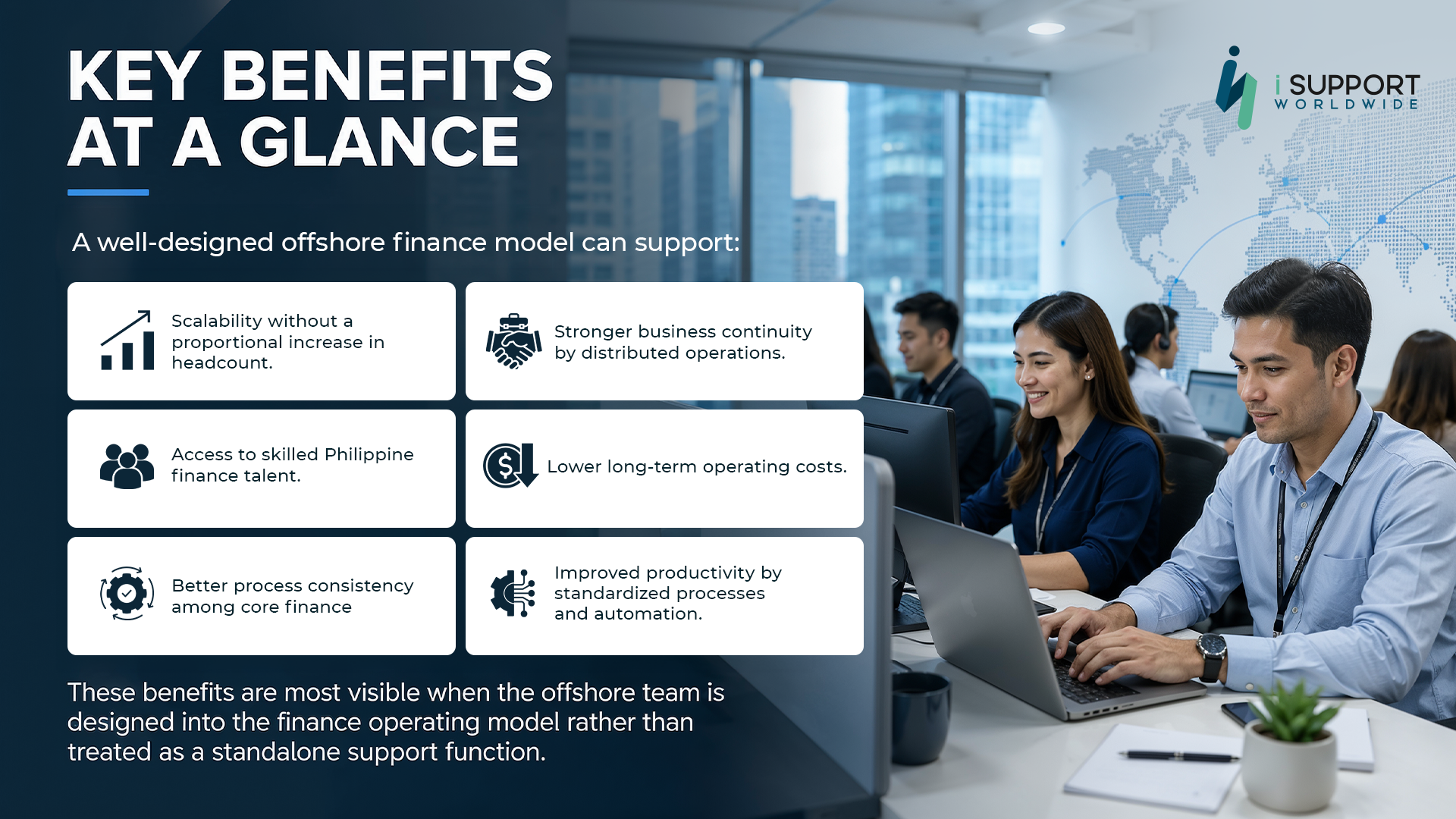
This is why more finance organizations are moving beyond simple finance outsourcing and investing in a retained offshore operating model. The goal is not exclusively labor arbitrage. It is to create scalable finance shared services that improve process consistency, strengthen accountability, and support growth.
Offshoring vs Outsourcing: A Simpler View
Model | How It Works | Typical Limitation |
Outsourcing | External vendor executes tasks | Limited ownership |
Offshoring | Dedicated team integrated into your org | Requires structured setup |
One useful approach to think about it is that offshoring is extension and outsourcing is delegation.
Which Finance Functions Should You Offshore First
A successful finance offshoring strategy usually starts with repeatable, measurable tasks. The best initial functions for a global finance team are often accounts payable, accounts receivable, reconciliations, payroll support, and financial reporting support. These workstreams are easier to document, standardize, and monitor, which makes them strong candidates for an offshore transition.
As the model matures, companies can expand into more analytical work such as FP&A offshore support, management reporting, and process optimization. That progression allows the offshore team to build trust while the business gains confidence in the model. It also helps the organization avoid overcomplicating the first phase of the move.
A structured finance offshoring strategy typically evolves in phases. Here’s a sample:
Phase 1: Transactional Functions
- Accounts payable
- Accounts receivable
- Payroll
- Reconciliations
- Bookkeeping
Why start here:
- Faster implementation
- Immediate cost efficiency
- Easier process standardization
Phase 2: Control & Reporting
- Financial close support
- Financial reporting
- Compliance support
Focus:
- Improving process consistency
- Strengthening visibility and governance
Phase 3: Strategic Finance
- FP&A offshore teams
- Budgeting and forecasting
- Financial analysis
Your offshore team becomes a true business partner, not just a support layer.
Why the Philippines remains a strong location
The Philippines offers more than cost advantages. It remains a premier destination for offshore staffing, particularly in finance and accounting. Companies evaluating finance outsourcing options in the Philippines are often drawn to the country’s large talent pool, strong English proficiency, and familiarity with global business processes. These advantages make it easier to build a high-performing team that can integrate into existing workflows.
For businesses seeking outsourcing to the Philippines, the value proposition goes beyond cost. The country offers a mature services ecosystem, strong alignment with communication, and a workforce increasingly experienced in finance and accounting services, offshore accounting team support, and process-driven operations. That makes it a viable choice for companies that want efficiency and capability.
Conclusion
A finance offshore model works best when it is built as a capability, not just a labor solution. For companies evaluating outsourcing to the Philippines, the strongest case is often a global capability center that combines talent, governance, and scalability. That approach gives finance leaders the control they need while creating a stronger and more efficient operating model for the future.
Every organization approaches offshoring differently based on its structure, growth stage, and priorities.
Build a finance offshoring strategy with an expert. iSupport Worldwide, a 2026 Inc. 5000 Regional Mountain awardee, helps organizations design and scale high-performing global capability centers with the right mix of talent, governance, and operational control.
About the Author Denise Romero works as a copywriter at iSupport Worldwide, where she specializes in B2B content that helps businesses flourish. She specializes in creating clear, compelling messages that engage professional audiences and support strategic marketing goals. |
Founded in 2006, iSupport Worldwide is a US-owned offshoring leader based in the Philippines, delivering tailored solutions to enhance operational efficiency and exceed client expectations. Recognized on the Inc. 5000 list of America’s fastest-growing private companies for three consecutive years, honored in Inc. Magazine’s Power Partner Awards, and a recipient of the ACES Award for Inspiring Workplaces in Asia, iSupport Worldwide embodies a commitment to excellence. |