



Executive Summary
The future of work is reshaping workforce strategies by 2030, from global talent access and borderless teams to offshoring to the Philippines as a catalyst for scalability and growth. as a catalyst for scalability and growth.
For decades, workforce planning has been shaped by a simple assumption: talent must be sourced where the business operates. But by 2030, that assumption may no longer hold true.
The future of work is becoming increasingly borderless. Advances in technology, evolving employee expectations, and persistent talent shortages are changing how organizations find, manage, and retain talent. Geography is no longer the defining factor it once was. Instead, businesses are beginning to compete based on their ability to access skills, capabilities, and expertise wherever they exist.. Geography is no longer the defining factor it once was. Instead, businesses are beginning to compete based on their ability to access skills, capabilities, and expertise wherever they exist.
While remote work accelerated this shift, the next phase goes far beyond employees working from home. It involves building global workforces designed around skills rather than locations.
Organizations that recognize this transformation early may gain significant advantages in workforce scalability, business resilience, and long-term growth. Here are five predictions that could define the borderless workforce of 2030.
Why Workforce Planning Is Changing Faster Than Expected
Business leaders are facing a convergence of workforce challenges unlike anything seen before. Talent shortages continue across industries, digital transformation is accelerating skill requirements, and workforce expectations are evolving rapidly.
Talent Shortages Are Becoming a Global Challenge
Many organizations are struggling to find qualified candidates for critical roles. As specialized skills become harder to source locally, businesses are increasingly looking beyond their immediate markets to fill capability gaps.
The competition for talent is no longer local. It is global.
Companies that limit hiring to a single city, state, or country may find themselves competing with organizations that have access to a much larger talent pool.
Skills Are Emerging as the New Competitive Advantage
Traditional hiring often prioritized proximity. By 2030, workforce strategies are likely to prioritize skills instead.
Organizations will increasingly focus on identifying the best person for the role regardless of location. Skills-based hiring allows companies to access expertise faster, improve workforce flexibility, and build teams capable of adapting to changing business demands.
Technology Is Reducing Geographic Barriers
Collaboration tools, cloud-based systems, project management platforms, and AI-powered productivity solutions have made distributed work more practical than ever.
Teams can now collaborate across continents with minimal disruption. As technology continues to evolve, geographic boundaries will become even less relevant to daily operations.
What a Borderless Workforce Looks Like in 2030
A borderless workforce is not simply a remote workforce.
As competition for skilled professionals intensifies, many organizations will expand beyond local hiring markets and evaluate global workforce strategies. This may include offshoring, building distributed teams across regions, or partnering with providers that specialize in offshoring to the Philippines and other established talent hubs. Rather than being driven solely by labor arbitrage, these strategies will increasingly focus on accessing specialized skills, accelerating growth, and improving workforce scalability.
Teams Built Around Skills, Not Locations
Instead of asking, “Who can we hire nearby?”, organizations will increasingly ask, “Who is the best person for this role?”
This shift enables businesses to assemble highly specialized teams based on expertise rather than proximity. The result is often greater agility and faster access to critical capabilities.
Distributed Collaboration Becomes Standard
By 2030, distributed teams may become the norm rather than the exception.
Organizations will develop leadership practices, communication frameworks, and operating systems specifically designed for global collaboration. Success will depend less on where employees work and more on how effectively teams work together.
Global Talent Access Becomes a Business Requirement
Businesses seeking rapid growth will likely view global talent access as a strategic necessity.
Whether through direct hiring, global partnerships, outsourcing arrangements, or dedicated offshore teams, organizations will increasingly build workforce models that extend beyond a single labor market.
Five Predictions for the Borderless Workforce by 2030
Prediction #1: Skills Will Matter More Than Geography
For much of modern business history, location played a major role in hiring decisions.
By 2030, skills may become the primary workforce currency. The World Economic Forum projects that nearly 40% of workers’ core skills could change by 2030, making skills visibility and continuous development central to workforce planning. projects that nearly 40% of workers’ core skills could change by 2030, making skills visibility and continuous development central to workforce planning.
Companies that build hiring strategies around capabilities rather than geography are likely to gain access to broader talent pools and reduce hiring constraints created by local shortages.
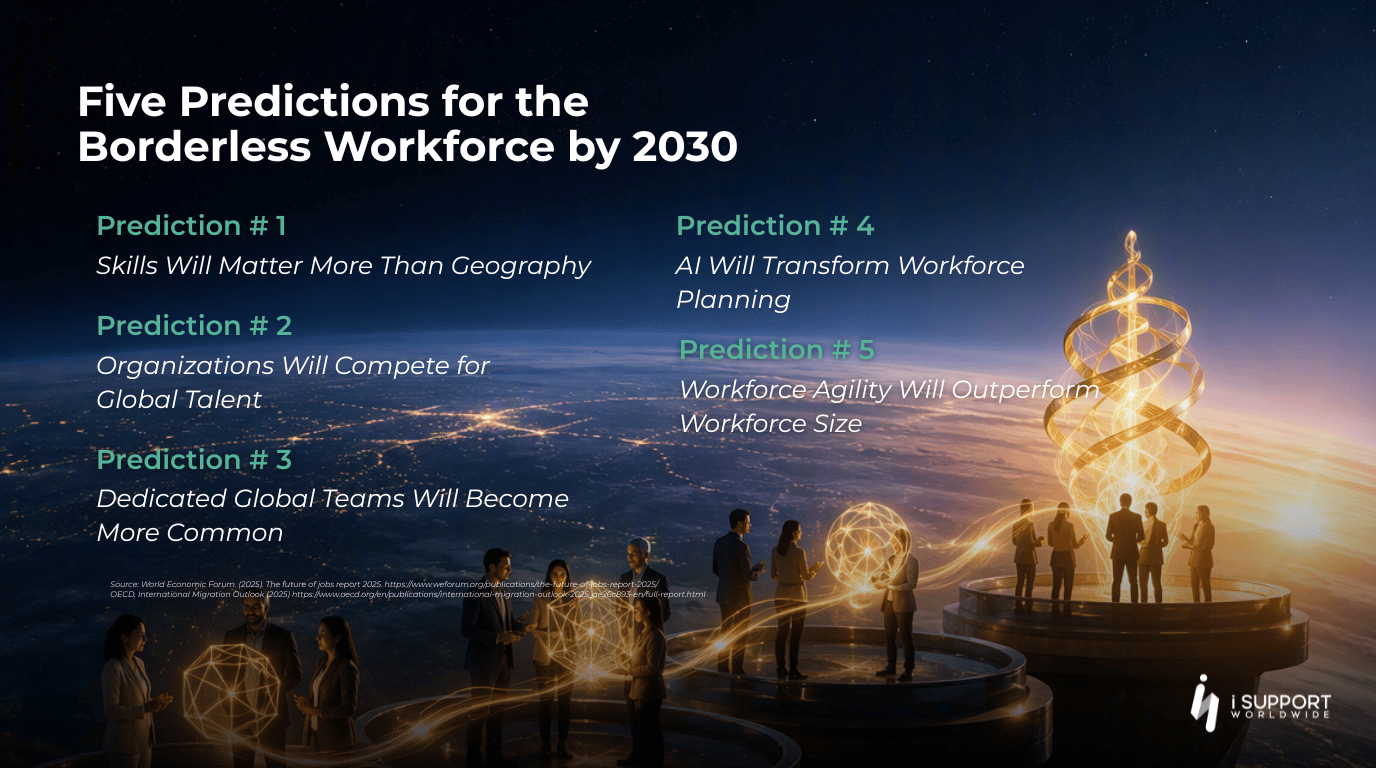
Prediction #2: Organizations Will Compete for Global Talent
As hiring becomes increasingly borderless, competition for top talent will intensify.
Businesses will no longer compete solely with local employers. They will compete with organizations from around the world seeking the same skills.
This reality will force leaders to rethink recruitment, workforce planning, and employee value propositions.
Prediction #3: Dedicated Global Teams Will Become More Common
Many organizations have already discovered that building dedicated teams outside their home markets can improve scalability and operational flexibility.
Global workforce models are expanding beyond traditional local hiring. Digitally mediated work allows organizations to connect with talent across locations, while OECD research shows that countries are also adapting migration policies to attract workers with needed skills shows that countries are also adapting migration policies to attract workers with needed skills
By 2030, dedicated offshore teams may become a standard component of workforce strategies rather than an alternative approach.
As business leaders face ongoing talent shortages and rising labor costs, questions surrounding offshore staffing cost and the cost to build offshore team structures will become increasingly important. Organizations will evaluate not only financial considerations but also factors such as speed to hire, access to specialized talent, and long-term operational flexibility.
Countries with mature outsourcing ecosystems, particularly those supporting offshoring to the Philippines, are likely to remain attractive destinations for businesses seeking skilled professionals and established workforce infrastructure.
Prediction #4: AI Will Transform Workforce Planning
Artificial intelligence will play a growing role in forecasting workforce needs, identifying skills gaps, and improving talent allocation decisions.
Rather than simply automating tasks, AI will help organizations make more informed decisions about workforce composition and capability development.
This could allow leaders to build more agile and adaptive workforce strategies.
Prediction #5: Workforce Agility Will Outperform Workforce Size
Historically, larger organizations often benefited from workforce scale.
By 2030, adaptability may become more valuable than sheer headcount.
Organizations that can rapidly access new skills, expand teams efficiently, and respond to changing market demands will likely outperform businesses constrained by rigid workforce structures.
The ability to scale intelligently may become a stronger competitive advantage than organizational size alone.
What Business Leaders Should Do Today
While 2030 may seem distant, many of these workforce changes are already underway.
Organizations that wait until talent challenges become critical may find themselves reacting rather than leading.
Reevaluate Talent Acquisition Strategies
Leaders should assess whether current hiring practices are limiting access to talent. Expanding the search beyond traditional geographic boundaries may uncover new opportunities to strengthen workforce capabilities.
Build Workforce Flexibility
Agility starts with workforce design. Companies should evaluate whether their operating models support distributed collaboration, scalable hiring, and future workforce growth.
Explore Scalable Global Talent Models
Access to global talent is becoming an increasingly important consideration for growing businesses.
This does not necessarily require replacing existing teams. Instead, it may involve complementing internal capabilities through outsourcing, offshore staffing, or dedicated offshore teams that support business objectives while improving scalability.
As part of workforce planning, leaders should evaluate the long-term benefits of global talent models, including hiring timelines, workforce flexibility, and the overall cost to build offshore team operations compared to expanding exclusively through local hiring. Understanding the broader impact of offshore staffing cost can help organizations make more informed decisions as they prepare for future workforce demands. compared to expanding exclusively through local hiring. Understanding the broader impact of offshore staffing cost can help organizations make more informed decisions as they prepare for future workforce demands.
Prepare Leaders for Distributed Operations
A borderless workforce requires a borderless leadership mindset.
Organizations should invest in leadership practices that support collaboration across locations, cultures, and time zones while maintaining alignment and accountability.
The Future of Work Is Borderless
The workforce transformation expected by 2030 is not a distant possibility. It is already taking shape.
The organizations best positioned for future growth may not be those with the largest offices or the biggest local talent pools. They may be the ones that develop access to skills wherever those skills exist.
As workforce boundaries continue to fade, leaders must think beyond traditional hiring models and explore strategies that support agility, resilience, and long-term scalability.
The future workforce will be defined less by geography and more by capability. Organizations that begin building access to global talent, distributed expertise, and scalable workforce models today may be better.
As workforce strategies continue to evolve, many organizations are rethinking how they access talent beyond traditional geographic boundaries. For leaders exploring scalable global workforce models, iSupport Worldwide helps businesses build dedicated Manila teams that operate as a seamless extension of their organization, supporting growth in an increasingly borderless world.
About The Author Denise Romero works as a copywriter at iSupport Worldwide, where she specializes in B2B content that helps businesses flourish. She specializes in creating clear, compelling messages that engage professional audiences and support strategic marketing goals. |
| Founded in 2006, iSupport Worldwide is a US-owned offshoring leader based in the Philippines, delivering tailored solutions to enhance operational efficiency and exceed client expectations. Recognized on the Inc. 5000 list of America’s fastest-growing private companies for three consecutive years, honored in Inc. Magazine’s Power Partner Awards, and a recipient of the ACES Award for Inspiring Workplaces in Asia, iSupport Worldwide embodies a commitment to excellence. |