



Executive Summary
Building strong boundaries starts with identifying personal priorities, defining realistic limits, communicating expectations clearly, and remaining consistent over time. Whether it involves protecting focus time, limiting after-hours communication, or managing workload expectations, healthy boundaries enable employees to contribute effectively without sacrificing their physical, mental, or emotional health.
At iSupport Worldwide, employee well-being is more than a workplace initiative—it’s part of who we are. Through industry-leading benefits, wellness-focused facilities, healthcare support, employee engagement programs, and a culture that values work-life balance, we empower our people to excel both professionally and personally.
If you’re looking for a company that invests in both your well-being and your professional growth, explore the exciting career opportunities at iSupport Worldwide and discover what makes us one of the best places to work.
Table of Contents
|
There was a time when leaving the office meant leaving work behind. Today, work can follow us almost everywhere: to our homes, our vacations, our dinner tables, and even our bedside tables through a glowing smartphone screen.
While these habits may initially appear productive, they often create a pattern of chronic overextension that eventually undermines both performance and well-being.
What does it mean to set boundaries at work?
Setting boundaries at work means intentionally defining what you are and are not available for, while communicating those expectations in a way that promotes clarity, respect, and accountability.
Rather than limiting collaboration, boundaries help create a framework where everyone understands priorities, responsibilities, and reasonable expectations.
These boundaries can take many forms.
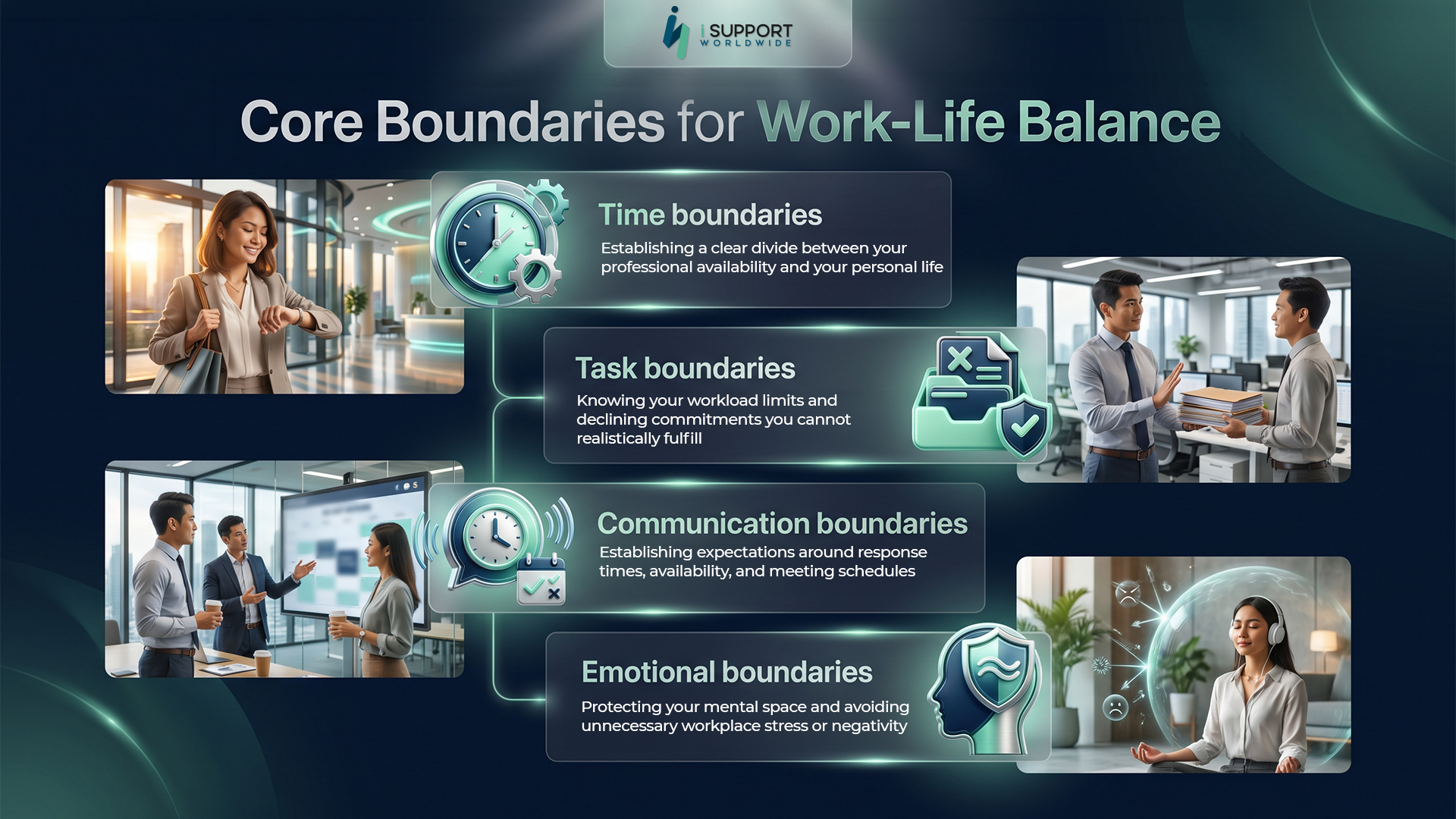
At its core, boundary-setting is about creating a professional life that supports your goals, preserves your energy, and contributes to a healthier work-life balance instead of constantly competing with it.
As The Washington Post notes, “setting an effective boundary means focusing on what’s within your control,” a reminder that healthy boundaries are less about changing others’ behavior and more about clearly defining your own limits and actions.
Why is it important to set boundaries at work?
The modern workplace offers remarkable flexibility and connectivity, but without intentional limits, those same advantages can blur the distinction between work and personal life.
Organizations increasingly recognize that employee well-being isn’t just a nice-to-have initiative, but it’s a critical driver of engagement, retention, innovation, and performance.
Here’s what healthy boundaries can do.
Prevent burnout
Burnout rarely happens overnight. It often develops gradually through prolonged exposure to stress, unrealistic workloads, and the belief that you must always be available.
By creating limits around your time and energy, you reduce the likelihood of chronic exhaustion and protect your capacity to perform consistently over the long term.
A strong commitment to employee well-being begins with recognizing that recovery is not a luxury. It is a requirement for sustained success.
Boost productivity
Contrary to popular belief, working more hours does not automatically result in better outcomes. Constant interruptions, multitasking, and changing priorities can significantly reduce focus and efficiency.
When boundaries help protect deep work periods, individuals often produce higher-quality results in less time.
In many cases, achieving meaningful work-life balance allows professionals to bring greater creativity, concentration, and problem-solving ability to their work.
Improve relationships at work
Clear boundaries reduce confusion around responsibilities, deadlines, and expectations. When colleagues know what they can expect from one another, collaboration becomes smoother and misunderstandings become less frequent.
Teams that embrace healthy boundaries often develop a stronger culture of trust, where employees feel comfortable communicating honestly about priorities, workloads, and challenges without fear of judgment.
Protect your well-being
Your mental, emotional, and physical energy are finite resources. Just as businesses manage budgets strategically, employees should manage their energy intentionally. Boundaries help ensure that work remains an important part of life without becoming the only part of life.
A supportive organization understands that protecting employee well-being ultimately benefits both individuals and the business as a whole.
How do you know if it’s time to set boundaries?
Not sure whether your boundaries need strengthening? Consider whether any of these situations sound familiar:
- You struggle to say “no” even when your workload is already full.
- You regularly work beyond your scheduled hours.
- You feel guilty whenever you take breaks, vacations, or personal days.
- You often feel overwhelmed, mentally exhausted, or emotionally drained.
- You consistently prioritize other people’s requests over your own responsibilities.
- You find yourself responding to messages during evenings, weekends, or family time.
If several of these apply to you, your current approach may be undermining both your work-life balance and your overall well-being.
How do you start setting boundaries?
Building boundaries is not an overnight transformation. Like any professional skill, it requires practice, consistency, and confidence.
Know your priorities
Before setting boundaries, identify what truly matters to you. Consider your professional goals, family commitments, health needs, hobbies, and personal aspirations.
Understanding your priorities provides a clearer framework for deciding where your time and energy should go. People who maintain a strong work-life balance often make decisions based on values rather than urgency alone.
Define your limits
Take an honest look at your capacity and establish realistic expectations.
This might include:
- Not checking work emails after a certain hour
- Blocking uninterrupted focus time on your calendar
- Limiting non-essential meetings
- Setting reasonable turnaround times for requests
- Avoiding overcommitment during busy periods
When organizations encourage healthy boundaries, employees can manage responsibilities more effectively without feeling pressured to constantly exceed their limits.
Communicate clearly
A boundary that remains unspoken isn’t really a boundary. Clear and respectful communication helps prevent misunderstandings while reinforcing expectations.
Here are some examples:
- “I’m currently focused on a priority project and can revisit this next week.”
- “I’d be happy to help, but I need to complete my existing commitments first.”
- “I’m unavailable after 6 PM, but I’ll respond first thing tomorrow.”
It’s also important to remember that boundaries aren’t one-size-fits-all. What feels reasonable and sustainable for one person may look different for someone else based on their role, workload, personal responsibilities, or work style. However, colleagues and managers may not be aware of those boundaries unless they are communicated. Open conversations help others understand your needs and expectations, making it easier to create mutual respect and avoid misunderstandings.
Transparent conversations contribute significantly to a culture of trust, where employees feel respected rather than micromanaged.
Learn to say no without guilt
Many professionals associate saying no with being uncooperative, but effective employees understand that every yes comes with a cost. Agreeing to too many commitments can dilute your focus and impact the quality of your work.
A thoughtful “no” protects your priorities while preserving professional relationships. In fact, the ability to say no appropriately is often a sign of maturity, self-awareness, and strong time management.
Stick to your boundaries
Consistency is what transforms boundaries from good intentions into meaningful habits. If you regularly make exceptions, others may become unsure whether your limits are truly important.
Maintaining healthy boundaries demonstrates respect for your own time and encourages others to do the same.
How does a healthy work boundary look like?
To make these concepts more practical, here are a few examples that can have a meaningful impact over time:
- Logging off at your scheduled time instead of routinely working late
- Taking your lunch break without simultaneously answering emails
- Declining additional work when your workload is already at capacity
- Turning off notifications during dedicated focus periods
- Taking vacation days without checking messages continuously
- Keeping workplace interactions professional and avoiding unnecessary office drama
These seemingly small actions contribute to stronger employee well-being, improved performance, and a healthy work culture overall.
Does setting boundaries at work make you selfish?
One of the most persistent misconceptions about workplace boundaries is the belief that they are selfish. In reality, boundaries are an act of responsibility.
When people maintain appropriate limits, they are more likely to:
- Deliver high-quality work consistently
- Maintain energy and creativity
- Avoid burnout and disengagement
- Build stronger professional relationships
- Contribute positively to a healthy work culture
Rather than pushing people away, boundaries establish clear expectations that strengthen collaboration and foster a lasting culture of trust.
Think of boundaries as respect in action: respect for your role, your responsibilities, your colleagues, and your well-being.
How do healthy boundaries create a healthy workplace?
Organizations benefit enormously when employees feel empowered to establish healthy boundaries. Teams become more productive, communication becomes clearer, and workplace stress becomes more manageable.
A strong and healthy work culture doesn’t expect employees to sacrifice their personal lives for professional success. Instead, it recognizes that people perform best when they have sufficient opportunities to rest, recharge, and maintain meaningful lives outside of work.
Companies that prioritize employee well-being, encourage work-life balance, and promote a genuine culture of trust are often recognized as the best place to work because they understand a simple truth: taking care of people is good for business.
How does iSupport Worldwide support employee well-being?
At iSupport Worldwide, we believe that creating the best place to work requires more than words. It requires meaningful investments in people.
That’s why iSupport Worldwide continues to invest in facilities, resources, and programs designed to help employees feel supported, energized, and empowered every day:
- Fully equipped gym with professional instructors to support physical health and fitness goals
- Break rooms with recreational amenities including PS5 gaming consoles, karaoke, flat-screen TVs with streaming platform access, internet connectivity, and board games for relaxation and social connection
- Comfortable sleeping quarters that allow employees to rest and recharge when needed
- Dedicated chat rooms and collaborative spaces that encourage connection and engagement
- Free meals, snacks, and drinks to keep employees fueled throughout the workday
- HMO coverage starting on day 1, providing immediate access to healthcare support
- Onsite doctors, nurses, and healthcare staff for convenient medical assistance and health monitoring
- Wellness talks, seminars, and webinars focused on physical, mental, emotional, and financial well-being
- Employee engagement activities and programs, including events, workplace celebrations, games, contests, and social initiatives that foster connection, collaboration, and a positive workplace culture
With industry-leading benefits, wellness-focused facilities, and a commitment to creating a healthy work culture, we’re building an environment where people can do their best work while feeling their best every day.
If you’re looking for a company that truly lives its commitment to employee well-being, now is the perfect time to join us.
About the Author Shekina P. Malonzo is a Licensed Professional Teacher and multifaceted Content Developer at iSupport Worldwide, specializing in creating tailored materials for the offshoring industry. |
Founded in 2006, iSupport Worldwide is a US-owned offshoring leader based in the Philippines, delivering tailored solutions to enhance operational efficiency and exceed client expectations. Recognized on the Inc. 5000 list of America’s fastest-growing private companies for three consecutive years, honored in Inc. Magazine’s Power Partner Awards, and a recipient of the ACES Award for Inspiring Workplaces in Asia, iSupport Worldwide embodies a commitment to excellence. |