



Executive Summary
Dedicated offshore teams help CEOs expand capacity without continuously increasing internal headcount, improving workforce scalability while giving internal teams greater focus on strategy, innovation, leadership, and sustainable business growth.
Growth creates a difficult question for CEOs: How do you increase business capacity without continuously increasing internal headcount?
More customers, new markets, and expanding operations require more people and resources. But responding to every increase in demand with another internal hire can create a larger, more complex organization.
That is where dedicated teams offer a different path.
By building dedicated offshore teams, companies can expand operational capacity, access specialized talent, and improve workforce scalability without making internal hiring the default response to growth.
For CEOs, the goal is not simply to add fewer people. It is to build the capabilities the business needs in a smarter, more scalable way.
What Is a Dedicated Offshore Team?
A dedicated offshore team is a group of professionals built around a company’s ongoing functions, workflows, and business objectives.
Rather than operating as disconnected resources, dedicated teams can be integrated into the organization’s processes and support functions such as:
- Customer support
- Finance and accounting
- IT and technical operations
- Marketing
- Sales support
- Back-office operations
The strategic value is straightforward: the business gains additional capability without needing to create every new position internally.
For CEOs looking to scale without increasing headcount at the same pace as business growth, this changes how workforce planning can be approached.
How Do Dedicated Teams Help Companies Scale Without Increasing Headcount?
Dedicated teams help companies scale without increasing headcount by adding operational capacity outside the core internal organization.
Instead of automatically expanding departments whenever workloads increase, business leaders can identify where additional capabilities are needed and determine whether those capabilities need to be built internally or through offshoring.
This creates four strategic advantages.
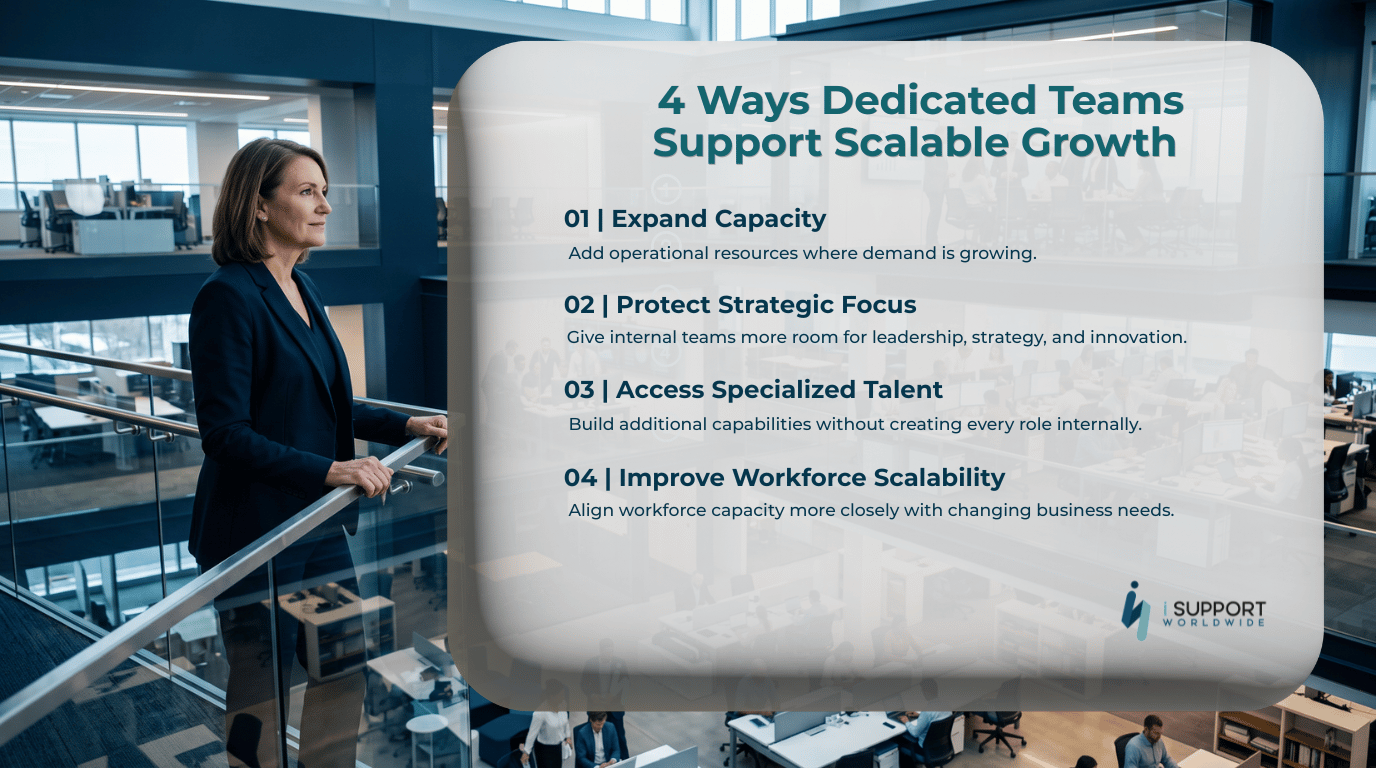
1. Expand Capacity Without Expanding Every Department
Business growth often puts pressure on existing teams.
More customers can increase service requirements. Sales growth can create additional administrative work. Market expansion can put pressure on finance, technology, marketing, and operational functions.
Internal hiring is one way to respond, offshore staffing provides another.
Companies can build dedicated offshore teams around functions experiencing capacity constraints rather than automatically adding more permanent positions to the internal organization.
This separates two concepts that are often treated as the same thing:
Business growth does not always have to mean proportional internal headcount growth.
The company can expand what it is capable of delivering while maintaining a focused internal structure.
2. Keep Internal Talent Focused on Strategic Priorities
Workforce capacity is not only determined by how many employees a company has.
It also depends on what those employees spend their time doing.
Experienced professionals and managers can become consumed by repetitive processes, administrative responsibilities, production work, and daily execution.
As those responsibilities grow, strategic work competes for the same limited capacity.
Structured dedicated teams can take ownership of clearly defined operational responsibilities, giving internal teams more room to focus on leadership, strategy, innovation, and decisions that require deeper institutional knowledge.
The point of offshoring is not simply to move work elsewhere.
It is to create more leverage from the workforce the business already has.
3. Access Offshore Talent Without Building Every Role Internally
As companies scale, they often require a broader range of capabilities.
A growing business might need additional customer support professionals, accountants, IT specialists, marketing talent, or operational resources. Building all those capabilities internally can increase organizational complexity.
Dedicated offshore teams offer CEOs another option.
Instead of immediately opening a new internal position, leadership can ask:
- Which capabilities are essential to our growth?
- Which responsibilities require direct internal ownership?
- Which functions are suited to offshore staffing?
- Where would additional capacity remove operational bottlenecks?
- Which activities are consuming resources that could be focused elsewhere?
These questions transform headcount planning into workforce strategy.
Rather than measuring growth by the number of employees added, leaders can focus on the capabilities the organization needs to accomplish its objectives.
4. Build Greater Workforce Scalability
Growth rarely happens in a perfectly predictable line.
New customers, new markets, changing priorities, and evolving business models can change capacity requirements.
That makes workforce scalability increasingly important.
An offshoring strategy gives CEOs another workforce lever. Leadership can determine which capabilities belong inside the core organization and where offshore teams can provide additional execution capacity.
This creates a more flexible approach to growth.
Instead of asking: “How many people do we need to hire?”
CEOs can ask: “Where do we need more capability?”
That shift encourages leadership to think beyond headcount and design the workforce around business outcomes.
What Makes an Offshore Team Effective?
Offshoring alone does not create scalability. Structure does.
An effective dedicated team needs clearly defined responsibilities, workflows, communication, integration, leadership, and accountability. NIST recommends identifying, assessing, and mitigating cybersecurity risks across supply chains, while FINRA highlights due diligence, data protection, monitoring, and clear offboarding controls for third-party relationships.
That distinction is especially important for growing organizations.
Adding offshore talent without a clear operating structure can add complexity. Building the team around defined workflows and responsibilities creates a stronger foundation for workforce scalability.
The question is not simply where employees are located.
It is how the team fits into the company’s broader operating model.
When Should CEOs Consider Offshore Staffing?
- Where is limited capacity slowing growth?
- Which responsibilities require internal ownership?
- Which functions could gain leverage from a dedicated offshore team?
Grow Capability, Not Just Headcount
Sustainable business growth is not about creating the largest workforce possible.
It is about having the right talent, operating structure, and capacity behind your priorities.
Dedicated teams give CEOs another way to achieve that.
With the right offshore staffing strategy, companies can build dedicated offshore teams, improve workforce scalability, and scale without increasing headcount at the same rate as business demand.
So instead of asking:
“Who should we hire next?”
Consider a more strategic question:
“What capability does the business need next, and what is the smartest way to build it?”
iSupport Worldwide helps businesses build dedicated offshore teams aligned with their operational needs and growth priorities.
Explore how a dedicated offshore team can give your business the capacity to grow without making internal headcount your only growth lever.
How Dedicated Teams Help CEOs Grow
About The Author Denise Romero works as a copywriter at iSupport Worldwide, where she specializes in B2B content that helps businesses flourish. She specializes in creating clear, compelling messages that engage professional audiences and support strategic marketing goals. |
| Founded in 2006, iSupport Worldwide is a US-owned offshoring leader based in the Philippines, delivering tailored solutions to enhance operational efficiency and exceed client expectations. Recognized on the Inc. 5000 list of America’s fastest-growing private companies for three consecutive years, honored in Inc. Magazine’s Power Partner Awards, and a recipient of the ACES Award for Inspiring Workplaces in Asia, iSupport Worldwide embodies a commitment to excellence. |