



Executive Summary
Artificial intelligence (AI) is transforming the workplace by helping organizations improve efficiency, automate routine tasks, and accelerate decision-making. However, the rapid adoption of AI also introduces significant risks that employees and business leaders must understand and manage responsibly.
As AI continues to reshape modern workplaces, organizations that combine innovation with responsible governance will be best positioned for long-term success.
At iSupport Worldwide, we embrace technology as a tool to empower people. Through a culture built on accountability, continuous learning, work-life balance, and professional growth, we help businesses leverage innovation responsibly while enabling talented professionals to build meaningful global careers.
What happens when the technology designed to make work easier begins making critical decisions on behalf of the people using it?
Are you becoming too dependent on AI?
One of the most subtle forms of AI misuse occurs when employees become overly dependent on it.
Instead of using AI as a tool for brainstorming, research assistance, or task acceleration, some workers begin outsourcing judgment itself. This may save time in the short term, but it creates a dangerous gap between execution and understanding.
Consider a manager preparing a strategic recommendation. Rather than analyzing business conditions, customer feedback, and market realities, the manager asks AI for a solution and forwards the result almost unchanged. If leadership later asks deeper questions, the recommendation quickly collapses because nobody truly understands the reasoning behind it.
This can be especially damaging in organizations that pride themselves on strong professional development initiatives. Genuine professional development requires learning, experimentation, and occasional mistakes. When employees rely excessively on AI, they may appear productive while quietly reducing their own growth.
Ironically, the very technology designed to enhance human capability can weaken it when used without discipline.
Here are two kinds of AI misuse
According to Forbes, AI misuse in the workplace generally falls into two categories.
Intentional misuse
This occurs when employees knowingly use AI in ways that violate company policies, deceive employers, or gain an unfair advantage. Examples may include presenting AI-generated work as entirely their own, using unauthorized AI systems, or deliberately bypassing established processes.
Unintentional misuse
This happens when employees genuinely believe they are helping the organization but inadvertently create risks due to a lack of understanding, oversight, or critical evaluation. Overreliance on AI, sharing sensitive information with AI platforms, or accepting AI-generated recommendations without proper review often fall into this category.
The distinction matters because not all AI-related risks stem from bad intentions. In many cases, the greatest challenges arise when workers trust technology too readily, allowing convenience and efficiency to replace critical thinking, accountability, and human judgment.
AI can quietly damage company culture
It can happen much faster than most organizations expect.
Healthy company culture depends on trust, authenticity, accountability, and meaningful collaboration. Problems emerge when employees begin presenting AI-generated work as their own expertise or use AI tools to avoid conversations that require genuine human engagement.
Imagine a leader using AI to draft all feedback conversations without personalization. The words may sound professional, but employees often recognize when communication feels generic. People do not build trust with algorithms. They build trust with other people.
A strong and healthy company culture is created through real interactions, thoughtful leadership, and honest communication. If AI becomes a substitute for those elements rather than a support system, workplace relationships can become surprisingly shallow.
Even recruitment teams may encounter this issue. Candidates increasingly use AI to generate applications, while employers use AI to screen them. At some point, two algorithms may end up evaluating each other while the actual humans remain spectators to the process.
Data security is one of the biggest AI risks
Many employees underestimate the importance of data security when using AI tools.
A seemingly harmless request such as “improve this client presentation” can become a major issue if the uploaded document contains confidential information. Sensitive financial data, customer records, strategic plans, and proprietary processes should never be entered into unauthorized systems.
Organizations often promote attractive client or employee benefits, but protecting employees, customers, and company assets requires more than benefits packages and workplace perks. Responsible AI use and data handling must remain a priority.
When confidential information is exposed through improper AI usage, the consequences can include regulatory penalties, reputational damage, legal complications, and a significant loss of trust.
Those risks are far more expensive than the few minutes someone hoped to save.
AI can create unfair workplace decisions
Another significant concern involves bias. AI systems learn from data, and data often reflects historical patterns, including unfair ones. If employees blindly trust AI-generated recommendations regarding hiring, promotions, disciplinary actions, or resource allocation, they may unintentionally reinforce existing inequalities.
Many organizations emphasize career growth opportunities and equal access to advancement. However, these goals become harder to achieve when AI recommendations are accepted without human review.
Professionals must remember that technology can assist decision-making, but responsibility still belongs to humans.
An AI tool should contribute insights and not deliver the final verdict.
AI affects work-life balance in unexpected ways
Most people assume technology improves efficiency, which should theoretically support better work life balance. In some cases, that is exactly what happens.
In other situations, however, AI creates the expectation that employees should respond faster, produce more content, complete more tasks, and operate at an increasingly relentless pace.
The result can be a workplace where productivity targets continuously expand because technology makes additional output possible. Instead of supporting work life balance, AI may inadvertently contribute to burnout if organizations fail to establish healthy expectations.
A well-designed workplace uses AI to reduce unnecessary work, not to fill every recovered minute with new assignments.
After all, if a tool saves two hours but management immediately replaces those two hours with additional tasks, employees may wonder whether they gained efficiency or merely upgraded their workload.
What does responsible AI use actually look like?
Responsible AI use is surprisingly simple in theory, even if it requires discipline in practice.
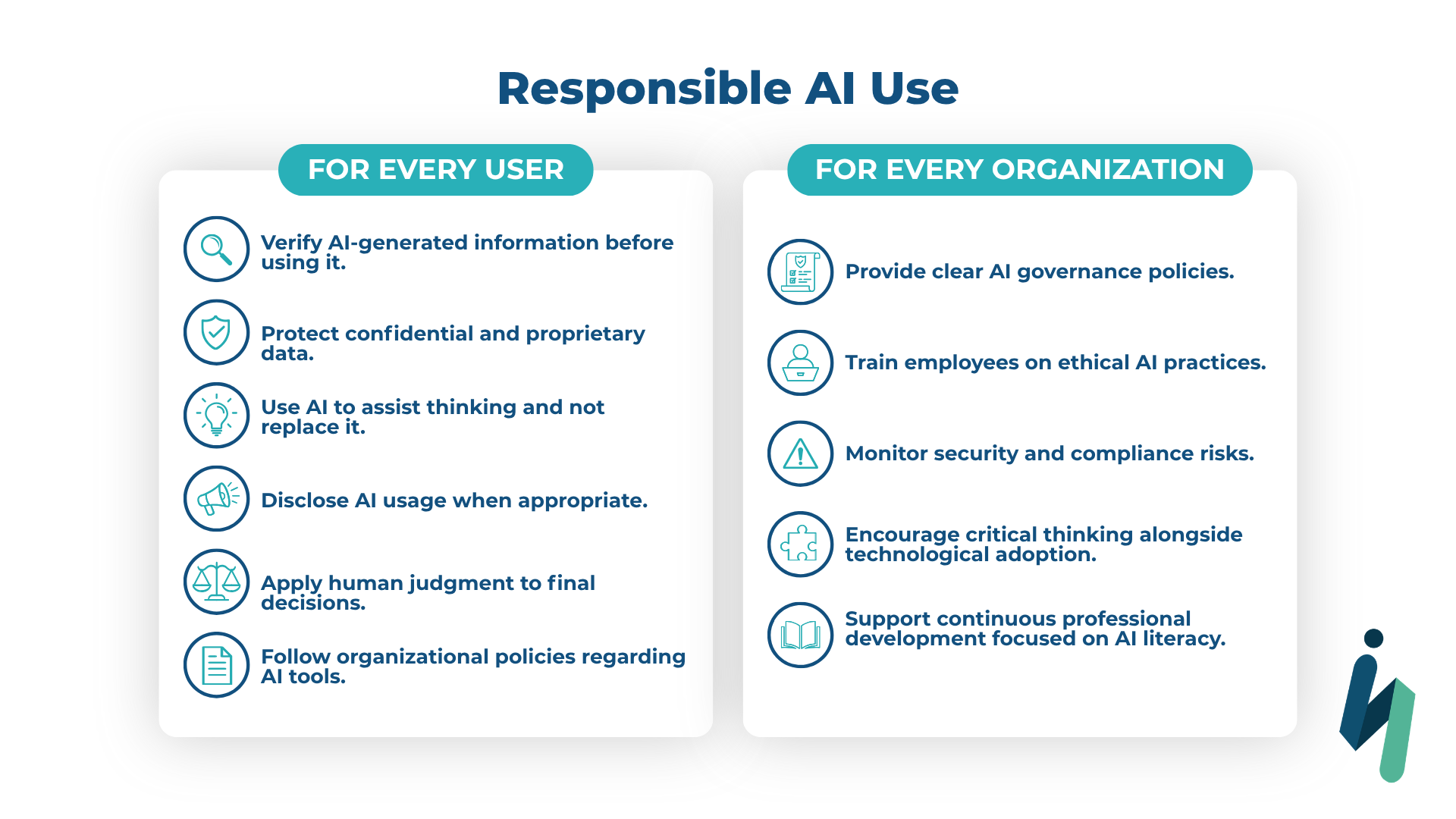
Most importantly, leaders should reinforce a healthy company culture where employees feel accountable for outcomes, regardless of whether those outcomes originated from human effort or algorithmic assistance.
As leadership experts have noted, effective AI adoption is not simply a matter of purchasing new technology. As noted in Harvard Business Impact, successful AI adoption depends less on the technology itself and more on how leaders prepare people to work alongside it.
This reinforces an important principle of responsible AI use: long-term success depends as much on human capability, leadership, and judgment as it does on the technology itself.
The future of work still belongs to humans
AI is neither a workplace hero nor a workplace villain. It is a powerful tool whose value depends entirely on how people choose to use it.
The smartest organizations will not be the ones that automate everything possible. They will be the ones that understand a simple truth: technology performs best when it amplifies human intelligence rather than attempts to replace it.
Because while AI may be capable of generating answers in seconds, it still cannot replicate the curiosity, accountability, wisdom, and judgment that good employees bring to work every day. Those remain uniquely human advantages worth keeping.
If you’re looking to grow with an organization that embraces innovation responsibly, values work life balance, offers competitive employee benefits, and creates genuine career growth opportunities, discover what makes iSupport Worldwide a workplace where both people and technology can succeed together.
Using AI at Work? Don't Skip These 6 Essential Habits
About The Author Shekina Malonzo is a Licensed Professional Teacher and Content Developer at iSupport Worldwide, specializing in creating tailored materials for the outsourcing and offshoring industry. She develops content that supports both client engagement and talent alignment. |
Founded in 2006, iSupport Worldwide is a US-owned offshoring leader based in the Philippines, delivering tailored solutions to enhance operational efficiency and exceed client expectations. Recognized on the Inc. 5000 list of America’s fastest-growing private companies for three consecutive years, honored in Inc. Magazine’s Power Partner Awards, and a recipient of the ACES Award for Inspiring Workplaces in Asia, iSupport Worldwide embodies a commitment to excellence. |