



Executive Summary
Discover how Fortune 100 companies leverage global talent to scale operations, increase resilience, and drive growth, and how mid-market businesses can build dedicated teams using the same proven strategies.
Introduction
Many business leaders assume offshore transformation is reserved for Fortune 100 companies with massive budgets, large global operations, and complex technology infrastructure. But the core principles behind enterprise success are now accessible to growing companies through outsourcing, dedicated teams, and offshore staffing solutions.
By treating global talent as a strategic resource, not simply a lower-cost labor pool, mid-market businesses can scale more efficiently, access specialized expertise, extend operating hours, and build greater resilience.
What Fortune 100 Companies Understand About Offshore Transformation
Offshore transformation has evolved beyond traditional cost reduction. While labor efficiency remains an important consideration, leading companies now use global teams to support innovation, business continuity, customer experience, and long-term growth.
The most successful organizations recognize that talent is no longer limited by geography. A company headquartered in the United States may recruit customer support professionals in the Philippines, software specialists in Eastern Europe, finance experts in Latin America, and data analysts in India. This global approach allows businesses to match specialized skills with business needs, regardless of where those skills are located.
Fortune 100 companies commonly use offshore teams to:
- Access specialized expertise that may be scarce in their domestic market
- Scale departments faster than traditional local hiring allows
- Extend operating hours across multiple time zones
- Improve business continuity and operational resilience
- Accelerate digital transformation and innovation
- Support customers across regions and languages
- Manage rising labor costs without compromising growth plans
This shift is especially important as organizations face talent shortages, changing employee expectations, and increasing competition for technical and operational professionals. A local-only hiring strategy can limit how quickly a company responds to new opportunities. A global talent strategy creates more options.
Offshore transformation is strategic, not transactional
Traditional outsourcing often focuses on completing a defined task at the lowest possible cost. Offshore transformation takes a broader view. It asks how a global team can improve the way a company operates and create a stronger foundation for growth.
For example, an organization may initially offshore customer support to manage demand more efficiently. Over time, that team may also identify recurring customer issues, improve knowledge-based content, support quality assurance, and provide insights to product or operations leaders.
The offshore team is no longer treated as an external vendor completing isolated tasks. It becomes part of the company’s broader workforce transformation strategy.
That distinction matters. Companies that focus only on hourly rates may overlook factors such as:
- Talent quality
- Team stability
- Communication
- Training and management
- Data security
- Process maturity
- Cultural alignment
- Long-term scalability
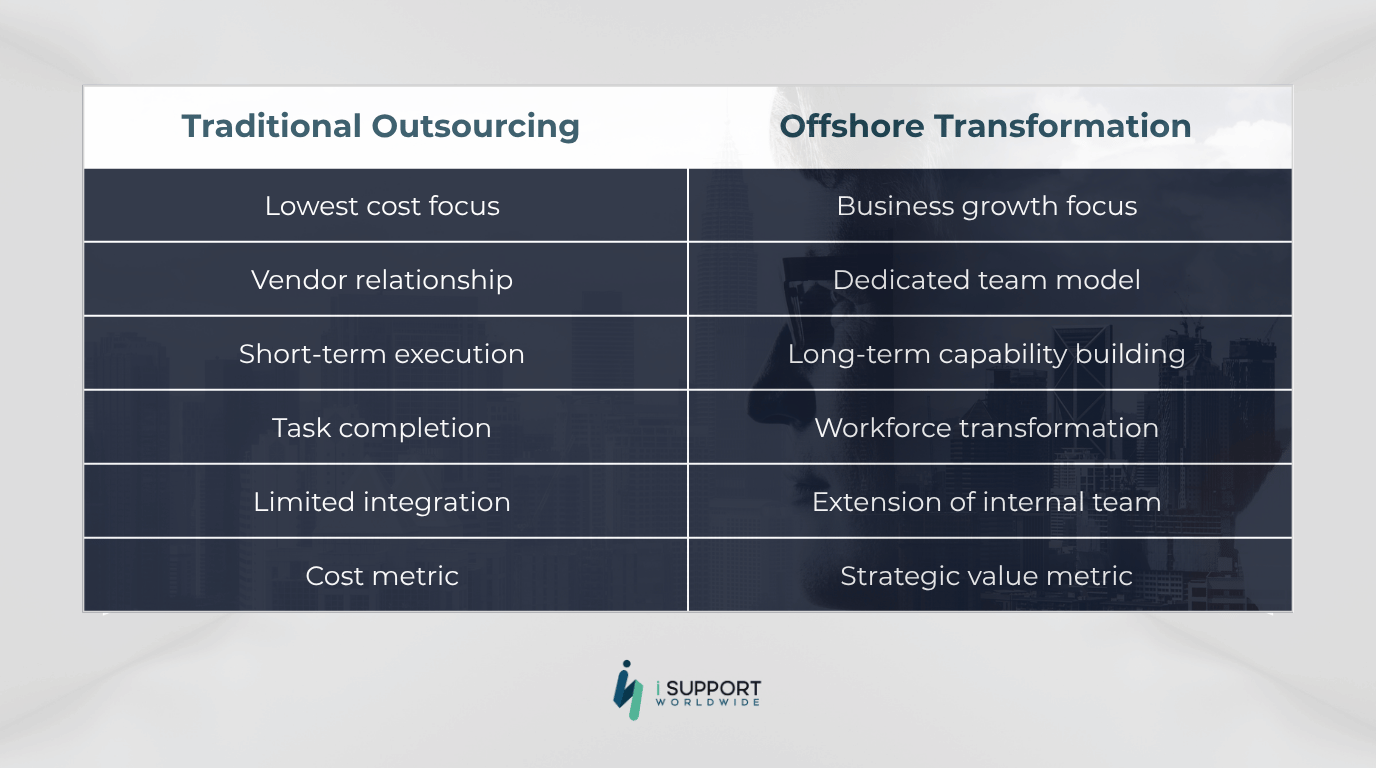
Fortune 100 companies typically evaluate offshore operations through this wider strategic lens. Their objective is not merely to spend less. It is to build a more flexible, capable, and resilient business.
Real Fortune 100 Examples of Offshore Transformation
Fortune 100 companies use a combination of offshore outsourcing, global delivery centers, international subsidiaries, external suppliers, and global capability centers to access talent and expand operational capacity.
These businesses show how offshore operations can support more than cost reduction.
Apple relies extensively on outsourcing partners for substantially all of its hardware manufacturing, including components, assembly, and product testing. This allows the company to combine centralized product design with specialized global manufacturing capacity.
General Electric provides an example from business-process operations. In 1997, GE Capital launched a 20-person pilot focused on improving back-office operations. The operation later became independent from GE in 2005 and evolved into Genpact, a global business-services company.
Walmart illustrates how business scale can be supported by globally coordinated operations. Its 2025 Form 10-K describes retail, e-commerce, supply-chain, and distribution operations across countries and regions including China, India, Mexico, and Central America. Walmart International used 184 distribution facilities across Canada, Central America, Asia, and Africa to process and distribute imported and domestic products. The example shows that global transformation involves more than labor sourcing; it also requires logistics, technology, procurement, supplier standards, compliance, and operational coordination.
These examples show that offshore transformation can expand operational capacity, provide access to specialized expertise, and support business growth. While growing companies may not replicate Fortune 100 models at the same scale, they can apply the same principles through dedicated teams and strategic outsourcing.
How Mid-Market Companies Can Apply the Same Strategy
Growing companies no longer need Fortune 100 budgets to benefit from offshore transformation. With today’s collaboration tools and outsourcing partners, such as in the Philippines, businesses can build dedicated teams, access global talent, and scale more efficiently without establishing overseas offices. Success often comes down to applying the right principles:
- Start with critical business functions that directly support growth and efficiency.
- Build dedicated teams instead of relying solely on transactional outsourcing.
- Prioritize talent quality over short-term cost savings.
- Create scalable processes with clear workflows and accountability.
- Treat offshore teams as strategic assets that contribute to long-term business success.
By adopting these practices, mid-market organizations can capture the same advantages that Fortune 100 companies have leveraged for years.
Building an Offshore Team for Sustainable Growth
A successful offshore transformation usually begins with a focused pilot rather than an immediate attempt to move an entire department overseas.
Companies can start by:
Identifying a business function with clear capacity or talent constraints
- Defining the roles, responsibilities, and expected outcomes
- Selecting an outsourcing or offshore staffing model
- Establishing communication, security, and performance processes
- Launching a small dedicated team
- Reviewing results and improving workflows
- Expanding the model into adjacent functions when appropriate
For example, a growing software company may begin with a dedicated Philippines-based customer support team. Once the model is stable, it may add technical support, quality assurance, customer success, or operations roles.
This gradual approach reduces risk while allowing the company to develop the management practices required for distributed work.
iSupport Worldwide helps businesses build dedicated teams in the Philippines aligned with their operational requirements and long-term growth objectives. Rather than treating offshore staffing as a short-term labor solution, the company supports organizations in developing high-performing teams that can become an extension of their internal operations.
Conclusion
Fortune 100 companies have demonstrated that offshore transformation is not merely a cost-saving tactic. It is a strategic approach to accessing specialized talent, scaling operations, improving resilience, and supporting innovation.
Growing companies can apply the same principles without replicating the size or complexity of an enterprise organization. By starting with critical functions, prioritizing talent quality, building dedicated teams, and creating scalable processes, mid-market businesses can turn global staffing into a long-term competitive advantage.
The companies that embrace global talent strategies early may be better positioned to compete, innovate, and scale in an increasingly borderless workforce environment.
Explore how iSupport Worldwide helps businesses build high-performing dedicated teams in the Philippines to support sustainable growth and long-term operational success.
About The Author Denise Romero works as a copywriter at iSupport Worldwide, where she specializes in B2B content that helps businesses flourish. She specializes in creating clear, compelling messages that engage |
| Founded in 2006, iSupport Worldwide is a US-owned offshoring leader based in the Philippines, delivering tailored solutions to enhance operational efficiency and exceed client expectations. Recognized on the Inc. 5000 list of America’s fastest-growing private companies for three consecutive years, honored in Inc. Magazine’s Power Partner Awards, and a recipient of the ACES Award for Inspiring Workplaces in Asia, iSupport Worldwide embodies a commitment to excellence. |