



Executive Summary
Many professionals miss career-changing opportunities not because they never apply. Fear of rejection, imposter syndrome, and the belief that they must meet every requirement often prevent qualified candidates from taking action. In reality, employers evaluate much more than a checklist of qualifications. They look for potential, adaptability, problem-solving ability, cultural fit, and a willingness to learn.
At iSupport Worldwide, we believe great careers begin when talented professionals take that first step. As a trusted offshoring company, we connect skilled individuals with rewarding opportunities to join high-performing dedicated teams supporting businesses around the world. We value potential as much as experience, providing professionals with the chance to grow their careers, gain international exposure, develop new skills, and make a meaningful impact. Your next opportunity could be the one that transforms your future, but you’ll never know unless you take your shot.
Table Of Contents |
Every day, qualified professionals scroll past job opportunities that could potentially elevate their careers, increase their income, expand their networks, and expose them to valuable learning experiences, yet many never make it beyond the job description because they have already convinced themselves that they are not the right candidate.
Perhaps you’ve looked at a role that seemed exciting, only to become fixated on the three qualifications you lacked rather than the seven you already possessed.
The reality is that this scenario plays out far more often than many people realize, and it reveals a surprising truth about career growth: many opportunities are not lost because of rejection but because of hesitation.
In a highly competitive job market where organizations are constantly searching for professionals who can contribute to dedicated teams, solve business challenges, and adapt to evolving workplace demands, failing to apply often eliminates the possibility of success before the process has even begun.
How many opportunities have you talked yourself out of?
The modern job search can feel overwhelming, especially when candidates are exposed to hundreds of listings featuring lengthy requirements, ambitious expectations, and descriptions that make every position sound like it was designed for a superhero rather than a human being.
As a result, many job seekers view requirements as strict barriers instead of flexible guidelines.
For example, a candidate may see a position requiring five years of experience and automatically withdraw from consideration because they only have four years, despite possessing relevant achievements, industry knowledge, and transferable skills that could make them a strong contender. Similarly, a professional exploring career opportunities within dedicated teams may convince themselves that leadership, communication, or technical requirements are beyond their abilities, even when their daily work already demonstrates those competencies.
What many applicants fail to realize is that hiring decisions are rarely based on a single qualification. Employers evaluate a combination of skills, experience, growth potential, cultural fit, adaptability, and attitude. In fact, many organizations, including offshoring companies, assess whether candidates can learn, collaborate, and contribute effectively over time rather than simply checking every box on a job description.
Why do you hesitate to take your shot?
Before learning how to pursue opportunities more confidently, it is important to understand why people often hesitate in the first place.
Fear of rejection
Human beings are naturally wired to avoid situations that might lead to disappointment, embarrassment, or perceived failure. Receiving a rejection email can feel personal, even when the decision may have been influenced by factors completely outside the applicant’s control.
Ironically, attempting to avoid rejection often results in something far worse: guaranteed inaction.
An application that is never submitted cannot succeed, cannot open conversations, cannot generate interview opportunities, and cannot lead to unexpected career paths.
Imposter syndrome
Imposter syndrome convinces capable professionals that their accomplishments are accidents rather than evidence of competence. It creates the illusion that everyone else is more prepared while exaggerating our own shortcomings.
This mindset is particularly common among individuals pursuing opportunities with dedicated teams or global organizations, where they may assume that other applicants possess superior qualifications.
However, research and workplace observations repeatedly demonstrate that competence and confidence are not always connected. Many successful professionals take action despite uncertainty rather than waiting for certainty to arrive.
The need to feel fully prepared
Many candidates postpone action because they believe they need to feel completely prepared before pursuing an opportunity.
They want one more certification, one more year of experience, one more successful project, or one more accomplishment on their resume before they finally take the leap. While continuous learning is beneficial, there comes a point where preparation stops being productive and starts becoming a convenient excuse for postponing action.
The reality is that few professionals ever feel 100% ready for opportunities that ultimately change their careers. Whether it’s applying to work with high-performing dedicated teams, pursuing leadership positions, or exploring opportunities with growing organizations like outsourcing or offshoring companies, growth often begins before confidence catches up. The professionals who move forward are not necessarily the ones who feel ready; they are often the ones who choose to act despite feeling uncertain.
Golden handcuffs
Not all hesitation comes from self-doubt. Sometimes, professionals stay where they are because their current situation feels too comfortable to leave.
Higher salaries, attractive benefits, flexible schedules, long tenure, or familiarity with a role can create what is often called “golden handcuffs,” incentives that make it difficult to pursue new opportunities, even when career growth has stalled. While there is nothing wrong with appreciating the stability you’ve earned, comfort can sometimes mask missed opportunities for learning, advancement, and greater fulfillment.
Here's why it's worth exploring opportunities
The workforce has evolved dramatically over the past decade, creating unprecedented access to career opportunities. According to the World Economic Forum, expanding digital access and the normalization of remote work have enabled a growing range of jobs to be performed online.
Remote work technologies, international collaboration platforms, and the growth of offshoring companies have enabled businesses to build dedicated teams composed of talent from different regions, cultures, and professional backgrounds. This means that opportunities which may have been inaccessible years ago are now available to a much broader pool of professionals.
By taking your shot at opportunities, you gain benefits that extend far beyond a potential job offer.
You gain market feedback
Every application provides valuable information about how employers perceive your experience, skills, and qualifications.
Whether you move forward in the hiring process or not, the experience helps you identify strengths, opportunities for improvement, and areas where additional development could make you more competitive.
You expand your professional network
Many candidates view applications as one-time transactions, but they are often the beginning of long-term professional relationships.
A recruiter who does not hire you today may remember you for a future opening. A hiring manager may recommend you for a different position. An interviewer may become a professional contact years later.
Many candidates view applications as one-time transactions, but they are often the beginning of long-term professional relationships. A recruiter who does not hire you today may remember you for a future opening. A hiring manager may recommend you for a different position. An interviewer may become a professional contact years later. According to Stanford, researchers who analyzed LinkedIn data from 20 million users over five years found that weak professional ties were the most helpful for career advancement, highlighting the long-term value of expanding your network through new opportunities.
The opportunity you apply for today can open doors that have not even been created yet.
You build career resilience
Every application, interview, and networking interaction develops skills that become increasingly valuable over time.
Professionals who consistently pursue opportunities generally become more comfortable with uncertainty, more confident in presenting their strengths, and more adaptable in navigating challenges. These qualities are highly valued within dedicated teams because they contribute to stronger collaboration and long-term professional success.
The next opportunity could be your breakthrough
It is natural to focus on the possible cost of pursuing an opportunity, including rejection, uncertainty, or disappointment. However, there is also a cost to not trying.
Every opportunity you choose not to explore closes the door on outcomes you cannot fully predict.
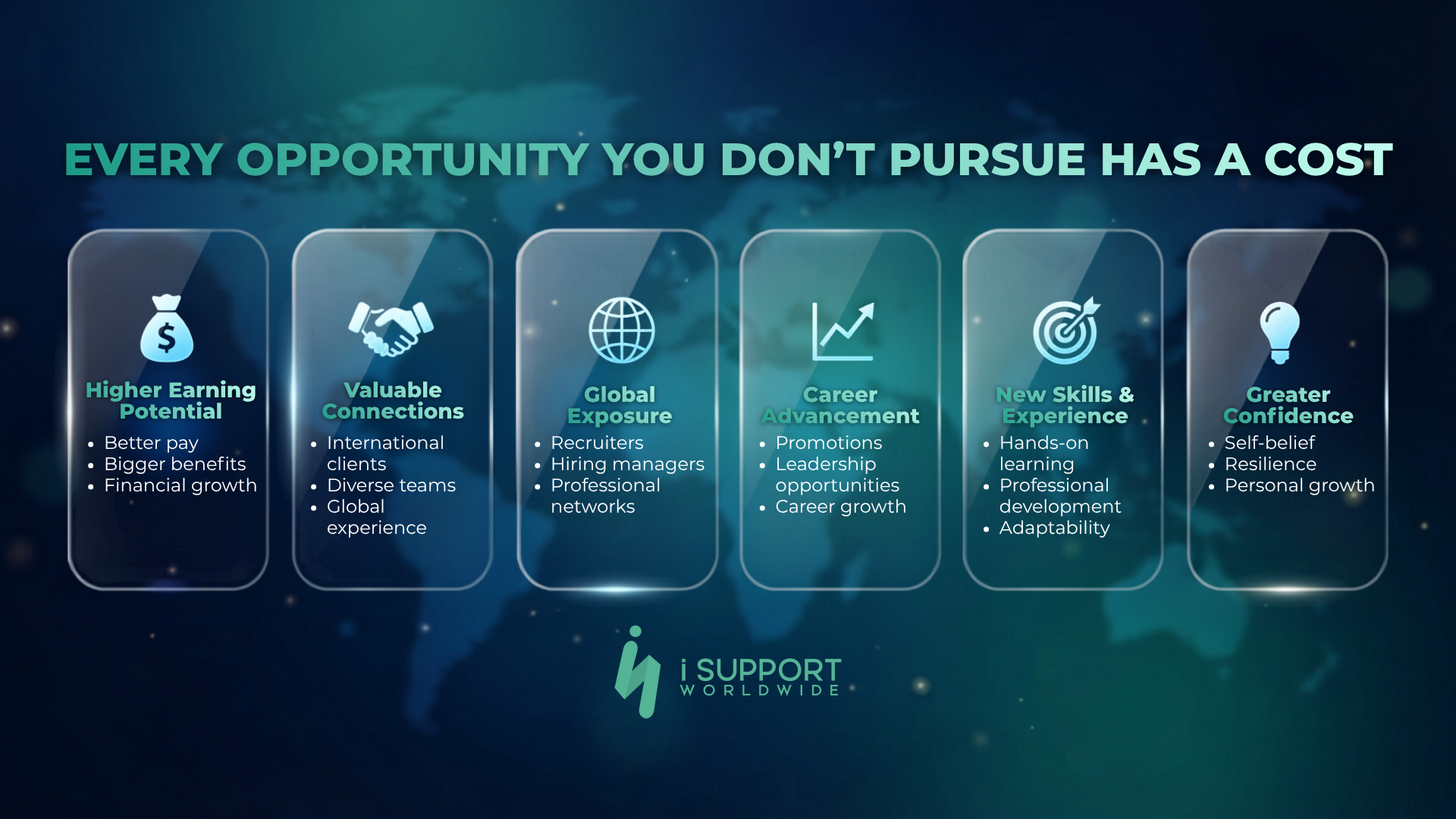
While not every application results in an offer, every opportunity you avoid guarantees that no new possibility will be created. Over time, these missed opportunities can compound. By choosing not to engage, you may also miss the chance to discover where your skills are valued most.
Here’s how you can build the courage to take more opportunities
Courage is often misunderstood as the absence of fear when, in reality, courage is the decision to act despite fear.
Here are practical ways to strengthen that mindset.
Shift from "what if I fail?" to "what will I gain"?
The brain naturally focuses on potential risks, yet career advancement often depends on recognizing potential rewards.
Instead of imagining rejection, consider the possibilities that could emerge from a single application: a new role, a salary increase, exposure to international markets, participation in high-performing dedicated teams, or a chance to work with growing companies.
Treat job descriptions as guidelines
Most hiring managers understand that the ideal candidate rarely exists.
If you meet a substantial portion of the requirements and believe you can perform the role successfully, applying is often worthwhile.
Employers frequently hire individuals based on potential and train them in areas where additional development is needed.
Create a habit of taking small risks
Confidence is often mistaken as something people either have or don’t have, but in reality, it is a skill that develops through repeated exposure to challenges and unfamiliar situations.
Every time you apply for a role that pushes beyond your comfort zone, contribute an idea during a meeting, volunteer for a cross-functional project, or pursue an opportunity that feels slightly intimidating, you train yourself to become more comfortable with uncertainty and less dependent on guaranteed outcomes.
Over time, these seemingly small acts of courage accumulate into greater self-confidence, making larger career moves such as applying for leadership roles, changing industries, or pursuing international opportunities feel significantly less overwhelming. The goal is not to eliminate fear altogether but to build enough experience taking risks that fear no longer determines your decisions.
Separate opportunity from identity
A rejected application is feedback on a particular opportunity at a specific moment in time. It is not a judgment of your intelligence, worth, potential, or future success.
Rejection is part of the process, not the definition of a person.
The fastest way to miss an opportunity is to convince yourself you don't deserve it
The opportunities that make the biggest difference in our careers rarely arrive when we feel completely prepared for them. More often, they appear as roles that seem slightly beyond our current experience, projects that challenge us to learn new skills, or openings that require us to step outside familiar routines.
The truth is that employers cannot evaluate your potential, appreciate your strengths, or recognize the value you can bring to a team if you never put yourself forward. Every application represents more than a chance to land a job; it is a chance to gain visibility, build connections, learn from the hiring process, and open doors that may lead to future opportunities.
You simply won’t know unless you take the first step.
So instead of focusing on the possibility of rejection, consider the cost of never trying. A rejection may close one door, but choosing not to apply closes every door before you’ve even had the chance to knock.
Because while success is never guaranteed, one thing certainly is: you will miss 100% of the opportunities you never pursue. And sometimes, all it takes to change the direction of your career is having the courage to click the button below.
About The Author Shekina Malonzo is a Licensed Professional Teacher and Content Developer at iSupport Worldwide, specializing in creating tailored materials for the offshoring industry. She develops content that supports both client engagement and talent alignment. |
Founded in 2006, iSupport Worldwide is a US-owned offshoring leader based in the Philippines, delivering tailored solutions to enhance operational efficiency and exceed client expectations. Recognized on the Inc. 5000 list of America’s fastest-growing private companies for three consecutive years, honored in Inc. Magazine’s Power Partner Awards, and a recipient of the ACES Award for Inspiring Workplaces in Asia, iSupport Worldwide embodies a commitment to excellence. |