



Executive Summary
As local talent pools become increasingly constrained, businesses are adopting offshore staffing solutions as a scalable workforce strategy, enabling access to specialized expertise, stronger operational flexibility, and sustainable growth.
Introduction
For decades, hiring local talent wasn’t just common practice. It was the default.
When a position opened, companies posted listings within their city, state, or region and competed against neighboring employers for the same talent pool. The assumption was simple: the best employees were the ones close by.
Today, that assumption is harder to defend.
Business leaders face a different reality than they did even five years ago. Talent shortages persist across industries. Competition for skilled professionals continues to intensify. Hiring timelines stretch longer, labor costs climb higher, and growth initiatives often stall because companies cannot secure the people they need.
According to ManpowerGroup’s 2026 Global Talent Shortage Survey, 72% of employers worldwide report difficulty filling open roles, the highest level on record, with AI and specialized technical skills now the hardest to find. In Asia Pacific and the Middle East, shortages are even more acute, with countries like Japan (84%) and India (82%) reporting extreme scarcity.
The organizations thriving in this environment are asking different questions.
Instead of asking, “Who can we hire locally?”
They’re asking, “Where can we find the best talent to support our business goals?”
The answer is changing the way modern companies build teams.
Why Local Hiring Became the Standard
For most of modern business history, geography determined access to talent.
Employees worked in physical offices. Collaboration happened face-to-face. Technology limited the ability to manage distributed teams effectively. Hiring locally was less of a strategic decision and more of a logistical necessity.
As a result, organizations built workforce strategies around proximity rather than access.
But many of the factors that made local hiring essential no longer exist.
Cloud-based systems, digital collaboration platforms, project management tools, and workforce technologies have transformed how work gets done. Teams can now communicate, collaborate, and perform at high levels regardless of location.
The workplace changed.
Many hiring strategies did not.
The Hidden Cost of Limiting Your Talent Search
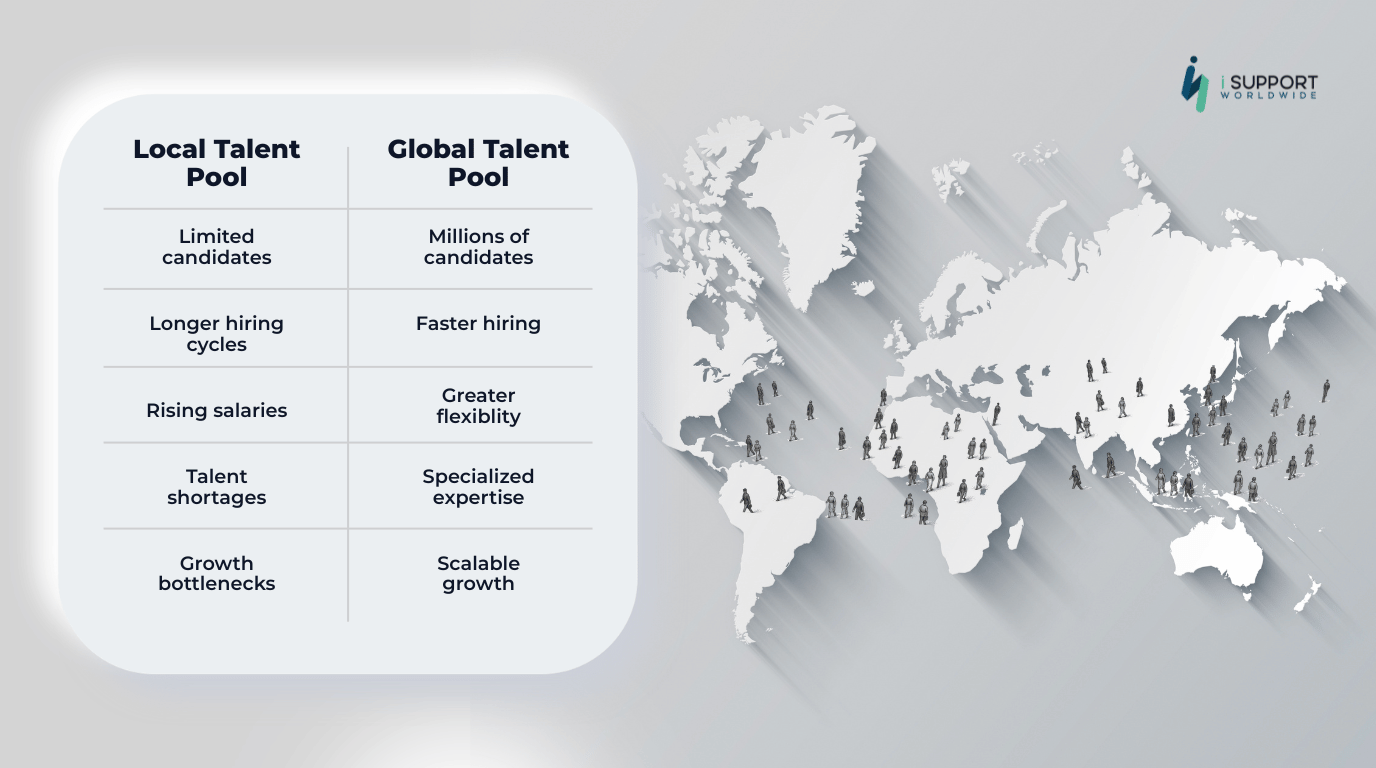
When companies restrict their search to a single city or region, they often create growth constraints without realizing it.
The most obvious challenge is a smaller talent pool.
When every employer in a market is competing for the same professionals, businesses face longer hiring cycles, more vacant roles, and greater difficulty finding specialized expertise. Gartner research shows that only 31% of recruiting teams currently use labor market data to inform their talent strategy—meaning most organizations are making workforce decisions without a clear view of external talent availability.
But the impact extends beyond recruitment.
Unfilled positions can slow projects, increase workloads for existing employees, delay client deliverables, and limit a company’s ability to scale. As growth accelerates, these workforce gaps become operational bottlenecks.
In many cases, leaders assume the problem is a lack of available talent.
The real problem is that they’re searching in only one place.
Today’s workforce is global. Restricting hiring to a local market means intentionally ignoring a much larger pool of qualified professionals who can help move the business forward.
What High-Growth Companies Understand
The companies gaining a competitive edge are not necessarily those with the biggest budgets.
They are the ones with the broadest access to talent.
Rather than limiting hiring decisions to geography, these organizations focus on capability, experience, cultural fit, and business impact.
As a result, they are often able to:
- Hire faster by tapping into global availability instead of waiting for local candidates.
- Access specialized expertise that may not exist in their immediate market
- Increase operational flexibility through time-zone coverage and distributed capacity.
- Scale teams more efficiently without being constrained by local labor supply
- Reduce workforce bottlenecks by diversifying talent sources.
- Build greater resilience into their operations against regional economic shifts.
Most importantly, they can continue growing even when local labor markets become constrained.
This shift is not about replacing local employees.
It’s about giving businesses more options and creating a workforce strategy that supports long-term growth.
In today’s environment, talent acquisition is increasingly becoming a global strategy rather than a local activity. Gartner predicts that by 2026, more than 60% of companies will rely on flexible leadership models, with demand for interim and fractional executives growing roughly 30% year over year.
The Rise of Dedicated Offshore Teams
One of the biggest misconceptions about offshoring is that offshore teams are difficult to manage.
In reality, many organizations already operate across multiple locations, business units, and time zones.
Customers, vendors, stakeholders, and operational functions often span different regions and countries. As a result, managing geographically diverse teams has become a normal part of modern business operations.
Organizations that see the greatest success with dedicated offshore teams establish clear communication processes, performance expectations, accountability frameworks, and operational standards.
When implemented effectively, dedicated offshore teams function as seamless extensions of the business. They provide access to highly skilled professionals while helping organizations increase efficiency, improve service consistency, and support scalable growth.
The focus shifts from where team members are based on the value they create.
Successful offshore staffing strategies are built on strong operational design, clear workflows, and alignment with business objectives. When those elements are in place, geography becomes far less important than performance and outcomes.
Why Workforce Strategy Needs to Evolve
Many business leaders continue to approach workforce growth the same way they did a decade ago.
The challenge is that labor markets have changed faster than workforce strategies.
Organizations that rely solely on local talent pools often face increasing competition for skilled professionals while experiencing slower growth and greater operational pressure.
Meanwhile, companies that utilize offshore staffing and dedicated offshore teams can scale more efficiently, strengthen operational capacity, and respond more quickly to market opportunities.
This is no longer simply a workforce decision.
It is a strategic business decision.
The question is no longer whether qualified professionals exist beyond local markets.
The question is whether organizations are prepared to leverage offshoring as a competitive advantage.
Leaders who incorporate offshore workforce solutions into their long-term strategy position themselves for greater flexibility, scalability, and resilience.
How iSupport Worldwide Helps Businesses Build Global Teams
At iSupport Worldwide, we help organizations move beyond the limitations of traditional workforce models.
We partner with growing businesses to build dedicated offshore teams that integrate seamlessly into existing operations. Whether companies need support across customer experience, back-office functions, finance, marketing, administration, or specialized operational roles, our offshore staffing solutions provide access to highly skilled professionals aligned with business objectives.
Rather than viewing growth through a local workforce lens, we help business leaders leverage offshoring to create scalable, high-performing teams built for long-term success.
The result is increased operational capacity, stronger workforce flexibility, and a more scalable foundation for sustainable growth.
The Future of Hiring Isn't Local
Local teams will always play an important role in business success.
But they are no longer the only option.
The most successful organizations understand that exceptional talent exists beyond geographic boundaries. They are embracing offshoring, investing in dedicated offshore teams, and creating workforce models designed for scalability.
Businesses that continue limiting themselves to local talent pools risk missing opportunities to strengthen operations and accelerate growth.
Those that adopt offshore staffing as part of their workforce strategy gain a significant competitive advantage.
The future belongs to organizations that can build the best team possible, regardless of location.
Ready to explore how dedicated offshore teams can support your growth goals? Schedule a discovery call with iSupport Worldwide and discover how our offshore staffing solutions can help your business scale faster, operate more efficiently, and stay competitive in an increasingly talent-driven market.
Beyond Local Talent: The Workforce Advantage Growth-Focused Companies Are Leveraging
About The Author Denise Romero works as a copywriter at iSupport Worldwide, where she specializes in B2B content that helps businesses flourish. She specializes in creating clear, compelling messages that engage professional audiences and support strategic marketing goals. |
| Founded in 2006, iSupport Worldwide is a US-owned offshoring leader based in the Philippines, delivering tailored solutions to enhance operational efficiency and exceed client expectations. Recognized on the Inc. 5000 list of America’s fastest-growing private companies for three consecutive years, honored in Inc. Magazine’s Power Partner Awards, and a recipient of the ACES Award for Inspiring Workplaces in Asia, iSupport Worldwide embodies a commitment to excellence. |