



Executive Summary
Businesses evaluating traditional hiring versus offshore staffing must weigh the cost of hiring, scalability, and access to a global talent pool to maximize ROI and sustainable growth.
In the outsourcing vs. hiring debate, businesses in 2027 are looking beyond salary comparisons. Rising workforce costs, persistent skills gaps, and pressure to scale efficiently have made total return on investment a more important measure.
Hiring gives companies direct control over their workforce and culture. Outsourcing, particularly through a dedicated offshore team, can reduce employment-related overhead, expand access to talent, and make growth more flexible.
Key takeaway: Outsourcing generally delivers better ROI for repeatable operational and support roles, while in-house hiring remains valuable for leadership and strategy. For many businesses, a hybrid workforce combining both models produces the strongest return.
1. The Real Cost of Hiring vs. Outsourcing in 2027
The cost of hiring employees extends well beyond base salary. Businesses must also consider recruitment, onboarding, training, benefits, payroll administration, equipment, software, workspace, and ongoing management.
In fact, SHRM’s 2025 Talent Trends and Benchmarking Report found that the average direct cost per hire is $5,475 for non-executive roles and $35,879 for executive positions, even before accounting for vacancy-related productivity losses, lost opportunities, or the time it takes new hires to reach full productivity. These figures highlight how quickly hiring expenses can add up, particularly for businesses scaling their teams.
Turnover adds another layer of expense. When an employee leaves, the company must recruit and train a replacement while managing the productivity gap created by the vacancy. These costs can make an apparently affordable local hire more expensive over the full employment lifecycle.
Outsourcing works differently. With an offshore staffing partner, many recruitment, human resources, infrastructure, and administrative responsibilities are managed through one service arrangement. This gives the client a more predictable workforce cost while reducing the demands placed on its internal teams.
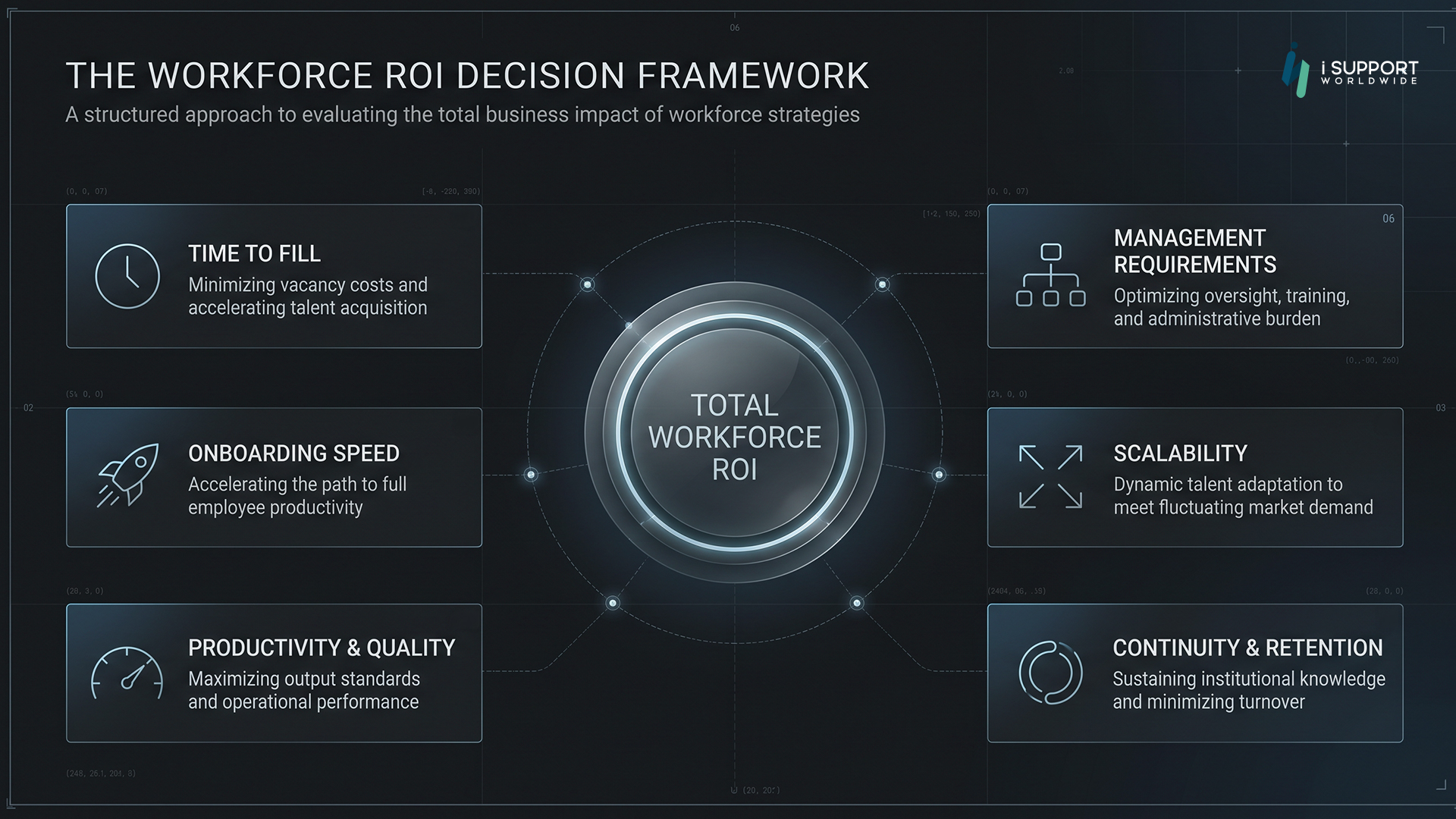
However, outsourcing ROI should not be measured by cost savings alone. Businesses should also examine:
- Time required to fill a position
- Speed of onboarding and deployment
- Productivity and service quality
- Internal management requirements
- Ability to expand or restructure the team
- Business continuity and employee retention
A lower rate does not automatically create a better return. The greatest value comes from partnering with an offshore provider that can recruit qualified professionals, support their performance, and help them integrate with the client’s existing operations.
2. How Does Outsourcing Compare to Hiring in Terms of ROI?
For many operational roles, outsourcing can deliver better ROI than traditional hiring because it reduces overhead, improves cost predictability, and provides access to a broader talent pool.
Here is how the two workforce models compare:
| Business factor | Traditional hiring | Outsourcing |
|---|---|---|
| Upfront investment | Typically higher | Typically lower |
| Recruitment responsibility | Managed internally | Supported by the provider |
| Access to talent | Often limited by location | Broader, global talent pool |
| Scalability | Requires additional hiring resources | More flexible team expansion |
| HR administration | Handled by the employer | Largely managed by the provider |
| Cost predictability | Can vary by employment expense | Usually more predictable |
| Cultural integration | More direct | Requires intentional collaboration |
Speed is one of outsourcing’s most important advantages. A business that spends months trying to recruit locally may lose productivity, delay projects, or overburden existing employees. Offshore staffing can widen the available talent pool and help the company build capacity more efficiently.
Scalability also affects ROI. Traditional hiring may require additional recruitment, office capacity, technology, and management support every time the team grows. An established offshore staffing model makes it easier to expand operations without recreating the underlying infrastructure for every new position.
This allows businesses to direct more of their capital and leadership attention toward product development, customer acquisition, and other growth priorities.
3. When Should Businesses Hire In-House vs. Outsource?
Businesses should consider in-house hiring positions requiring direct authority, deep institutional knowledge, or daily involvement in company-wide decisions. These may include:
- Executive leadership
- Business strategy
- Core product ownership
- Senior client relationship management
- Roles responsible for shaping company culture
Outsourcing is often a strong option for structured, process-driven functions that can be performed remotely and measured through clear performance indicators. Common examples include:
- Customer service
- Technical support
- Finance and accounting support
- Administrative services
- Data processing
- Marketing support
- Back-office operations
The decision should begin with the nature of the work rather than its job title.
Leaders can ask four practical questions:
- Is the role central to strategic decision-making?
- Can its responsibilities and outcomes be clearly documented?
- Can performance be measured remotely?
- Would access to an offshore talent pool improve cost, capacity, or recruitment speed?
If a role is process-driven, digitally enabled, and supported by measurable goals, outsourcing may deliver a stronger financial and operational return.
If it requires direct organizational leadership or highly sensitive strategic ownership, hiring in-house may be the more appropriate investment.
4. Why a Hybrid Workforce Can Deliver the Best ROI
The choice between outsourcing and hiring does not need to be absolute. A hybrid workforce combines an internal core team with dedicated offshore professionals, allowing each group to focus on the work it performs best.
For example, a company might retain department leaders and strategic decision makers in-house while building an offshore team for customer support, bookkeeping, administration, or IT services. Internal leaders maintain direction and accountability, while offshore employees provide the operational capacity needed to execute the strategy.
The Philippines is a leading destination for offshore staffing because of its large English-speaking talent pool, service-oriented workforce, and professionals with experience supporting international companies. Businesses can access capabilities across customer service, finance, technology, healthcare support, marketing, and other functions.
Through iSupport Worldwide, companies can build dedicated offshore teams that operate as extensions of their existing workforce. This approach goes beyond transferring tasks to a third-party vendor. It gives businesses an opportunity to establish long-term teams with defined responsibilities, performance expectations, and connections to the client’s culture.
When implemented thoughtfully, the hybrid model can help companies control workforce costs, scale operations, and preserve internal focus.
Frequently Asked Questions About Outsourcing vs. Hiring
Is outsourcing cheaper than hiring employees?
Outsourcing can be more cost-efficient for operational and support roles because the provider manages many recruitment, HR, infrastructure, and administrative requirements. Actual savings depend on the role, location, operating model, and provider.
Which delivers better ROI: outsourcing or hiring?
Outsourcing often delivers better ROI for repeatable, measurable work requiring flexibility and scale. Hiring may offer better long-term value for executive, strategic, and culture-defining positions.
What roles are suitable for offshore staffing?
Customer service, accounting support, IT support, administration, data processing, marketing support, and other digitally enabled functions are commonly suited to offshore staffing.
How should a business calculate outsourcing ROI?
Compare the total cost and business output of each option. Include compensation, recruitment, benefits, infrastructure, management time, turnover, productivity, service quality, and the time required to fill and deploy the role.
Conclusion
In 2027, the outsourcing vs. hiring decision should be based on total business value rather than salary alone. Hiring offers direct control and cultural integration, while outsourcing provides scalability, cost efficiency, and access to global talent.
For many organizations, a hybrid workforce delivers the best ROI. By retaining strategic roles internally and building a dedicated offshore team for operational functions, businesses can increase capacity without placing unnecessary pressure on costs or internal resources.
Ready to strengthen your workforce ROI?
Explore how iSupport Worldwide can help you build a dedicated offshore team aligned with your operational needs and long-term growth goals.
Outsource or Hire? The 2027 ROI Decision Guide
About The Author Denise Romero works as a copywriter at iSupport Worldwide, where she specializes in B2B content that helps businesses flourish. She specializes in creating clear, compelling messages that engage professional audiences and support strategic marketing goals. |
| Founded in 2006, iSupport Worldwide is a US-owned offshoring leader based in the Philippines, delivering tailored solutions to enhance operational efficiency and exceed client expectations. Recognized on the Inc. 5000 list of America’s fastest-growing private companies for three consecutive years, honored in Inc. Magazine’s Power Partner Awards, and a recipient of the ACES Award for Inspiring Workplaces in Asia, iSupport Worldwide embodies a commitment to excellence. |